


This is the fifteenth in my series of short, quickly written, weekly philosophy essays.
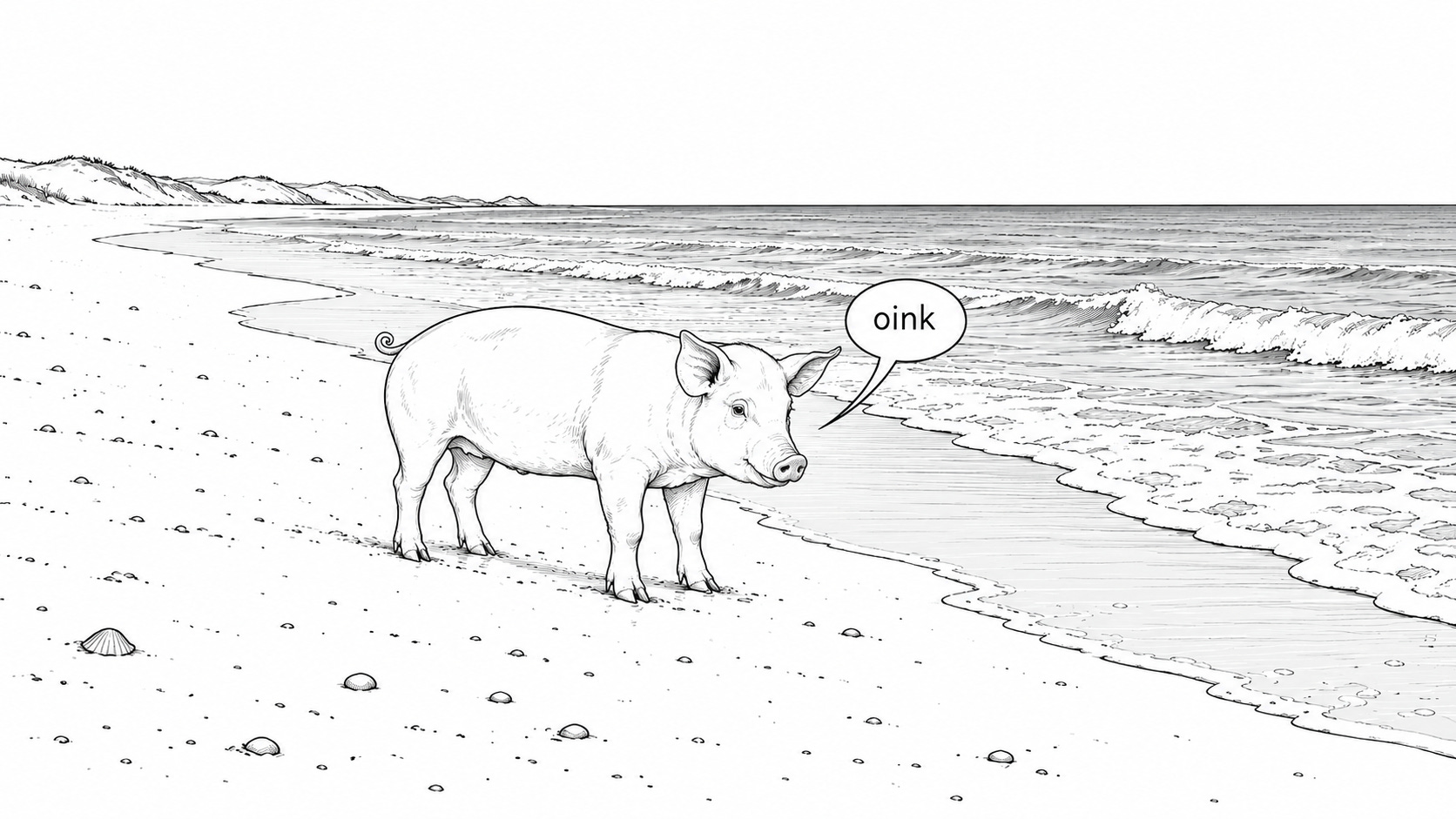
Imagine that you and I go on a trip to the farm. We are very taken by the cute little piglets: they are so sweet and funny and sociable with each other. They seem to recognise the farmer, Mr Jones, who happens to be an expert in pigs. Mr Jones tells you and me about some of the latest research into the capacities of pigs, pointing at the piglets and bigger pigs around us whenever they display relevant interesting behaviours.
We watch the pigs for ages, and come away more convinced than ever that not only do the pigs have inner lives — in the sense of having subjective experiences, first-person perspective, and so on — but that all these claims about pigs being particularly intelligent also seem to stack up. On the way to the car I tell you that I like Mr Jones but that my recent decision to stop eating pigs is feeling like a good one.
Imagine now that on our way home from the farm, you and I stop off at the beach. It’s a lovely October afternoon, quite bright after the storm that took place overnight. We are wandering slowly across the sand towards the sea, chatting about the pigs, when you spot it. The word ‘HELP’, scrawled in the sand! We look around urgently, but can’t see anyone anywhere. We immediately phone the coastguards and spend the time before they arrive running up and down the beach, and looking out into the sea, searching for the person who wrote the message. Some hours later we still haven’t found the person or any further clues, and we are feeling distraught. The coastguards are busy doing their thing, but they clearly haven’t had any success either.
Then, suddenly, a guy wearing sunglasses rocks up, carrying a movie camera. We explain to him what’s been going on, and he grins sheepishly. “I was here overnight, shooting some scenes,” he tells us. “And I saw this amazing thing happening. I caught it on my movie camera! The wind was making beautiful patterns in the sand. All these fantastic rippling effects. Most of the patterns got washed away, but the one that looked kinda like the word ‘help’ was far enough away from the sea... And I didn’t want to destroy it… It was such an insanely random super-cool thing. I’m gonna feature it in my movie, for sure! But now I realise that I should’ve left a note or something. I’m really sorry for all the trouble this has caused you guys…”
I’ve written here quite a few times about the AI mystery of ‘the conscious thing’.1 You know what I mean. Someone tells you that they believe AI is conscious, and you ask them “But what do you mean by ‘AI’ here? What is the thing that you think is conscious?” And perhaps they look bemused. Or perhaps they give you an odd answer like “The conversations you have with GPT!” or “The persona that Claude is taking on while acting like an assistant!” or “The electrical events in the wires at the data centres!” If you think I’m making up these examples, then go chat with some people who work in AI…
I have much more to say about these matters. I haven’t written here yet, for instance, about why I think I should be open to the possibility, in principle, that non-biological physical things could bear consciousness. Or why I think this would be contingent on such things having the capacity for psychological states. And I have more to say in response to answers to ‘What is the conscious thing?’ that are less odd than ‘conversations’, or ‘instances of personas taking on personas’ or ‘electrical events in wires’. I also want to tell you more about why I think we have such strong reasons to conclude that what AI is producing (whatever AI is!) is far better thought of as involving the simulation of consciousness than anything that should lead us to believe that AI is conscious.
For now, however, I simply want to emphasise the distinction between ‘the conscious thing’ (me, for example) and the ‘conscious mental states’ (thoughts, for example) that we conscious things bear. I’m happy to accept this pretty ordinary distinction, even though I have many questions about how all of this fits together, and whether ‘mental state’ is the best term here, and so on. I’m very interested in these questions, but I’m going to set them aside for now. This is partly because I’m trying to keep this piece as non-technical as possible, both in terms of philosophy and the science of AI.2 And partly because I don’t need to get into any of that for you to grasp the pretty ordinary kind of distinction that I’m referring to — the kind of distinction you’d accept as obtaining between me (as an example of a ‘conscious thing’) and my thoughts (as an example of the ‘conscious mental states’ I bear).
Okay! Now, think about someone, let’s call him Adam, who believes that he’s come across good evidence for the existence of some particular examples of these ‘conscious mental states’. You see, Adam has been having lots of conversations with the LLMs, and the answers that Adam has been receiving during these conversations seem, to him, to provide good evidence that some thoughts exist, somewhere. “I don’t think the conversation itself has thoughts,” Adam tells you, “But the conversation sure as hell seems to provide good evidence that there are some thoughts — thoughts that aren’t my thoughts! — that are involved here somewhere.”
Now, as feared, Adam can’t give a very convincing answer to your question about what the ‘thinking thing’ is that is having these thoughts. And he also can’t tell you what it would mean for thoughts to exist without something somehow ‘bearing’ them. But he is very anxious, nonetheless, to avoid dismissing the seemingly good evidence that there are some thoughts involved somewhere! After all, Adam has extra reason to be anxious here, because Adam works in AI and feels deep responsibility about these matters.
Think about all this, and then ask yourself: is AI more like the case of the pigs, or the message in the sand? Might Adam simply be panic-searching the beach, refusing to talk to the guy with the movie camera?
But, if you like, you can listen to my recent podcast episode with Tim Crane on the topic of consciousness, where I kick off the conversation by asking: “So, my opening question to you is do you think that consciousness is a type of experience? Is it a mental state? Is it a property of a mental state? Is it one of these things? All of these things? None of these things?” Check out also my recent episode with JP Andrew on the topic of animals, where we also talk about these kinds of things!