


This is the ninth in my series of short (though in this case, not so short!) quickly written, weekly philosophy essays.
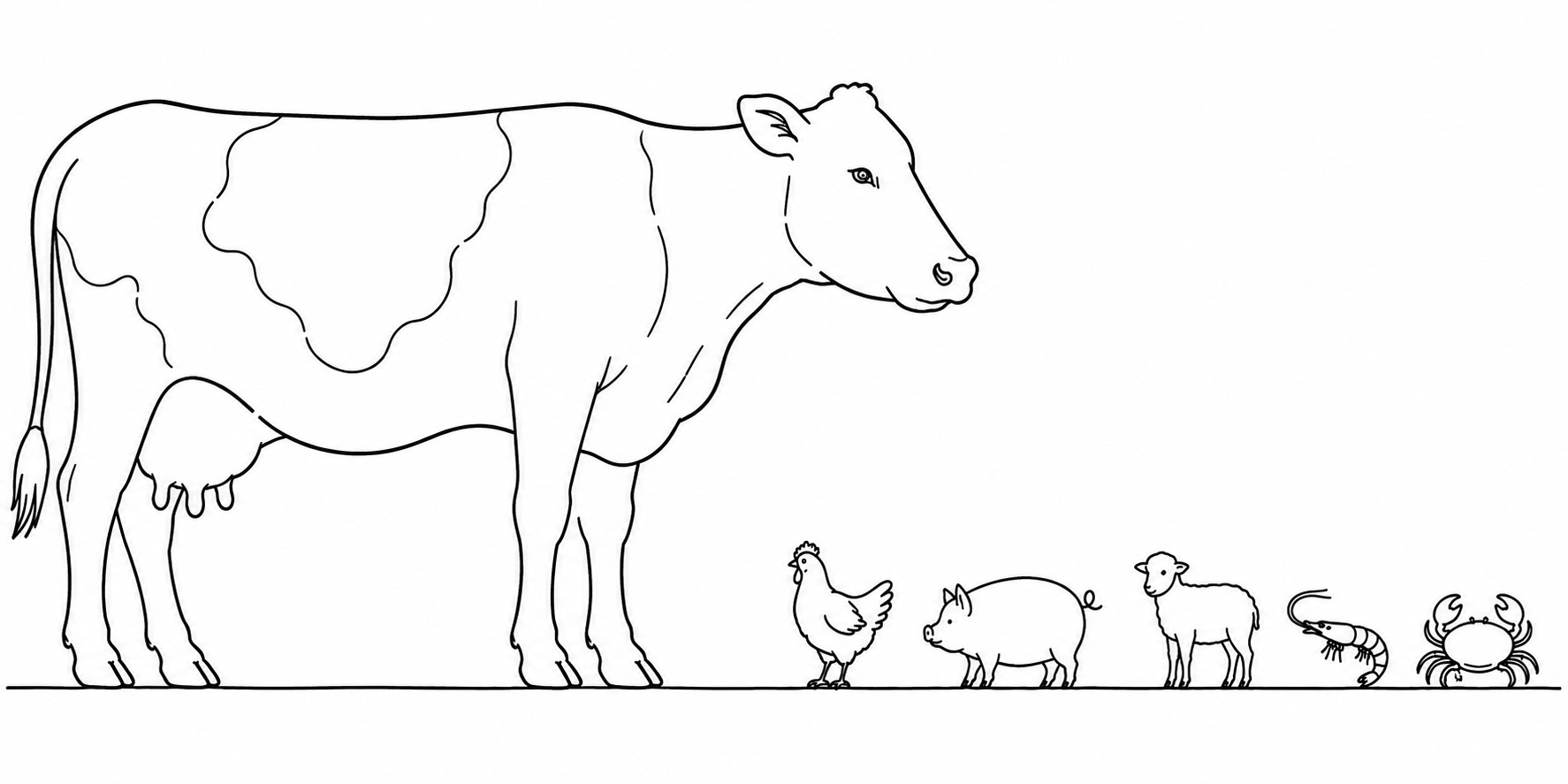
A few months ago, I mentioned here that I’d given up eating chicken and pork. I’m glad to report that I’ve been keeping this up, though I now prefer to say “the chickens and the pigs”. When someone asks if I have any dietary restrictions, that is, I tell them, “I don’t eat the chickens and the pigs”.
I’m aware this locution makes me sound weird! But weirdness can make people stop and think. And I’m a big believer in taking the useful hit on little things like this. What I mean, of course, is that I use this locution to remind myself and other people of the obvious fact that chicken meat and pork meat comes from animals. It comes from particular animals. It comes from ‘the animals’. As in the ones who are currently still alive or died recently. The chickens and the pigs. I’m going to keep saying it!
I’ll admit now that, in terms of philosophy, the thing I want you to take away from this piece is the argument I’m going to make towards the end, about the idea of ‘morally better’. This will be my first full response to a problem I’ve been thinking about for quite some time. Nonetheless, if instead you go away thinking there’s some small value in referring to meat-eating in my weird way, then I’m convinced I’ll have done something good.
But what about all the other animals, you ask! Why haven’t I given up eating the ducks and the sheep and the deer and the fish?1 Particularly when I claim to care about doing good.
The obvious starting point is to emphasise that, on my admittedly limited awareness, it seems pretty clear that when you’re ordinarily picking between the animals to eat, the chickens and the pigs are the most likely to have been particularly violently factory farmed. It seems difficult, for instance, to buy a chicken salad sandwich — one of my favourite things to eat — that hasn’t been produced on the back of some particularly extreme animal cruelty.
This goes some way to explaining my approach. But the full answer to why I haven’t given up eating all the animals hinges on something else that seems pretty clear to me: I’m morally weak.
The moral weakness problem
I’ve written before about how hard I find it to stop eating the animals. The animals are my favourite thing to eat, by far, and also to cook. I love cooking. But I’ve also written about how convinced I am that it’s bad and wrong to eat the animals. Indeed, my belief is that it would be bad and wrong to eat the animals even in a world with no factory farming. Even in a world with fantastic standards of animal welfare. This is because I think it’s a failure of basic moral respect to eat the dead body of a once living thing. Particularly when you don’t need to. Particularly when there are other delicious and affordable options easily to hand.
Now, I should probably clarify that I don’t believe that dead things can be the objects of disrespect. Rather, I think the disrespect in question is directed towards the living instances of the dead animal’s species.2 This probably sounds like a strange view! And you might find even stranger my further view that this problem doesn’t disappear in the case of lab-grown meat — something I wrote about for Aeon a few years ago. But you can probably get somewhere towards the disrespect in question by thinking about how you’d react to someone playing with the bones of a human skeleton. And the main point I want to make here is just that my moral concerns about eating meat go beyond my view that factory farming is horrific.
Like most people, however, I sometimes struggle to do the right thing when it collides with my strong desires. And one of my strongest and most easily fulfillable desires, now that I live in America, is to eat great cheeseburgers. This is in addition to my long-time strong desire to eat great steaks. And I’ve found, so far, that I can very easily prevent myself from eating the chickens and the pigs, as long as I permit myself to continue eating the cows. Indeed, as I write this, I realise that as long as I can continue to eat the cows, I could probably quit eating all the other animals much more easily than I’d previously thought! Except for the seafood.
The number of animals argument
This brings me to one of the few Peter Singer arguments that I quite like. It’s an argument focused on counting the number of meals you can get from different types of animal. The simplified version tells us that if Rebecca eats the cows instead of eating the chickens and the pigs, then even if Rebecca eats the same number of meaty meals, she will surely eat a far smaller number of animals, over all. A quick glance online suggests you can get something like 160 meals from a cow, but only four from a chicken.
Now, you don’t have to be some kind of moral aggregationist, like Peter Singer, for this argument to hit hard. Someone that is, for instance, who might go about picking between ‘eating the cows’ and ‘eating the chickens and the pigs’ based on the outcomes of complex calculations aimed at working out the overall amount of suffering that would be produced in both cases. If instead, like me, you think such approaches don’t take seriously enough some Nozickian-type notion of the ‘separateness of animals’, then surely you should still care about the number of animals you wrong!
Nonetheless, it might seem as if I’m smuggling in a bit of consequentialist reasoning here. That perhaps I’m trying to justify doing wrong by doing ‘less wrong’. Or perhaps I’m mentally trading away the life of the cow to save the lives of the chickens and the pigs. I’ll return to all that in a moment.
First, a far simpler personal problem arises if I want in any sense to depend on this ‘number of animals’ idea: I’m going to really struggle to quit the seafood. The only thing I enjoy eating as much as steaks and cheeseburgers is seafood pasta, and each portion of seafood pasta contains a large number of animals. I ate some fantastic seafood dishes in Scandinavia the past couple of weeks, and each time I did, I ate more animals than most only-cow-eaters would eat in a lifetime. Okay, there was also a meal during which I ate duck hearts on toast — maybe twenty of these delicious juicy pink little things, followed by a wonderful monkfish in a (yes) seafood bisque. But I don’t often have the option to eat duck hearts, and I could easily give them up.
More pressing is the following. Even though I would surely have prioritised eating the seafood in the naval nations of Scandinavia even if I’d still been eating the chickens and the pigs, there were definitely some meals during which I’m sure I would’ve chosen the chickens or the pigs, instead. There was a schnitzel I really wanted, for instance. Therefore, it seems as if giving up the chickens and the pigs likely meant that I ended up eating an increased number of animals during my fortnight in Scandinavia.
I don’t think this was a one-off. When I gave up eating the mammals for a few months a couple of years ago, the realisation that I was eating the seafood at almost every meal played a large part in my decision to start eating the mammals again. This is mainly because the standard moral argument in favour of eating the seafood over the mammals doesn’t really work for me.
The animal capacities argument
This standard argument is the argument on which you conclude that the animals that are less sentient, or less conscious, or less intelligent, count for less, morally. Now, I wrote here recently about my unease at the idea of depending on notions like consciousness and sentience and intelligence to differentiate the moral value or moral status of types of living thing. Indeed, I’m happy to put intelligence aside at this point, mainly because I think there can be no good arguments for judging such things on intelligence, alone.
But a general meta problem, for me, about these ‘animal capacity arguments’ is that I’m unconvinced that any human could ever know enough about non-human animals to make these kinds of distinctions sufficiently reliably — particularly in terms of ruling out the possibility of a particular animal having such capacities. I mean, “Hey, don’t worry, Rebecca, that particular animal hasn’t told us that it’s conscious or sentient, so you can definitely conclude that it isn’t!” (I’ve even argued this kind of thing about electrons.) Moreover, while I do know what people are trying to get at when they say things like ‘less sentient’ or ‘less conscious’, nonetheless the ontologically and morally crucial thing, for me, is whether an animal is sentient or conscious at all.
In other words, if I could be certain that some particular animal was the kind of thing could never be conscious nor sentient, then perhaps that information could play a decisive role in my decision-making about eating meat. But for now, I’ll accept that I can’t use this kind of reasoning to justify eating the seafood over the mammals. And that I’d be on shaky ground even trying to use it to conclude that it would be ‘morally better’, if I did.
The ‘morally better’ problem
I’m now going to turn full-on towards this notion of ‘morally better’, because it really isn’t a straight-forward matter for a non-consequentialist like me. This will help me to address my earlier concern that depending on ‘the number of animals’ idea could be smuggling in consequentialist reasoning. It’ll also give me the chance to share the outcomes of some thinking I’ve been doing about rights and liberalism and moral theory.
I’ll begin by emphasising that a strong view I hold is that consequentialists often make incorrect conflations between concepts like ‘right’ and ‘more good’. As Rawls tells us, one useful way of comparing moral theories is to consider their relations to the right and the good. In simplified Rawlsian terms, consequentialists prioritise the good over the right. In the more complex terms I prefer, consequentialists don’t really value anything, qua consequentialists. Rather, they instrumentalise the things that they claim or imply to have value — typically some conception of the good, but sometimes other things like rights — in order to evaluate rightness and wrongness. Utilitarians, for instance, tell us that the rightness and wrongness of things like actions, or states of affairs, or principles, or rules, depend on the extent to which these things track a hedonistic conception of the good. This, in simplified Rawlsian terms, counts as prioritising the good over the right.
I’m now going to try to persuade you that such approaches are at risk of introducing weird further relations between the two.3 In particular, that followers of such approaches often make over-conflations between: 1) ‘right’ and ‘more good’ or ‘less bad’; and between 2) ‘wrong’ and ‘more bad’ or ‘less good’.
Take the following example. Imagine that some kind of consequentialist tells you that the right thing to do when faced with a choice between killing one person and killing one hundred people is to kill the one person, because killing the one hundred people would bring about ‘more bad’. You can fill in the further reasoning for yourself. Okay, perhaps you want to respond at this point that surely I recognise that killing can sometimes be morally permissible! Surely, for instance, I accept the permissibility of killing in at least some instances of self-defence? Well, to deal with that, let’s switch to an example that involves making a choice between torturing one person for fun or torturing one hundred people for fun. My guess is that you’ll find it much harder to accept that torturing someone for fun can be morally permissible. But the bigger point, here, is that I don’t need to make this about moral permissibility! All I need to argue is that neither option would ever be ‘the right thing to do’, in the sense, for instance, of being the option you must take to avoid doing wrong.
What’s more, even if I can’t get you to accept this — if for instance, you think that in some complex situation torturing someone for fun could indeed be the right thing to do — my hope is that the example might have helped you to accept that there could sometimes be a difference between ‘less bad’ and ‘right’. Just think of the situations, for instance, in which you think that torturing someone for fun wouldn’t be the right thing to do, but would nonetheless be ‘less bad’ than doing something else.
I do accept, however, that persuading you that sometimes you should acknowledge a difference between these two things isn’t going to be enough here! So let me now try to explain — via two separate ways — why I’m so anxious about the over-conflation of these kinds of things.
1) Rights need bite!
First, I picked the example of ‘torturing the one or torturing the hundred’ because, on my view, both options involve rights violations, and on my view, violating a right is always wrong. This doesn’t mean that I think all wrongs include rights violations. And it also doesn’t mean that I think all rights are held unconditionally. Rather, it means I think that when a right holds, it’s wrong to violate it. Nonetheless, I chose the torture example because I do happen to think that the right not to be tortured is a right that’s held both unconditionally and generally. In other words, that all of us are always perfectly obligated never to torture anyone, whether it’s for fun or any other reason. That torturing, in all instances, is always wrong.
And what I mean by ‘wrong’ here is clearly different from ‘less bad’. This is because both acts — torturing the one and torturing the one hundred — are wrong, on my view, regardless of whatever real or hypothetical comparison we place them into. The single rights violation remains wrong, qua rights violation, even if the alternative is infinite rights violations!
What’s more, one of the reasons it’s so important to me that there’s a notion of ‘wrong’ that we can depend upon outside of ‘totting up relative badness’ is that otherwise rights lose their moral bite. Otherwise, that is, the possibility sneaks in that we should not only permit, but also require — on the grounds of it being ‘the right thing’ — someone to commit the single rights violation, in order to avoid committing the multiple rights violations. Then, as I argued recently on The Pursuit of Liberalism, what can we depend upon to protect ourselves in the face of the totalitarians?
2) Sometimes there is no right choice!
I now want to turn briefly to a further concern I have about this kind of over-conflation. This is a concern that could be shared by someone who doesn’t hold my unusually hardcore view about rights. It runs something like this. If we conflate ‘more good’ with ‘right’, then aren’t we at risk of concluding that there is a ‘right option’ in situations in which there simply isn’t such an option? Indeed, at maximum, in all situations in which there is a ‘more good’ one!
What I’m getting at is the following. When you are faced with many ordinary ‘choosing’ situations, surely it often doesn’t come down to one option being ‘the right one’, or there being a ‘right thing to do’. This seems most easy to conclude about boring situations such as choosing between picking up a cake with your right hand or with your left hand. But isn’t it also the case in many much more morally-loaded situations, such as choosing between which one of two really great guys to date? I’ll write more about this topic another time, but I’ll note here that I’m pretty committed to the idea that in most situations there are almost infinite justifiable things that a person could decide to do: this idea is becoming more and more central to my thoughts on the conjunction of liberalism and moral theory.
All I need to conclude for now, however, is that acting on the assumption that all — or simply too many — option sets have a ‘right answer’ put us at risk of the totalitarians again. Aside from being conceptually messy, that is, this over-conflation could risk some pretty concerning downstream consequences. It could leave you open, for instance, of being judged to have acted wrongly, when all you did was to pick an option that was, at best, in some objective sense ‘less good’, and at worst, failed to track the preferences of some powerful person.
The place for ‘less and more bad’
I’m now going to argue that even for someone like me — someone who has such a hardcore view about the demandingness of rights, and such a pluralistic view about ordinary option sets — that there is nonetheless an important place that notions like ‘less bad’ and ‘more bad’ can play in arguments about right and wrong actions.
I’ll begin by accepting that violating the right not to torture is ‘more bad’ than teasing a friend — even though clearly, for me, it isn’t something like the ‘relative amount of badness’ that makes the act of torture wrong. Again, the act of torture is wrong, on my view, regardless of any real or hypothetical comparison we enter it into. Regardless, that is, of whatever bit of ‘totting up’ you might want to do. Okay, you probably want to respond, “Ah but of course you think that violating the right not to torture is more bad than teasing your friend, because only one of these things includes a rights violation!”. Sure. But I can go a stage further here, and conclude that some ‘extra badness’ occurs when you torture two people as opposed to torturing one. And what’s more, I don’t have to accept that doing the latter would therefore be ‘the right thing’ in order to conclude this. Rather, I can simply acknowledge that, in the two-person instance, you are causing great badness for each person. If you’re really into counting, you could sloganise this as: ‘two bad more than one bad’!
Now, I should note at this point that my view is that doing wrong always includes doing bad, but that doing bad does not always includes doing wrong. For example, I do bad to you when I accidentally and totally unavoidably run over your foot, even though I don’t wrong you — I don’t count as blameworthy, for instance. Whereas, I’m happy to accept that there’s no example in which I wrong you without doing bad to you. Moreover, ‘doing bad’, on my view, isn’t a matter of adding to some ‘aggregated amount of badness’ in the world. That is, I don’t need to depend here on some notion of ‘a worse world’ or a ‘more bad state of affairs’. Indeed, I’m pretty glad about this, because I don’t think that things like worlds and states of affairs can experience badness! I don’t even know what such a thing would mean. So, in simple terms, you can conclude from this that my view is that ‘doing bad’ means causing something bad to happen to the kind of thing that can experience bad things.
It seems clear, on this view, that I can go further than concluding that in the case of torturing the two people I have twice violated the right not to torture. Yes, I have committed two such specific wrongs. But I can also conclude that I have brought about ‘more badness’, and I can do it without buying into the aggregative notion of ‘adding to the badness in the world’. Indeed, if I don’t conclude that ‘more badness’ occurred when I tortured Person Two on top of the badness that occurred when I tortured Person One, then surely I wouldn’t be taking the interests of Person Two sufficiently seriously!
What’s more, I can conclude this kind of thing in instances involving any number of people, and I can conclude it regardless of how much each of the people suffered, or any complications along those kinds of lines. I mean, to return to slogan form, if the comparison is between ten people and nine people, then ‘ten bad more than nine bad’! Unlike the consequentialists, that is, I don’t have to enter into complex calculations here based on weird notions of commensurability.
Again, none of this commits me to concluding that it is ‘right’ for me to torture the one person instead of torturing the one hundred. Indeed, my view, as you might have guessed, is that I should never torture anyone. That it’s always wrong to do so. And that I should choose to die, rather than choosing to torture either of the people. Of course, I often worry that I wouldn’t take that choice. But all I need to conclude here is that by torturing the two instead of the one, I would be ‘doing more bad’ as well as ‘doing wrong’. This, on my terms, gets me to something pretty similar to the notions of ‘morally worse’ and ‘morally better’.
The ‘only cows’ solution
It seems, therefore, that I can indeed argue that I ‘do less bad’ by eating the cows than by eating the chickens and the pigs, as long as by eating the cows I eat fewer animals. Okay, the seafood poses a problem here, so I guess I’ll have to quit eating the seafood if I start using them as some kind of coping mechanism.
One last objection you might throw at me, however, is that the ‘less bad’ argument I need to make here must relate to the particular badness that I believe is occurring each time I eat an animal. And perhaps you think that moral disrespect is not so easy work out in terms of ‘extra amounts of badness’ as instances of torture — even though my position depends on the countable idea of disrespecting all the living instances of the dead animal’s species.
Well, sadly, the only world in which my ‘cows instead of chickens and pigs’ approach would depend on the disrespect concern — as opposed to the disrespect concern in combination with the factory farming concern — is the world with fantastic animal welfare. And that world seems a long way away. Indeed, it seems there’s no urgent need, at all, for me extend my ‘less bad’ argument much beyond the specific torture example I gave above. This is because it seems clear that the vast majority of factory farmed animals do indeed suffer torture.
I commit here, therefore, to eating only the cows — with my seafood caveat — on the view that this will involve me ‘doing less bad’ than the nearby alternatives. But I know, full well, that I’ll still be doing wrong.
I accept that some readers might find this piece overly indulgent. “Why should I care about Rebecca’s overly philosophical niche moral handwringing?”, they will ask. “Didn’t we get enough of that in her recent piece about not going to church?” Well, again, I’m happy to take the hit! As with most things I write on this Substack, I hope to achieve the following three things with this piece: 1) to show non-philosophers what it is to do (analytic) philosophy; 2) to present novel or under-discussed arguments, which I believe to have some philosophical importance; and 3) to work out the answers to problems that bother me, and, in doing so, to become a better philosopher.
I talked about this view and more with the excellent J.P. Andrew on the latest episode of Working Definition, which focuses on defining the term ‘animal’!
What a surprise that an approach that instrumentalises x doesn’t take x seriously enough!
For what it's worth, I ended up writing a post in response which I hope you find interesting; it was fun to think through the points at which I was resisting the logic you presented: https://earnestnessisunderrated.substack.com/p/arguing-with-a-philosopher
This might be a cavil, but if you want to keep the locution weirdness consistent while also highlighting the fact that we are eating other beings rather than some commodified product, shouldn't you use "the aquatic animals" or something along those lines, instead of "the seafood". The "food" part of "the seafood" presupposes a lot.