


This is the first in my series of short, quickly-written, weekly philosophy essays.
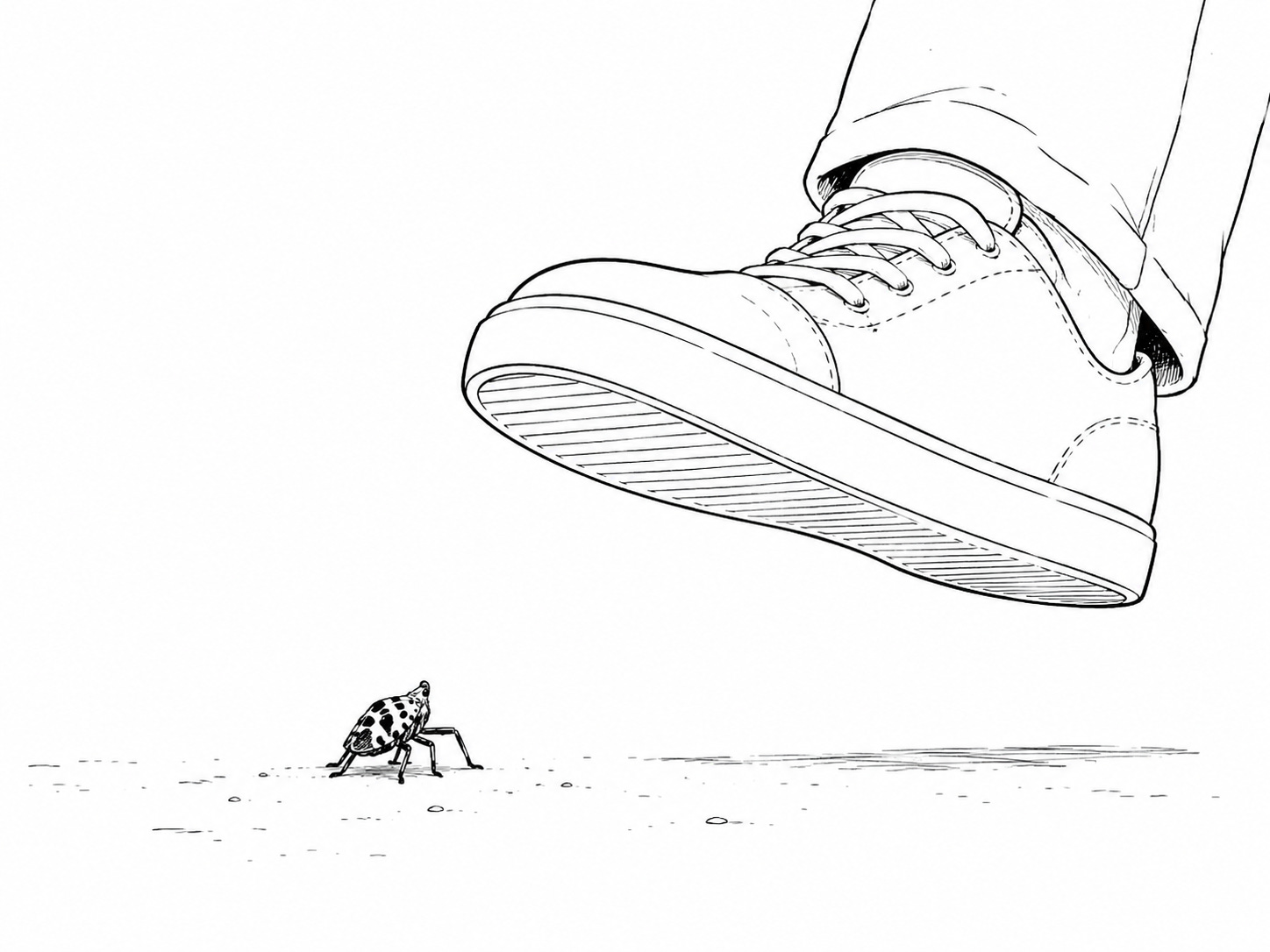
In the summer, the people of DC and VA delight in squashing spotted lanternflies. A typical example of this phenomenon involves an adult human expressing disgust towards one of these little bugs, before jumping on it, often while laughing and feeling some degree of pride.
A recent local news article begins “It's time to kill spotted lanternflies nymphs again.” The DC Urban Forestry Division website advises “using a portable vacuum cleaner to suck them off the plant” because the lanternflies “typically jump at any disturbance of the plant, which makes them difficult to smash by hand”.
Of the perhaps 30 people around here whom I’ve asked about this matter, only one has fully agreed with me that the practice of stamping on lanternflies is morally horrible. That said, several did express their concern at the ‘taking delight’ element.
Now, at this point, if you know about the lanternflies, you’re probably getting annoyed by the fact that I haven’t explained that they’re an ‘invasive species’. And yes, I could go into details about how, apparently, the lanternflies have very few local non-human predators, and how, apparently, they have the potential to cause great damage to local crops and other plants.
That said, it’s notable that the Urban Forestry Division page I referred to above attempts to promote calm by stating that:
“Spotted lanternflies do not bite or sting, and they cannot damage your house or other structures. They have not been found to cause significant damage to healthy landscape plants. Their sheer numbers may become a nuisance and their honeydew excretions may lead to the growth of sooty mold on plants and horizontal surfaces underneath the trees that the nymphs and adults are feeding on.”
I’m sure you can point me to much stronger claims about the risks the lanternflies pose! But I’m not particularly interested in those claims, for now.
I’m also not particularly interested, for now, in trying to persuade you that it’s morally horrible when people take delight in killing living things. I’ll just leave my sadness at that, hanging here — my sadness at this serious gap between the ways some of us conceive the world — in the hope it makes you reconsider, if you are one of those people. I have spoken before about how I believe and hope that the way we humans currently treat insects is something that our descendants will look back on in horror. But I’ll set all that to one side, for now.
Rather, I’m going to offer you one simple argument in favour of pausing before you stamp on a lanternfly, this summer.
This argument hinges on the idea that every single living thing has some moral value. The idea that, just by being alive, a thing gains some kind of moral specialness: that it becomes, in some sense, a matter for our concern; something towards which there are ways in which we should and shouldn’t behave. Indeed, that being alive is essential to what such a thing is. And that this is of extreme relevance to us humans, as the kinds of things that are not only alive, but are able to deliberate on — and understand something of — the significance of being alive.
Of course, if being alive is essential to some things in the world, and not to others, then this means that when I said that these ‘living’ things “become a matter for our concern” and “gain some kind of moral specialness”, I was speaking loosely. If being alive is essential to these things, then when ‘they’ are not alive, ‘they’ are not such things!
Okay, if it were possible for something that was un-alive to be alive, then that could make it the kind of thing that did ‘gain’ and ‘become’ in these ways. And some people spend a lot of time thinking about the relevance of such ideas to foetuses, and even AI. But lanternflies, at least in their ‘nymph’ and fully-grown stages, are unequivocally alive, to the extent that I don’t need to persuade you of this. I’ve written here before about how hard it is to define ‘being alive’. But if the lanternflies that you will squash this summer are not alive, then we must seriously reconsider the ways in which we ordinarily use the term!
Now, I’ve no idea what it is like to be alive, as a lanternfly. I don’t know whether being a lanternfly involves having an internal world, feeling pain, feeling sadness. I bet there are entomologists who have strong views about these matters. But whatever these entomologists told me about this, it would not weaken my belief that it is wrong to stamp on the lanternflies.
This is partly because I don’t think that being an expert in insects makes you an expert in what it is like to be an insect. And it’s partly because I don’t think that any human could ever get anywhere close to being an expert in what it is like to be an insect — never mind what it is like to be a particular insect! Again, however, all I want to do today is make you pause before you unthinkingly kill a particular instance of the particular insect that is the spotted lanternfly.
Think, first, of the difference between the lanternfly and a tiny pebble of the same size. Okay, perhaps the pebble you are thinking of is more beautiful than the lanternfly. Perhaps you think it damages my case that the lanternflies are generally considered ugly! As it happens, I think that the lanternflies in their nymph stage are very cool-looking. But I don’t care about beauty, here! I mean, good luck trying to persuade me that how good you look gives you more moral status than me. At best, you will be making a category error. And arguing that people with physical disabilities look ‘less good’ in some important way than people without such disabilities, will not, and should not, get you far.
Think, instead, about the fact that this little thing moves. But don’t tell me why it does! I don’t care, for now, about whether the lanternfly moves because God imbued it with powers, or because the laws of nature are acting on it in such ways as to deny it, and any of us, the capacity for free agency. Instead, simply think about the fact that it moves.
In the nymph stage, the lanternfly hops around awkwardly. Pushing back on those teeny spindly legs, like a little robot. Except, also, that it eats! Unlike a robot, the lanternfly eats and rests, and it needs to do these things. It also mates. Now, who knows if the lanternfly finds pleasure in mating, but again I don’t care about that for now. (Sorry, lanternflies! And sorry, entomologists, you’re not needed here.)
Think also about how each lanternfly is a particular example of this kind of thing. That each lanternfly is a particular example of the kind of thing that lives, and moves, and eats, and mates. It’s that one! It’s the one you saw earlier, across the table, by the window! Hopping along, in its funny little way, on that particular set of spotted spindly legs.
Now, sometimes people want to persuade you that living things gain moral value when they are in their multitudes. That you shouldn’t torture the trillion shrimp, or however the EA argument goes, because of all the moral value that these shrimp accrue together. But if it is wrong to torture the trillion, then it is wrong to torture the one, or your maths depends on taking the valuable property (whether it is being sentient, or conscious, or intelligent, or alive, or whatever) away from the creature, and putting it (this non-extractable property) into some kind of ‘aggregation pot’. But I’ll save expanding on this anti-consequentialist argument for another day.
For now, the sole point I want to make is that you don’t need to know about the intelligence, or consciousness, or sentience, of a particular living thing to afford it some small amount of moral consideration. To determine such a thing worthy of the kind of consideration that you would never afford to a pebble or a bicycle. To pause when you see the spotted lanternfly this summer, and ask, should I? Must I?
Of course, perhaps you will come to the conclusion that the ‘invasive species argument’ overrides your concern for the particular lanternfly under consideration. And I will disagree with you about that, then. But at least you will have considered the particular lanternfly, as a living thing. Different from you, but worthy nonetheless of some of your time and concern.
Thanks to GPT for the picture.
For me, all life forms are precious works of art billions of years in the making. We have to have some principals here. I always capture and release insects in my home. I do kill mosquitoes and wipe up the ants that scout an area and single a food source to the troops. Better than wiping up hundreds of them. I could never justify killing anything just because I can. All life “wants” to live. Get your magnifying glass out and checkout insects. It’s a whole new world.
Lolz of course.