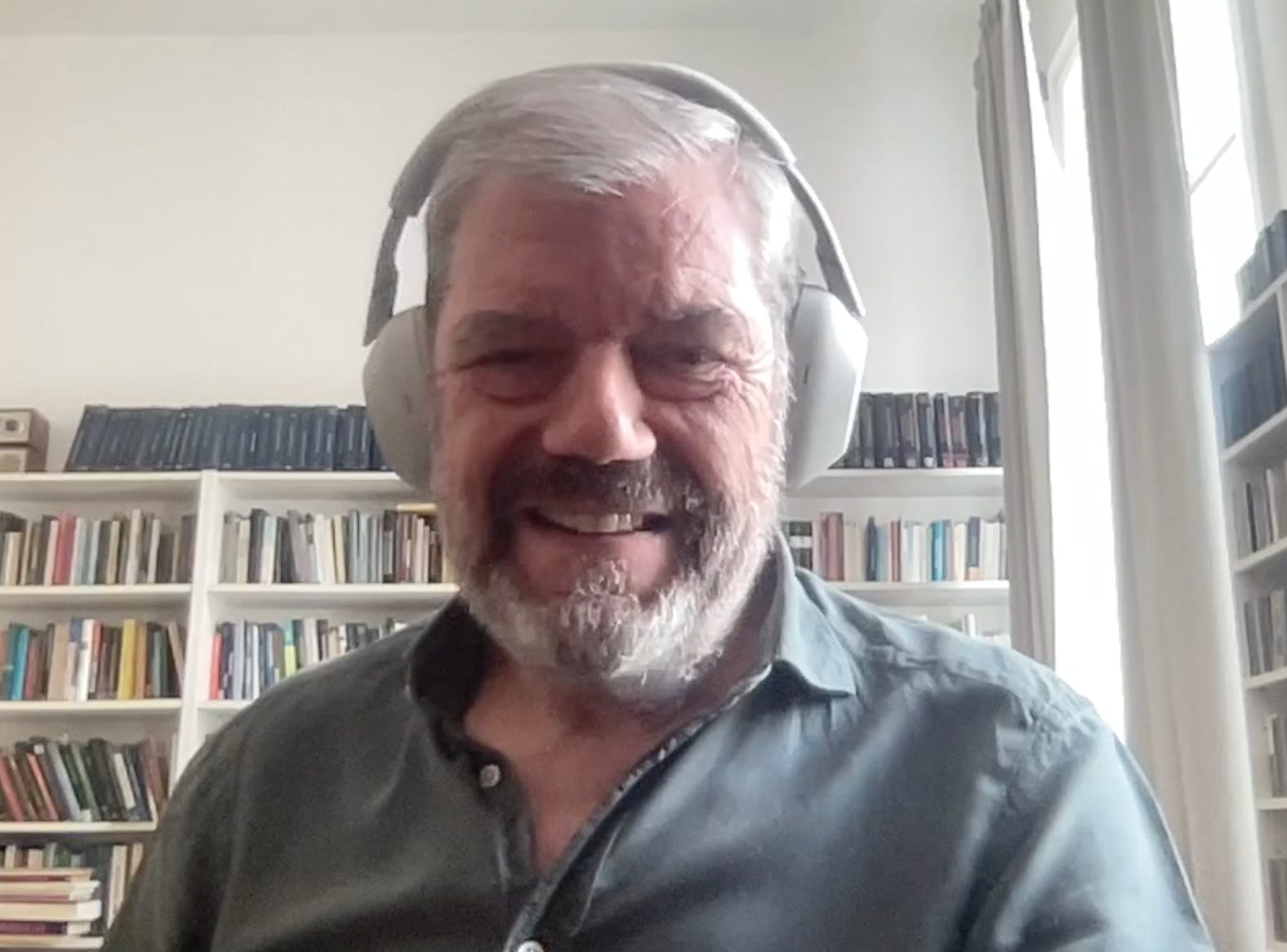

In this episode, Tim Crane and I discuss consciousness.
We talk about what it is for an organism to be conscious, whether there’s such a thing as a non-conscious experience, the difference between trying to explain why we’re conscious and trying to explain how we’re conscious, what people are talking about when they talk about AI consciousness, the relevance of consciousness to moral status, and more.
In short, we do some philosophy! I hope you enjoy it...
TRANSCRIPT
[This transcript was generated by AI, so while it’s been checked over, it may contain small errors.]
REBECCA: Hi, I’m Rebecca Lowe and welcome to Working Definition, the new philosophy podcast in which I talk with different philosophical guests about different philosophical concepts with the aim of reaching a rough, accessible, but rigorous working definition.
Today I’m joined by Tim Crane. Tim is Professor of Philosophy at the Central European University in Vienna, where he’s also Pro-Rector for Foresight and Analysis — a philosophical title if you’ve ever heard one. He was previously at Cambridge and UCL. He’s written lots of good books, including The Mechanical Mind, Objects of Thought, The Meaning of Belief.
He’s also weighed in philosophically on even more important matters, like what Jaffa Cakes are and the aesthetic value of wine. But today we’re going to be talking about consciousness. Thanks so much for joining me, Tim.
TIM: Thanks Rebecca. Thanks for the invitation.
REBECCA: You’re very welcome. Okay, so an obvious place to start would be with Thomas Nagel. So, Thomas Nagel tells us, or people think that Thomas Nagel tells us, that consciousness is having a what-it’s-like-to-be-ness.
But at the beginning of that famous bat paper, he explicitly says things that are a bit more like — I wrote a couple of these down — he says, “that an organism has conscious experience at all, means basically that there is something it is like to be that organism”. So, that’s something about conscious experience, rather than consciousness.
He also says, “fundamentally, an organism has conscious mental states if and only if there is something it’s like to be that organism, something it’s like for the organism.” So, there we have conscious mental states.
So, my opening question to you is do you think that consciousness is a type of experience? Is it a mental state? Is it a property of a mental state? Is it one of these things? All of these things? None of these things?
TIM: You’ve given me the answer already. [laughter] Consciousness is a property of certain mental states or mental events or mental processes. We can go into the distinction between those things if you want. But consciousness isn’t a type of experience itself. It’s rather, it’s a characteristic of certain kinds of mental phenomena. I would say ‘conscious experience’, that phrase is somewhat pleonastic, because I don’t think there are unconscious experiences. There are unconscious effects on experiences, but not unconscious experiences themselves.
REBECCA: I’m very glad to hear you say that because I was thinking about this this week, and I could not think of a non-conscious experience. I mean, people talk about having unconscious experiences. I think that’s parasitic on being conscious. It seems to me like a kind of temporary state of something that’s conscious. I’m not even sure really if you can have an unconscious experience, to be honest. But the idea of a non-conscious experience just seems to me to be absurd.
TIM: Yeah, I think I agree with that. I think there are what psychologists like to talk about “things below the level of consciousness”, by which they mean things that actually impact on your consciousness, but you don’t register. So, subliminal influences, effects of what they call ‘priming’ in psychological experiments. These are sometimes called ‘subconscious effects on experience’, but I still regard this as part of the total experience.
REBECCA: Also, that seems like that would be the effect on the thing, rather than the thing itself, perhaps.
TIM: Yeah, or there could be aspects of experience which are conscious, but you don’t notice them. I think we need to have that distinction. It can’t be that everything that’s in consciousness is something that you’re currently aware of or noticing.
REBECCA: Okay, that sounds right. What about mental states then? So what is an example of a non-conscious mental state?
TIM: Well, my paradigm example is perhaps one of the paradigm examples of a mental state, which is belief. Believing something, in the sense of holding something to be true. So, believing that the world is round, or believing that you are now currently wearing glasses or something like this. Sometimes people distinguish between conscious belief and unconscious belief. I don’t think this is a useful way to talk. I know what they mean.
But I think the characteristic feature of belief is that it persists beyond changes in your consciousness. You don’t stop believing that the earth is round when you fall asleep. You carry on. It’s a persisting state of yours, which you then can bring that state to consciousness. You could become aware of what it is that you believe. But that’s not itself the believing. So I think belief is a paradigm of an unconscious state. But there are also other drives like unconscious desires and motivations, which are needs, which I think are part of our unconscious as well.
REBECCA: So, on the idea of then these beliefs persisting, even when you’re not consciously aware of them, or you’re not thinking on them, I guess one thing you could say then is something like, is that contingent on having been conscious of that thing in the first place? But then I remember, I’m pretty sure I read you — or maybe it was someone else, but I think it’s you — talking about the kinds of things we believe that we haven’t ever deliberated on or thought about.
I think maybe it was even you who gave this example of the president wearing socks. Is that one of your examples, or is that some other philosopher of mind? I forget now.
TIM: I might have picked up this brilliant insightful example from someone else. [laughter]
REBECCA: I think — I read this a long time ago, and I can’t remember. But this is this idea that most people believe that the president wears socks. But they quite clearly haven’t gone around thinking — it wasn’t one day when they were seven years old, and they thought that the president had socks, and then it’s contingent on that.
TIM: Exactly. Yeah, so I think our concept of belief allows there to be beliefs which you are born with, for example — that isn’t one of them — or beliefs which are consequences of other things that you believe, or things that you will draw out as a consequence. This is more about belief than about consciousness, but I think we need to have all those distinctions in mind.
But we don’t need to think that for every case where you think that it’s true that you believe something, that that thing has already always been in your mind, or there from birth, or something like this.
REBECCA: Yeah, that sounds right. So, I think we’re getting some kind of picture of consciousness then as not just being to do with awareness. It seems like it’s something bigger than that. Is that right?
TIM: Well, awareness means different things to us. [laughter] I think this is where it’s hard to pin down. So, I think because — I think everyone’s familiar with the phenomenon that — so, take your visual experience now.
There are parts of your visual experience, things in your visual experience, things that you are experiencing, which you’re not paying attention to. And in that sense, you’re not aware of them. So at the moment, I’m aware of the screen, I’m aware of you. And I’m not aware of the window next to me, but I can turn my attention to it if I can. But it’s certainly in some sense in my consciousness.
So, I think we need a distinction between those two things: what you’re currently paying attention to, and what’s in consciousness, so to speak. That applies to the case of vision, I think. But it curiously doesn’t apply to the case of thought. I don’t think we have a distinction. In the case of thought, thinking is pure attention, so to speak.
REBECCA: So you couldn’t have non-conscious thought, or something like that.
TIM: I don’t mind people talking about non-conscious thought. But I think the paradigm where we’re talking about thinking is conscious episodes of thinking, or a process of running something through in your mind consciously. In that case, when you’re running something through in your mind consciously in that way, there’s no distinction between being conscious and attending to it. You’re simply attending. That’s all I mean.
REBECCA: That makes sense. So if we try to think about what kind of ballpark of kind of thing consciousness is, you said it’s a property of certain mental states. You also talked about, you used this phrase “in my consciousness”, which seems like it’s a particular part of you in some sense.
What kind of ballpark of a kind of thing is it? I mean, is it a state of affairs? Is it a capacity? Is it a property? It could be more than these things, and maybe conscious is different from consciousness. I’m very aware you could say, you know, “a conscious cat” or “a conscious Rebecca”. That seems like you’re talking about a property. When we talk about consciousness, that seems a little different. Then we get these distinctions between, like, ‘having consciousness’ or ‘being conscious’, ‘being a subject of experience’. Some of these seem quite active; some of them seem quite passive.
Is there some sort of ballpark of type of thing that’s useful to think of these as fitting under?
TIM: Yeah, I think so. I said “in my consciousness”, but that was a sort of metaphorical way of talking or an image. Rather like the phrase, ‘the stream of consciousness’, which is associated with —
REBECCA: Virginia Woolf —
TIM: Well, yes, in literature, then but in — William James used it. But actually, it was also used by Alexander Bain, the Scottish philosopher, earlier than James. And G. H. Lewes, who was George Eliot’s husband, as well as other things.
So, they use this phrase, ‘the stream of consciousness’. I think that what that connotes is a certain kind of temporal existence. That your consciousness is essentially something that develops across time. And it unfolds over time, as some writers say. One of my former students, Matthew Soteriou, he talks about how things unfold over time. And I like that image. And that suggests that consciousness is primarily a property of things which are changing, which have a kind of temporal dynamic.
And I think there it’s useful to think in terms of events and processes, rather than states. Actually, states are static in their very nature. State is something static. It’s something that persists and doesn’t change. Whereas, an event is something which unfolds over time. And a process is — a process may be something different, or it may just be a long event. And this depends on how you think about it.
But I think the temporal way of which things exist in consciousness is very important. That will be my starting point.
REBECCA: So, could we conclude from this, then, that if you’re not the kind of thing that persists across time, you can’t be conscious?
TIM: Yeah, I think not just persisting across time, I think it’s the way you occupy time. So, I mean, I persist across time. But there’s a difference between me and my life, I think. Whereas, I think I exist for each moment of my existence. I’m wholly — as Hugh Mellor said — I’m wholly present. I’m totally there for each moment of my existence. It’s not a part of me that’s here, and part of me that’s somewhere else. I know some philosophers are going to disagree with that. But this is my starting point.
REBECCA: You’re wholly there in a bodily sense, but —
TIM: I’m wholly there. This is the whole.
REBECCA: But I mean you’ve just told us that you’re not always aware in the internal sense of awareness across time.
TIM: That’s true. That’s true. Sometimes, I’m completely out of it. [laughter] But I exist in my entirety at each moment of my existence. Whereas an event, my life, does not exist in its entirety at each moment of its existence. It’s rather spread across time, which has temporal parts. So, I like that distinction. And I think that consciousness is primarily predicated of events and processes. Primarily.
So that’s where I would start with the category of event and process. But then the question you asked is, well, what kind of property is it? I want to say it’s a property rather than a capacity. When we talk about capacities here, we’re talking about things like the capacity for vision, or the capacity to feel sensation, or the capacity to reason, or something like this. Whereas, there isn’t a capacity to be conscious. That’s the wrong classification.
REBECCA: I think if you’re thinking about capacities, it seems a little more, to me, like it’s the thing that obtains, when the capacity is in operation. Or something like that.
TIM: That’s right. Yeah, exactly. Good. That’s a good way to put it. Yeah, I’d say like the exercise of the capacity. So, your capacity, for example, to feel bodily sensation, to feel pain, or pressure, or warmth, and things in your body. You exercise that capacity, and the exercises of that capacity are conscious events. That’s my ontology, so to speak.
REBECCA: That sounds good to me. I think that may also help us with when we think about — and I want to get onto this in a moment — the kinds of things that could be conscious.
It seems to me some kinds of things — you could say something like, maybe before humans evolved to be conscious, they had the potential to be conscious. Or, maybe you could say when we’re asleep, we still have the capacity, but we don’t exercise it. So, you could do a kind of potentiality thing, which could enable you to talk about both when it is that this thing doesn’t appear to be occurring. But also the kind of thing that might experience these kinds of events or processes.
Okay, so just quickly, we seem to be converging on something like — you said it’s predicated of events or processes. What would be the simplest starting point that we’ve got to at this point, do you think?
TIM: So, well, let’s step back, and say — because Nagel asks a different question, which is “what is it like to be a bat?” So there, he’s talking about a bat is a being which has a certain kind of consciousness. So it’s a conscious being, he’s assuming that.
REBECCA: Yes, so he is talking about organisms. He’s pretty clear about that from the beginning, isn’t he?
TIM: Yeah. So what is it then for an organism to be conscious? I would say it’s nothing more than the organism to have capacities which result in conscious episodes, or conscious exercises of them, like sensation or perception or conscious thinking. Now, that’s not a definition of consciousness, but neither is Nagel’s. So I’m just saying that’s the relationship between what people call ‘the creature consciousness’ — the consciousness of a being — and the consciousness of its states. I think the second thing explains the first.
REBECCA: Yes, that makes sense. So, we’ve got something like ‘consciousness’ is having — or ‘to be conscious’ is having capacities that result in certain kinds of episodes. I don’t think we can say ‘that result in conscious episodes’ because then we are kind of circular. But —
TIM: That’s fine for me, because I don’t think this is something you can define. I think it’s just you’re trying to locate it within a certain structure.
REBECCA: Yes, that makes sense. We’re thinking about the kind of thing it is, rather than what it is, at this stage.
TIM: Yeah.
REBECCA: So, I want go back to your point about the relation between consciousness and persisting across time. I think this can bring us quite neatly on to the kinds of things that can be conscious, that can have consciousness, that can have these states that have the property of consciousness.
TIM: Yeah.
REBECCA: So, an obvious kind of comparand with the human being at the moment is AI. It’s very interesting, for the first time in at least recorded human history, or currently known human history, we have a thing that isn’t a human being that you can talk with. And there’s a lot of loose talk about it being conscious. Part of this is a function of just different conceptions of consciousness.
But one thing I’ve been thinking about a little is the relevance of whether AI is a particular thing. So, it seems to me like the obvious starting point for considering whether AI is conscious — at least if you’re comparing it with us — is you can say, look, it’s not alive. You come into some problems then because it’s quite hard to say what living is, what counts as alive. My belief is I don’t think that there’s anybody who thinks that AI is alive. Or we have to completely change the concept of alive: the concept it’s picking out is not the thing that those people are talking about.
But I do think — I’ve made this argument a few times — I haven’t really thought it through 100 per cent, so I’d be interested to know what you think about it, because it does touch on this point that you already made. I feel like an easier way of getting into whether AI could be conscious is to say “particular things are conscious”. So, if particular things are conscious, then it might be the case that this can tell us something about living things, but let’s just start with the particular thing. And I don’t think AI is particular.
I’m not really sure what it would be for AI to be particular. David Chalmers has tried to divide it up into: are we talking about instances? are we talking about conversations? are we talking about models? I’m not convinced that AI is the kind of thing that persists across time in having some identity. And I can’t really think what it would be to be conscious if you didn’t have that.
So, I think what I’m asking is: is it easier to go in down this kind of ‘particular’ route, or is it easier to go in down this ‘is it alive?’ route?
TIM: Yeah, it’s very interesting. There are many things here.
REBECCA: Or maybe there’s some other way.
TIM: There is another way, I think. But on the particular thing, it’s quite interesting, because — I don’t know if you know Spike Jonze’s film, Her?
REBECCA: Oh, yeah. Yeah, I saw that.
TIM: Where the Joaquin Phoenix character falls in love with Scarlett Johansson, who is an AI. And this was way before — this is 10 years before ChatGPT occurred. It was very interesting. And there’s a moment, I think, at the end of the film when he gets terribly upset because it turns out that she’s falling in love and having these correspondences with 6,000 other people.
REBECCA: Yeah, exactly.
TIM: And somehow this completely undermines his feeling that he had something very special. And I’m sure that if Richard Dawkins discovered that his Claudia was also having conversations with other eminent scientists, telling them how brilliant they were, then this would upset him too. [laughter]
Unless, of course, you take your line where you say, well, actually, this isn’t a particular thing. So you’re confused to think that you could fall in love with it. You can fall in love with it like you could fall in love with a piece of music, or something which has many manifestations and many variations.
REBECCA: Or justice. You might say you love justice.
TIM: Yeah, or something like that. So, you could think of it that way. And I think that’s a good point.
But I would like to go back to less controversial assumptions. And also, the thing about life is — I think it’s very, very important that we’re alive. [laughter] It’s incredibly important to our being. The nature of our being. Our dasein. Our whole being toward death, and everything that we have that makes us distinctive.
But I think I want to separate out the idea that AI as it actually is — that is to say, real existing AI, like real existing socialism, right? [laughter] Real existing AI. Whether that is conscious or can think. From the idea of whether any artificially created thing could be conscious or think.
So, let’s just focus on the first thing. Because I think it’s hard to — people have tried to do this. Anil Seth, Ned Block, and others —
REBECCA: Yeah, I read some of those.
TIM: They’ve tried to argue for this essentially organic nature of consciousness. And I totally understand that and sympathize with it. I don’t know that you’re going to get a kind of apodictic argument for this, for that conclusion. Because you have to rule out the idea that there could be something which was artificially created, which was conscious or thinking, or something like that. And I don’t know how to rule out that idea.
But I think we can easily rule out the idea that a computer is such a thing. And there’s absolutely no reason to think these things are conscious. The reason people think they’re conscious is simply because they have verbal output. [laughter] That’s all they have. They just have verbal output, that’s all. And no one thinks that verbal output should be sufficient for consciousness.
And given that we know how these things work — and there’s a bit of a myth about this that I want to get on to in a minute. But given that we know how these machines work. We know they’re computers. These are computers designed to do a particular task. They are not designed to produce — coming back to our earlier definition — they’re not designed to produce experiences or episodes which have the property of consciousness. So, any consciousness that came out would have to come out just as a result of some non-designed feature of these machines. And there’s absolutely no reason to think that there are such features.
So, the mere presence of this text, and we know how the text is produced. They like to say — both the doomers and the boomers — whatever they are, the boosters? They like to say we don’t know how they work. And then people say, well, we don’t know how the brain works. So how do we know this isn’t a brain? Well, of course, it’s not a brain, right?
We know exactly what it is. It’s a vast number of extremely high-powered chips, connected together, making enormous calculations from enormous amounts of data, at a very, very high speed. That’s what they’re doing. There’s no magic about it. So the idea that somehow this might be consciousness — it seems to me that this is something that people lose any sense of, kind of, the order and priority of ideas, here. You know, this is a computer!
Our brains, on the other hand, are not computers. Our brains are organic parts of our bodies, which have evolved over millions of years, to produce this complexity, and the variety of psychological competences, and the exercises of these competences. None of which there’s any reason to think that an LLM, or any other computer, has.
So, I think it’s an interesting point that you’re making about the particularity. But we don’t really need to start from there. The question we need to ask ourselves is, why does anyone think these things are conscious at all, right? What has led people into this picture?
REBECCA: So, I think the advantage of the particular condition is something like: it’s easier to pick out what things are particular, than it is to pick out what things are alive. Although, like I say, I actually don’t believe that anybody thinks that AI is alive.
But I also think what’s going on in some of these conversations — some of it is probably a kind of smuggled-in physicalism, where they have some kind of thought that consciousness emerges in some sense, and therefore why can’t it emerge? So, you talked about the non-designed feature. They want to say, you know, there was a time back when we were just these zombie things, and then we ate enough bananas and then, you know, this stuff emerged. Which I kind of find crazy.
But I think there’s another thing, where often we’re just talking past each other. And they’re talking about these kinds of functionalist conceptions of consciousness, where what they’re really thinking about are things like: are the outputs similar to the kinds of outputs that the phenomenologically conscious thing puts out? So, they say something like “it puts out the text”. So, your point about verbal capacity not being sufficient for consciousness.
It’s quite hard to think of something that we can have that we could attribute verbal capacity to that isn’t conscious. I mean, maybe you think that about animals. I think characters in novels are an underrated comparison with AI. I mean, characters in novels have conversations. They reason, they do all these things — but we know that’s not actual reasoning. I want all the people who talk about this in relation to the AI stuff to just stick the word ‘zombie’ in front of it. I don’t think they mean ‘reasoning’ in the ordinary sense that we mean ‘reasoning’ — in the sense of reflecting on things, deliberating on things.
So, how much of this is just that they’re actually not talking about the Nagel-type consciousness, the stuff we’ve been talking about, which is contingent on having the capacity for mental states and all this stuff. They just mean, ”hey, it puts out the stuff that these things do”. Now that’s parasitic on it, and that’s problematic for them. But how much is it just a ‘talking past each other problem’, in the AI discussion?
TIM: No, there may be some of that. But it’s also — there are genuine differences of opinion.
I think if you think that verbal output is sufficient for consciousness, then you’re not a functionalist. You’re a kind of behaviorist. The functionalist cares what the internal structure is like. So, I’m a functionalist, and I would say there has to be the internal organization of the kinds of things that we are picking up as conscious things.
So, something like the concept of experience — something like a visual experience, or perceptual experience of some kind. That’s a capacity to register things about the environment, which results in certain episodes. Which are, for reasons I haven’t even tried to explain, which are conscious. Those things are conscious. And some of the upshots of experience are unconscious, some are conscious. I don’t know what that is. But calling them ‘qualia’ is just a word for it, so that’s not an explanation either.
REBECCA: Sure.
TIM: Some people just jump the gun, and say — or beg the question — I’m not entirely sure what the right metaphor is. [laughter] But you know, for example, there’s a well-known paper on AI consciousness, coordinated by a guy called Patrick Butlin. And it’s called The Butlin Report. But it’s got a bunch of very distinguished scientists and philosophers on it. And they start off by assuming not just functionalism — they say that they take as a working hypothesis what they call computational functionalism.
REBECCA: Yes.
TIM: So, computational functionalism doesn’t follow from functionalism. Functionalism is just about the causal structure. It doesn’t say those causal structures are computations. If you think those are computations, and you think that that’s necessary and sufficient for consciousness, which is what they argue — well, they assume, in this paper. Then, of course, it’s game over. [laughter] Because then all you need to do is find the computational architecture and the software, so to speak, that’s running in us. And then put that in a computer, and there’s no obstacle. Of course, you can’t do it. But there’s no obstacle in principle to that.
Whereas, I don’t think we should assume computational functionalism, because I don’t think that we should assume that the causal structure of our minds is computational. Because that’s another whole debate. But I think that’s substantial. I don’t think that’s just people talking past each other.
As for physicalism, I think some people like to think that a conscious AI follows from physicalism. But it clearly doesn’t. Because we’re talking about real existing AI here. We’re not talking about… Here’s what follows from physicalism. If you built something artificial that reproduced every single thing that a human being does artificially, then that thing would be conscious. And, of course, that’s true. And that follows from physicalism.
But that’s not what we’re talking about. We’re talking about real existing AI. We’re talking about computers. And they don’t — they’re not interested in how the brain works. They’re not interested in how human psychology works. What they’re trying to do is just get a certain output, in whatever way they can, by throwing as much money and computing power at it. And that’s what they’re interested in.
REBECCA: So, Anil Seth — I read one of his things arguing against the computational functionalists. And he makes this nice point that you can’t divide the brain into software and wetware, so why would you — [laughter] He also makes this nice point about simulating stuff as opposed to doing stuff.
TIM: Yes.
REBECCA: He then goes down the route, which I wasn’t so convinced by, where he says something like, “AI could become sufficiently lifelike”. Which I think maybe falls foul of his simulation objection. But I enjoyed reading that. And yes, the idea that, you know, the kind of functional organization of consciousness is computational, therefore — it seems to me like starting from the wrong place.
TIM: Yeah, it’s a very quick route to the conclusion.
So, yeah, I like Anil Seth’s work. But, I suppose, to give them more of a run for their money, if you wanted to build something that was artificial, that could have a chance of maybe coming up with something like experience or thought or genuine mental representation, then you’d have to give it a body. So I agree with that. I agree with people who say that.
So, start with robots. This is an Andy Clark sort of point. Don’t start with programs, start with robots. And there’s something to be said for that. But that’s not the battle we’re fighting at the moment, because at the moment we’re talking about LLMs, and those are computers, and they’re not robots. So I think we’ve got to knock that one off first, so to speak, before someone comes up with a plausible candidate for a robot consciousness.
REBECCA: I often wonder how you would actually really embody the thing, though. I mean, you can think of this little idea of, you know, putting your laptop on a wheelchair and wheeling it around. But that doesn’t actually make it embodied in the thing. And again, this may just come back to what we think the relation between the mind and the body is. We should probably talk about that.
I think you did say something like, just before, if we could replicate all the things that humans do, and all the things humans are, or something like that, it’d be conscious. So this seems to me either kind of trivially true, because you’re either saying you’re creating a thing that’s conscious, therefore it’s conscious. Or maybe you’re buying into this idea that if we can just replicate the bits and the processes — a bit like the idea that if we just understood absolutely everything there was to know about the brain, therefore we would understand consciousness. It seems like this is kind of correlative.
If we could just, you know, create ‘exact Rebecca’ again — but then that’s just the physical Rebecca. The idea that you can create the mental Rebecca just seems incoherent. And to me, the idea that you could create the thing with all of the processes — unless it’s just the trivial sense — I’m just not convinced, I think, that that would be necessarily conscious.
TIM: Right, so you don’t believe a molecule-for-molecule replica of you would be conscious?
REBECCA: No, I don’t know why I would believe that.
TIM: Okay, I think I do believe that. I think, if you don’t believe that, then you have to believe that there’s something other than the matter out of which you’re made. And I don’t mean something which is a higher-level organizing feature, like an emergent feature, but rather something which is not simply the product of the matter that you’re made out of.
REBECCA: I mean, part of the problem is going to be the particularity thing again. But we don’t have to say it’s Rebecca. We can just say it’s Rebecca’s twin, or something. It’s definitely not going to be me.
TIM: Yeah.
REBECCA: But I don’t think that’s what you’re arguing anyway. Or maybe it is.
TIM: No, I’m not. We could put that to one side. Because after all, there’s another whole debate here, which is probably for another podcast [laughter], which is about whether what matters to us as people is actually particular.
REBECCA: Yeah.
TIM: If you think of the Derek Parfit whole thing, that identity isn’t the important thing, but rather, you know, duplication can duplicate me, in a sense — I can survive as many things. In that sense, the point about the Scarlett Johansson character wouldn’t matter so much to someone like Derek Parfit. [laughter] But maybe that says something more about his psychology.
REBECCA: But you remember the hilarious bit in Anarchy, State, and Utopia, when Nozick talks about love in this sense. And he says something like — I don’t know why more people don’t write about this — he says something like, “if you love this particular person for these particular reasons, why on earth is that not transferable to the other person who just happens to meet all of those?” And, of course, reading it as a human being, like, that’s insane.
TIM: Yep.
REBECCA: But then you think about it a little more, and you do end up coming down to these — and I don’t buy it — but I think it could also be another way into thinking about the AI.
TIM: Yeah, well that touches on another question, which I think is the irreplaceable value of individuals.
REBECCA: Yes.
TIM: So, when I say that a molecule-for-molecule duplicate of you would be conscious, I’m not committing to the idea that you don’t have irreplaceable value.
REBECCA: Yeah, I know you’re not saying that.
TIM: In some ways, it’s a mysterious thing, irreplaceable value. But it’s actually an incredibly important part of our lives as human beings. So, that Nozick thing is absurd.
REBECCA: Yes.
TIM: For that reason. But, yeah — so where have we got to? [laughter]
REBECCA: Surely a lot of that does probably trade on ‘only Rebecca has had Rebecca’s experiences, only Rebecca thinks like Rebecca, has come to Rebecca’s conclusions, has felt these particular things in these particular ways at these particular times’.
TIM: Yeah, I think that’s one of those false or trivial things, isn’t it?
REBECCA: I’m not sure it is —
TIM: Of course only you have had your experiences. Other people could have experiences that are similar to yours.
REBECCA: Yeah, but they wouldn’t be the same.
TIM: They could have thought the same thoughts. They wouldn’t be the same particular experiences.
REBECCA: No, that’s right.
TIM: But then only you can have those. And I’m not so sure about that —
REBECCA: But it seems like that can’t be replicated in two senses. One is, can the thing that we’ve created have experiences? And two, well, yes, quite clearly they can’t have had Rebecca’s experiences. And then if it persists on, and is Rebecca, and we’ve got the real Rebecca, they’re having different experiences, too. Even if they go around together. Even if it’s attached to me like the little violin, or whatever. And I think this comes back to the particular thing. But yes —
TIM: I think the particular thing is very important. I’m just not sure whether it’s important in the way that you think it is, about how it relates to AI and the possibility of artificial consciousness.
REBECCA: I think for me it’s only a kind of placeholder route into the living thing. Just purely because I think it’s easier to pick out particular things, than is to pick out living things. And I don’t think consciousness, as we think about it, could be the kind of thing experienced by a non-particular thing — partly for the reason that you gave around persisting across time, and building these things, these beliefs.
So, this is a little bit like when people say things like “the market knows things” or they talk about the hive mind and collective consciousness. I just have a pretty hard-line view that that’s just the summation of the individual people thinking the things.
TIM: That’s just a way of talking.
REBECCA: So the idea that the group could be a bearer of knowledge — in the way in which the individual is a bearer of knowledge — I just don’t think you’re then talking about knowledge in the way we normally talk about knowledge. So similarly, the idea that the non-particular thing could have conscious mental states… That said, I have heard that the Portuguese man o’ war might be a problem for this, but I don’t know enough about marine biology, so I can just put that to one side.
TIM: Actually, in the case of these groups — where the groups know things. My feeling is we’re much happier with attributions of knowledge here, though, rather than attributions of belief. So, the idea that knowledge can be the property of collective, I think makes a lot of sense, actually. But that doesn’t involve — then you have to break the link between knowledge and belief, because beliefs are the individual mental states of individuals. But knowledge can be something that’s shared among people.
REBECCA: But isn’t it still just the case that it’s individual knowledge-bearers knowing things? And then maybe there’s some information, which they all have access to. So when people say things like “the book contains all the knowledge”, I just think what they really mean is ‘information’.
TIM: Yeah, books contain information, but I think communities can know things. The community of scientists. I mean, there may be now no scientist who’s capable — I’m sure it’s true — there’s no scientist capable of grasping the whole of modern science, in the way that my predecessor in my professorship in Cambridge, who was William Whewell in the 19th century, who was Knightbridge Professor of Philosophy. He was supposed to have had an encyclopedic knowledge of the science of his day, which is now something which would be impossible. But we can say that scientists as a group know things.
REBECCA: I just think that’s a shorthand for ‘you know this bit’ and ‘I know this bit’, therefore we can find our way to the particular — you know, we’re going to the shop, and you know the first bit of the journey, and I know the second bit of the journey. Collectively, we know the way. But I don’t think that the two of us are the kind of thing that can bear knowledge in the sense of knowing something, in the sense of being aware of it, having access to it. I just think it’s a shorthand.
TIM: That’s a view you have, but it’s not obvious. I think in the way we actually talk, we’re very happy about attributing knowledge, as opposed to belief. By belief here, I mean factual belief. I don’t mean religious belief, because religious belief is a sort of communal property as well.
REBECCA: So, I think what I’m saying is that that talk doesn’t come cheap. I agree that people do use that more loosely than other things. But then we get on to these other ways, and I think this is a little bit like you see in the AI stuff. People say the AI reasons, the AI acts, the AI thinks.
TIM: Yeah, but there are other reasons for denying knowledge to AI, which is that knowledge is truthfully acquired by a reliable method, and there’s no reliable method there.
REBECCA: But it can be overdetermined. And I think some routes in may be easier than other routes. So it’s just a practical matter. So where are we at now, if we come back to this question of what consciousness is?
TIM: Yeah, there’s one thing that I wanted to mention when you asked something earlier on, but we got sidetracked. Which was, there’s something I learned from your father [laughter] E. J. Lowe, who was my first teacher in philosophy, where he once said in a class that people think, talk, about consciousness as if it was just one single thing. But it may be many things. And he didn’t go into detail about this, but the remark stayed in my head.
And it seemed to me that this is a very good way of thinking about consciousness. Because the problem with the whole qualia way of thinking is that you think that there’s this one thing that, so to speak, attaches, you know, sort of glues itself on to certain mental states. And then inexplicably makes them the products of — makes them the episodes of consciousness. Whereas, in fact, if you think of the difference between conscious thinking, and conscious sensation, and conscious dreaming, conscious memory — the phenomenology of these things are so different.
So let’s not say there’s one thing, which is consciousness. Consciousness is a category that we apply to all these things. What we like to say in the theory of properties in metaphysics is a ‘determinable’. You can’t be conscious without being conscious in some way.
REBECCA: Yes, exactly.
TIM: But being conscious in a particular way is not ‘being X plus conscious’. So, I think of consciousness as a determinable property, which has many determinations in the different exercises of our mental capacities. That’s the next stage of my definition. [laughter]
REBECCA: I like that. If we were going to try and put that in the simplest possible terms, how would you do that?
TIM: I would say there’s conscious thinking, there’s conscious perception, there’s conscious sensation, there’s conscious fantasy. And there needn’t be one thing, consciousness, that all these things have in common. There needn’t be one.
So, if you think of it in physicalist terms, there needn’t be one neural correlative of consciousness — one single neural correlative of consciousness — because consciousness is going to be distributed across the brain, in this way. And there’s going to be consciousness in the back of your head for your visual system. And then for your reasoning, it’s in sort of the front of your brain.
And so, there’s no reason to think that consciousness will be one thing. That’s the way I’d put it. May I have another analogy? [laughter] Which is what it means to explain consciousness.
REBECCA: Yep.
TIM: And I’ve said this before in print, but no one ever reads it. [laughter] So I might as well try and say it again. There are two models in science you could have for this sort of thing.
One is getting a man on the moon. And there’s the moon, there’s your man, there’s your rocket. You fire the rocket at the moon, you get the man on the moon, and you’ve done it. You’ve got the evidence, you send the video back, you bring back the moon dust, that’s it. You prove that you’ve got the man on the moon, it was one thing.
But maybe consciousness isn’t like that — explaining consciousness isn’t like getting a man on the moon. Maybe it’s more like finding a cure for cancer, which will be another kind of scientific paradigm. At the moment, you know, enormous progress has been made in curing cancer. Now, if you get cancer, and they find it early enough, then for many many cancers, you will not die. And they can kill it and they can cure it.
But there isn’t one thing which is the cure for cancer, just partly because there isn’t one cancer. There are many different kinds of cancers. So it seemed to me that’s a better model for explaining consciousness. But people don’t like it in philosophy, because it doesn’t have the bizarre elegance of panpsychism, or something else. But that will be my approach as a naturalistic philosopher.
REBECCA: So maybe we should briefly touch on panpsychism, which I like to joke is mental.
TIM: Do we have to? [laughter]
REBECCA: But broadly, when we talk about explaining consciousness, it seems like there are two kinds of buckets of things. One is like, why do we have it? And the other is, how do we have it? The ‘how do we have it’ is the one that most people talk about.
The ‘why do we have it’ — people just want to say things like evolution. We’ve already talked about that a little. But the ‘how do we have it’, we come on to the kind of David Chalmers-type questions. We already touched on these a little in relation to AI. But these are broadly things like, ‘how do physical processes give rise to a rich inner life?’, I think he puts it. He sometimes puts it like that.
Sometimes, these things seem to be assuming some kind of physicalism, I think. They seem to be assuming that it’s the physical processes. They seem to be assuming it’s stuff that’s happening in the brain.
Talking about my dad, I seem to remember — I was trying to remember this last night — I remember having a conversation with him, a very long time ago, and we were talking about Descartes and the pineal gland [laughter]. And I remember him drawing me these little concentric circles to try to explain where he thought the mind was. And it ended up being in a kind of a little overlap of about seven different circles.
TIM: Oh, that’s great.
REBECCA: I can’t quite remember how it works. Maybe you know the answer to this. But, I mean, do you think the mind — does it make sense to say the mind is located in the brain? I’m not asking you if it’s in the pineal gland. But does it make sense to talk about the location of the mind?
TIM: Yeah, I think it makes sense. I think what I would rather say to make that make sense, I would appeal to the ideas I mentioned earlier on about capacities. So what is the mind, when we talk about the mind? You see, if you’re not in the business of substance, where you’re saying the mind is a substance, as Descartes did. So, if you’re not asking the substance question, then we can still use the phrase ‘the mind’.
I say a mind is a collection of mental capacities. And those are the capacities of the organism, primarily. Maybe they could be capacities of artificial things, but we don’t have any such examples at the moment. So, the mind are the mental capacities of organisms, and then those capacities are located in the organism — and some of them in the brain, others distributed throughout the organism.
And so that to me makes sense. The idea that the organism has capacities, some of them are mental. And, here, I mean irreducibly mental, but nonetheless not a property of some other substance, because I don’t ask the substance question. I reject the substance question and all its works and empty promises, as we used to say in the Catholic Church! [laughter] You weren’t brought up a Catholic.
REBECCA: I was not, but I find that stuff very interesting. I think you also reject the property thing. I think I’ve read you — again, this is a long time ago, so I might be getting this wrong — suggesting that the same kinds of problems arise for the property dualists as for the substance dualists. Because the property sort of reduces down to the substance, or something like this. Similar objections arise.
TIM: I don’t think that myself, although one of my students wrote a very interesting book on that — Ralph Weir — where he had that argument.
REBECCA: Ah yes, I have read some of his stuff. Maybe it was him I was reading.
TIM: Yeah, he’s very very ingenious. But I don’t ask the substance question. So I don’t say “one substance or two”. So I say “there are many”. If someone said to me, "How many kinds of things are there in the world?” I’d say, “How many do you want? You know, there are many many kinds of things!” [laughter] And they say, “No, how many fundamental kind of things?” I say, “What’s fundamental? What does that mean?” So, I’ve just gone overboard —
REBECCA: There is value, though, in categorizing —
TIM: Oh yeah, absolutely.
REBECCA: So one reason, for instance, when we think about this nice idea about consciousness maybe being many things, we still want to say that those are part of the set of things that fit into consciousness, or something like that. We might, in the process of doing that, rule out some things, and suggest that they’re actually not in there. But the many things have still got to be tied together by something.
TIM: Yes, you’re absolutely right. And that’s the bit that’s missing from my picture — which is the self. What ties the self together. And I’ve got the organism, and I want to say the self. I want to say that I am an organism. So if I’m a self, I’m also an organism. I want to say that.
But how to fit those parts into the other bits of the metaphysics I’ve described, I’m not clear about. And your dad wrote very interestingly about this, and I tried to address it once. But I haven’t made any progress yet about subjects of experience, I think.
REBECCA: Yes, so one thing that does strike me, I thought about this a little in relation to the AI. Sometimes people want to say in response to “oh but the AI doesn’t persist across time” — they want to say, “look, it now has a memory function”.
I think one reason they probably go down this route is because there are these Lockean theories of self-identity, which depend upon memory. Or at least, like, self-awareness of previous self-awarenesses, such that I remember what it was like to be 37, and 37-year-old Rebecca remembered what was like to be 30, blah blah blah, all the way back in the neat little chain. And suddenly, Rebecca exists across the 40 years she’s existed.
But, of course, that only works if the thing is conscious. You can’t, like, apply that to the non-conscious thing, because the kind of conception of memory that we’re depending upon is a conscious kind of memory.
TIM: Absolutely.
REBECCA: So, I just don’t think that that can work in response to the AI.
TIM: No, all they mean is just they’ve stored some of the conversations, and they arbitrarily group them together, that’s all.
REBECCA: So I don’t think that can work for the particularity thing, unless the thing is already conscious, in which case then you’re bypassing my point anyway, right? I’m only doing that to try to get into whether it’s conscious.
TIM: Yeah, okay, good. Yeah, I agree with that. That’s a good point.
REBECCA: Okay, one last thing I want us to talk about, because we’ve done, like, metaphysics and philosophy of mind and epistemology. Again, we don’t necessarily have to carve these up in too neat ways. But I just want to briefly touch on some of the moral questions.
So, I’m quite interested in how consciousness relates to the other kinds of things that are often treated as conditions of, or relevant for, moral status. So one thing that annoys me often, when I read stuff about this, is people sort of start downstream. They want to say “should we treat the animal in this way because it’s intelligent, or because it’s sentient?” I actually think quite a lot of that stuff probably just comes from being alive. I think these things are downstream of being alive, again.
But nonetheless, I guess I’m kind of interested in how consciousness and intelligence, and consciousness and sentience — like, can you be sentient if you’re not conscious? It depends on what notion of sentience you take. We’ve talked a little about the knowledge-bearing thing. But if you think about some of these kinds of conditions that sometimes people seem to think need to be met…
I don’t know, we discover that the shrimpy things on the moons of Saturn are alive. A load of people are then going to want to know, are they conscious? Are they intelligent? Are they sentient? And then they’re going to behave toward them — they’re going to treat them in certain ways.
Again, I think the really important thing is that they’re alive. But how do these kinds of things interrelate? Can you be intelligent if you’re not conscious? I don’t think you can. What are the kind of relations between these things? Is it just that it all reduces down to conscious life, or is that too much of a reduction?
TIM: I don’t know, actually. I’m not sure. I really find this very confusing. I mean, not about intelligence [laughter] because I think intelligence is — so, my forthcoming book —
REBECCA: Ah, a plug, excellent!
TIM: So, the plug for my forthcoming book, which is still a work in progress, but my book is called Against Intelligence, because I don’t think there actually is such a thing as intelligence. Intelligence is an evaluation that we use of the cognitive performance of certain beings and creatures. And so it perfectly makes sense just to call an AI ‘intelligent’. That’s absolutely fine. That’s an intelligent solution to the problem. Perfectly. It’s not a psychological category.
REBECCA: Sure.
TIM: There’s no such thing. So attempts to measure intelligence, or to say what’s distinctive of human intelligence, all fail. And it’s very striking fact about the attempt to find artificial general intelligence, that none of these geniuses — these Nobel Prize winners who are now populating our world with all this slop [laughter] — none of them can agree on what artificial general intelligence is.
REBECCA: Yeah, I know. I started writing a thing about this because it so annoyed me, but then it annoyed me too much to finish it. [laughter] I was going to do a thing where I was like, which are the most annoying definitions of this thing, and why do they all fall apart? And I actually couldn’t bear to do it.
TIM: That’s a great subject for a series of articles, if you can stop yourself from being annoyed. [laughter] But I came out the other end. I’m no longer annoyed because I realise intelligence doesn’t exist. I mean, of course, it exists in the sense that moral evaluation exists. But there’s no such thing.
REBECCA: That’s very convenient though, isn’t it?
TIM: No, it is very convenient, because it means that you can focus on the real question, which is not ‘is this real intelligence?’ But rather, ‘what tasks can computers actually perform?’ That’s the question people should be asking.
REBECCA: Right, yes.
TIM: We know what a computer is, and then we can look at the tasks and see which kind of tasks it can perform. So that’s the way they should be thinking.
REBECCA: It does seem like earlier on in these conversations, people did seem to cohere around some kind of sense of that. It’s only — I mean, I do think a lot of it is just the kind of obfuscation you see in writing about AI.
TIM: Yeah.
REBECCA: I think a large part of this is you don’t really get experts in their particular domains writing about AI. Instead, you get ‘the AI expert’, and they want to reinvent the wheel. You see this when they write about economics, or when they write about philosophy. You talk to an AI person and suddenly they’re like, “I’ve just discovered this thing!” And it turns out they’re talking about, like, supply and demand. And you’re like, oh my God.
TIM: I know, I know. It’s extraordinary. The place this computer science — which is what it is — has started to occupy in the intellectual workspace. And you have people like Geoffrey Hinton —
REBECCA: Oh, insane.
TIM: — pronouncing about these things as if as if they were deep moral guides for us.
So yeah, on the moral question, I don’t know. We clearly don’t think conscious life is sufficient, or else we wouldn’t eat so much of it. If we really thought that the lives of animals mattered — I mean, I say “we”, I mean some people claim to think that the lives of animals matter, in the way that human lives matter. But I don’t believe that —
REBECCA: You could be someone like Shelly Kagan, though, and think that you could have some kind of hierarchy of how much they matter. I mean, I don’t buy his utilitarianism, but I do think —
TIM: You could.
REBECCA: But that seems to me like a coherent position. I mean, I’m the kind of person who is fully convinced that eating meat is bad and wrong. I think even if the animals had the best possible lives and best possible deaths — whatever that means, caveat that — I still think it’d be wrong to eat their dead bodies. Yet I do it. I constantly am trying to stop. I’m currently not eating pork and chicken, although I went to a chicken place for lunch the other day and ate chicken.
So, I actually probably think I just do have some kind of — maybe some kind of naturalistic justification, working deep down, in a non-conscious way, or whatever! But you’re right, I think at least in terms of how people vote with their feet, it does seem as if they don’t think that. Although they may just not think that the animals are conscious.
Do you think the animals are conscious? Which kinds of animals are and aren’t conscious?
TIM: I don’t think there’s a sharp divide. But I think it’s pretty clear that the animals — most of the animals we eat, are conscious.
REBECCA: Seems pretty right. Although again, we come back into this problem of can we ever really know that something is conscious. The beautiful thing about being a human is that we have access to know that we are conscious, but the thing that depends upon is sadly not something we can apply to —
TIM: Yes, yes. I do think this is one of the more annoying arguments that we’re getting in the AI sphere, though. Which is, “look, I don’t even know if you’re conscious, so why don’t I say that my computer’s conscious?” [laughter] You know, seriously! Which is pretty much what Richard Dawkins was saying the other day.
REBECCA: Yes, that’s right. And also I’m pretty sure they don’t think that the rock or the pebble is conscious. If I throw the rock off the cliff, how are you going to respond?
TIM: Absolutely.
REBECCA: “Oh Rebecca, stop, stop! The poor rock!” I don’t think so.
TIM: Michael Pollan’s recent book is very good on this.
REBECCA: Yeah? Okay, I should read that.
TIM: A World Appears. He goes around and interviews lots of consciousness scientists. And actually, it’s from there I learned a very nice definition of sentience as opposed to consciousness. I mean, I think in some ways it’s a stipulation, because I think sentience and consciousness in ordinary life pretty much mean the same thing.
But he quotes Evan Thompson, who’s a brilliant philosopher from the University of British Columbia in Vancouver. And Evan Thompson defined ‘sentience’ as ‘the feeling of being alive’, which is very nice. Because you think, it’s one thing to be alive, and then there’s a question of whether you have the feeling of being alive. And that sort of somehow falls short of the idea of having a full conscious experience, or something, that we want to make that classification.
So I like that. And I learned a lot from Pollan’s book. It’s a very nice book.
REBECCA: This reminds me a little of some of those — Galen Strawson makes this nice point, it’s quite an obvious point, but he makes this point around, you know, your awareness can be sufficient for you to conclude that you’re conscious. But you obviously can’t do the same thing about free will, because you could feel as if you had the open choice and you took the open choice —
TIM: Yes.
REBECCA: — but feeling as if the thing is not the same as having the thing.
That said, I think we should finish. Now, this definition of sentience gives us an option for much simpler definitions of consciousness. I love the ones that we’ve been working on, but they’re quite complicated. I like at this point to say, if a little kid came up and, is like, “Hey, I’ve read all your stuff. Well, I haven’t read your stuff, but I’ve heard about all your stuff. What is consciousness?”
There are these much much simpler kinds of things. Like we could say, you know, “it’s being aware”, “experiencing”, “having an inner world”. Which one? If the kid comes up to you, which one are you going to go for? Or are you going to try to explain to them the more complicated…?
TIM: I’d say it’s when it feels like something.
REBECCA: Feels like something.
TIM: This is ‘what it’s like’ means. And we go on about it as if it’s some sort of made-up phrase. But in fact, ‘what it’s like’ means what it feels like, or what it tastes like, or what it smells like. I’d just say it’s when it feels like something.
REBECCA: Yeah, you eat the banana and you taste the banana.
TIM: Yeah, right.
REBECCA: You fall down the hill and you get a cut, and it’s not just that you get the cut, you feel the pain.
TIM: Yeah.
REBECCA: It feels like something.
TIM: Exactly.
REBECCA: All right, good. Well, thank you so much, Tim. This has been great.
TIM: Oh thanks, Rebecca.
REBECCA: A great conscious experience. [laughter]
TIM: Thanks very much for inviting me. It’s been really good, thanks. Really good to talk to you.