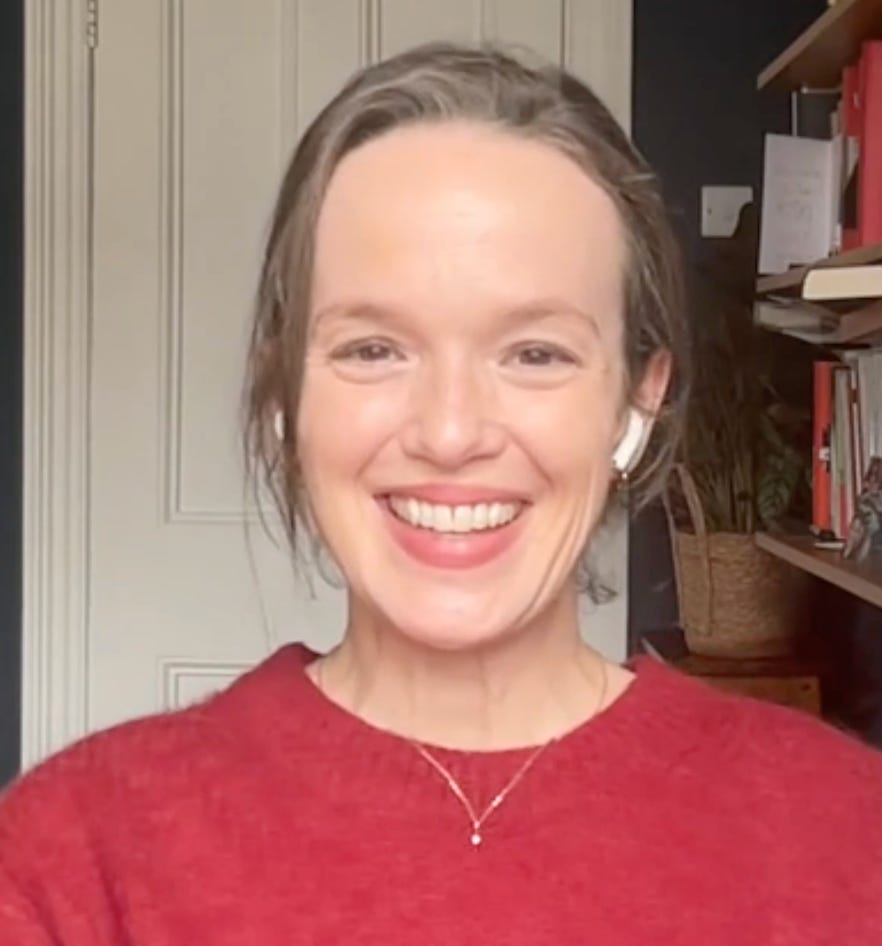

In this episode, Teresa Bejan and I discuss equality.
We talk about whether equality is one thing or many, the difference between distributive and relational notions of equality, what it means to be one another’s equals, the lasting influence of Roman law, the relevance of equality to relations between humans and animals, the idea of the Levellers as the original egalitarians, and more!
In short, we do some philosophy! I hope you enjoy it...
TRANSCRIPT
[This transcript was generated by AI, so while it’s been checked over, it may contain small errors.]
REBECCA: Hi, I’m Rebecca Lowe, and welcome to Working Definition, the new philosophy podcast in which I talk with different philosophical guests about different philosophical concepts with the aim of reaching a rough, accessible, but rigorous working definition.
Today, I’m joined by Teresa Bejan. Teresa is a professor of political theory and a fellow of Oriel College at the University of Oxford. She’s the author of Mere Civility: Disagreement and the Limits of Toleration. She’s working on the Clarendon edition of John Locke’s Letters on Toleration, a very exciting project. And she has an exciting new monograph coming out soon called First Among Equals: Visions of Equality Before Egalitarianism. She’s also always very fun to talk with.
So I’m delighted that she’s here with me today and, yes, that we’re going to be talking about equality. Thanks so much for joining me, Teresa.
TERESA: Thanks for having me.
REBECCA: So I was wondering, do you have a handy, neat, simple definition of equality for us? You know, some kind of starting point, which means we can then just spend the rest of our time having fun. You know, you telling me cool stuff about the Levellers, that kind of thing. Any chance of that?
TERESA: [laughter] Well, I’m afraid, Rebecca, the bad news is that I do not. But, you know, I’m hoping that in our conversation, that you might be able to help me. Because one of the things that drew me to writing a book on equality is just the way that it seemed to me that the apparent simplicity of equality — because I do think it strikes us as something that should be pretty simple. So just conversationally, we often think of equality as describing a kind of mathematical and quantitative relationship, a relationship of quantitative identity that should be open to measurement. So we should be able to tell when things are equal and when they aren’t.
But that apparent simplicity comes up pretty quickly against this reality, which is just that when we talk about equality, things get complicated very quickly. And so, one of the things I argue in the book is that instead of one clear and distinct idea of equality operating in the history of political philosophy, what we have is a host of many different complex ideas or aspects of equality.
So, in the book, I sort of trace different senses of equality from absence to evenness, balance and proportion, indifference and parity. And I hope that in this discussion, we can sort of come on to some of those senses and what they might do for us.
REBECCA: Yeah, that sounds very good to me. I’m very aware that philosophers — if you ever say anything to a philosopher like, “Hey, I really care about equality,” the first thing they’re going to say is, like, “Which kind of equality?”, or “What kind of equality?”, or “Which kind of egalitarian are you? Are you, like, a liberal Rawlsian egalitarian? Are you a socialist?”
So yes, and I think actually just even the everyday person in the street, if they read the newspapers, they probably have thought about things like equality of outcome and equality of opportunity. I tend to think those are pretty overdone and not always that helpful. But what I think I’m saying is that you just get straight into the idea of ‘equality of what?’, or ‘what kind of equality?’ you’re talking about. So this sounds to me right.
One thing I’m interested in, though — I’ve been thinking a little about this this week — I literally just put something on my Substack about this because you made me think about it so much — is, could there be something nonetheless that ties all of these things together? Some kind of glue that ties all of the matters of equality together to make them… Is too much of a thing to ask? I mean, there are other possibilities here, like there’s some kind of weird bundle, or family resemblance, or —
TERESA: Well, I think — so no, I don’t think it’s too much to ask. And I think maybe we can come to a sort of, maybe, if not quite an agreement, a kind of general sense of this thing that equality might be. But I would also want to argue that when we talk about equality as a political ideal, there I think there’s a much more definite bundle, as you say, or kind of collection of aspects of equality that we have in mind. And I think there’s a lot of — a lot to be said about disaggregating those senses, and kind of trying to get really clear on what each entails.
But your point about the political philosopher says, you know, we can agree that equality ought to be a value. Indeed, we might actually agree that equality is in some way definitive of distributive justice. But nevertheless, that leads us next to this question of ‘equality of what?’ And so you had this great debate in late-20th-century political philosophy of sort of ‘equality of what’? What is the currency of egalitarian justice?
But that debate, which was very interesting [laughter] and exercised a lot of very intelligent people for a long time, had some characteristic frustrations or even problems. So one problem is that it treats equality as being exclusively a question of distribution, and distributive justice.
REBECCA: Yes, I agree, I do think that’s a problem.
TERESA: So that there is some ‘what’ that we can divvy up into more or less equal shares and then distribute to equals. I mean, so that came up against what we think of as the relational egalitarian critique nowadays, following Elizabeth Anderson, that says, well, actually, maybe equality isn’t actually primarily a distributive principle at all. What it is is a relational principle. So it goes to how we treat one another as equals in standing. And so then, you know, there’s a whole debate about whether or not relational equality can be reduced to distributive equality in some sense, or vice versa.
But I suppose my sense, as someone who is broadly sympathetic to a lot of the points made by relational egalitarians, is that pressing that distinction between distributive and relational equality doesn’t get us nearly sort of deep enough. That instead, we need to really press the distinction deeper into the different senses of equality we have in mind.
So going back to some of those I mentioned earlier, you know, is equality a relationship of balance, in which we’re sort of setting two things that are different in kind and don’t share a unit of measurement against each other in some way? Is it a relationship of indifference, in which we recognise the differences between these sort of putatively equal parties but nevertheless refuse to take them into account? So we might think of that, then, as being equality as an ideal of procedural justice.
Or finally, the thing I think that a lot of relational egalitarians actually have in mind is equality in the sense of being an equal or being a peer. And so there I’d say actually, you know, we might be better off talking about parity of standing, than using this kind of mathematizing, quantitative language of equality.
REBECCA: I think that’s a really good point. I like that. I mean this, the distribution thing, bothers me for various reasons, although I also love reading that literature. It’s some of my favourite philosophy in the world.
I think, A, because distribution implies some kind of action. Maybe not as much as something like allocation — but distribution, I think, still does. And if you believe in God, then maybe that takes away some of those problems. Or you have to believe in a particular kind of God. In the past, that might have been more likely in political philosophy. I would probably personally not, even if I personally did, although I don’t.
I also think, however, it leads us on to those kinds of crude senses of talking about equality where people talk about pies. You know, they talk about slices of the pie. And then you get the capitalist who comes along and says, “Oh, but growing the pie!” The problem for me with all of those things is, the pie suggests that there is some kind of fixed outer full set of things, of which you’re taking a portion or a share.
So your portion or your share is in some sense, I think your point around, like, has some kind of quantitative kind of qualities because it is a portion of the share. Now, that might well work for certain kinds of concerns of justice. But I think in particular your point about this relational matter. Or, at least moral status. So if you think of something like equal moral status, as just in the basic sense of we’re all human beings, therefore we’re equal because we’re all a member of ‘being a human’. I’m not really sure where the pie is.
I mean, pie, then, I guess is humankind. But humankind is also the set of people you’re thinking about the relations... I think also some of these really fundamental things that we hold equally, like equal rights and equal freedoms, I also don’t think they fit very neatly into this, into this pie problem, either.
TERESA: No, so, right, so we might say there’s a kind of obvious, maybe a twofold mistake, right? So treating the sort of preexistence of this pie to be divided, that’s sort of, as you say, we talk about equal distribution, it encourages that kind of thinking.
And also your first point, which also implies the existence of some kind of authoritative distributor or decider. And so I think, I know I’m borrowing this phrase from somewhere. I think it’s Jacob Levy. But the idea that it encourages us to think of the state in particular as a kind of machine for distributing justice, right?
REBECCA: Exactly. And particularly when you think about something like rights. I mean, they’re equal just purely in the sense that we all hold the same thing, right? That’s a very different kind of way.
TERESA: But is it even? I mean, so Rogers Smith has a really interesting article published a few years ago where he just makes the point that one of the things that’s appealing about rights talk, I think, is precisely that it would seem to lend itself to this kind of distributive way of thinking about equality. We can have equal rights in the sense of having the same set of rights. But Rogers just points out that very rarely in, you know, in liberal democracies does anyone actually enjoy the exact same set of rights.
REBECCA: Oh, yeah, all I would apply this to is some basic set of moral rights that we each hold in virtue of being human. So something like, we all hold the right not to be tortured regardless — I mean, this is just a matter of moral fact. Not all historians of ideas believe in moral facts! But inasmuch as, whether you believe in it or not, there is a concept of rights, which is, you know, these are the kinds of things we have, as the kinds of creatures we are. They afford perfect moral obligations.
In that sense, something like that set of basic moral rights that we all hold, we don’t hold because they’ve been given to us — unless, like I say, you believe that God created us as we are. And I think it’s weird to think of them as being part of a pie. Because, I mean, I’m just not really sure what the pie is, again, in that situation.
TERESA: Yeah, that’s interesting. I mean, I sort of admit in the book that for a somewhat long academic monograph about equality, in which I do touch on debates in contemporary moral and political philosophy about so-called basic equality — so this kind of basic sense in which we are one another’s equals, to use Jeremy Waldron’s phrase — I don’t say very much at all about the basis of equality.
But I think for a lot of moral philosophers in particular, that is the question, because it’s only once we have a sense of the quality, or qualities, in virtue of which we are equal, that we can then know what sort of entailments follow from that. So if we are equal with respect to moral personhood, that would suggest that we are therefore entitled to rights that sort of act as a framework, within which we can exercise and develop that personhood.
So, I mean, that’s absolutely something that a lot of the historical figures I talk about are interested in. And, as you intimate, I mean, the answer for them is that there is an authoritative distributor, namely God [laughter]. And that our equal rights and liberties must have something to do with the fact that we are created in his image.
But for my own part, I’m just still stuck on this prior question of what on earth we mean when we say that we are equal, or one another’s equals. And again, particularly wanting to press on that — what I think is actually a disjunction between being equal, and being an equal. I think that those are just two different things.
REBECCA: Yes, so I mean, I think — I thought about it very hard this week. It’s not a very long period of time! But I think the thing that I am happy to claim is something like, it seems to me that equality is about morally relevant sameness.
So it’s something like, if you think about, I don’t know, equality of height. You know, let’s say you’re taller than me, or that I’m taller than, I don’t know, the child in the street. That doesn’t seem like a morally relevant non-sameness. There are some niche examples in which it might be. Let’s imagine we both grew up in the same country, where certain children, but not all children, aren’t given enough food because they’re members of certain groups or something. But that seems to me like a pretty niche side example. So I’m happy to say, generally, relations of height are not morally relevant.
Whereas, if you get two citizens who have the same legal right to political participation, that seems quite easily like some kind of morally relevant sameness. To the extent that, if one of them has it and the other doesn’t have it, we might say, why is that the case? Shouldn’t it be the case?
So I think, now I know from what you’ve suggested, but also from having read a little sneak preview of your book, that you might not be happy to accept this reliance on sameness. You also might want to ask something like, what’s the difference between sameness and parity?
I think I’m just happy to bite the bullet on sameness playing some role in equality because I think ‘equal’ has to. And to me, equal speaks of a kind of sameness. We can then argue about what the sameness is, or why it’s relevant. I think I’m probably just happy to come down on this morally relevant sameness as some tying-together feature factor.
TERESA: And as a creature of the same kind, Rebecca, I am happy that you are happy. [laughter] That is relevant to me. If you’ll just permit me an excursus just on what you said earlier —
REBECCA: No, that’s nice! [laughter]
TERESA: I’m going to butcher the historical particularities, but I do think it’s relevant. I mean, I think that one of the sources of the very prominent historical idea that people in the past, that the world had been initially inhabited in this golden age by a race of giants, was the fact that sort of people in the dark ages were digging up skeletons that were much, much bigger than they were. And that just had to do with sort of better nutrition in the past than after these — anyway, I’m butchering that. But I think it is interesting, right, to think about the historicity of thinking about human beings as being of the same race, and not a sort of distinct species.
REBECCA: Yeah, and again, as an analytic philosopher, I’m going to be looking for some kinds of conditions or something. I’m probably just happy to say we share certain capacities, even those of us who unfortunately can’t exercise those capacities well. The person in the coma still has the capacity for free agency even if, sadly, they spend the rest of their time in the coma. There are certain of these things which mean that if you meet sufficient of these conditions, therefore you’re an instance of being a human. Therefore we’re all part of the same group.
And just in that really thin basic sense, we are each other’s equals in the sense that we have this sameness. And I do think some basic set of rights and obligations can be derived from this. I know that’s going quite a long way from something quite small. But to my mind, that’s the kind of thinking that’s operating within these notions of — liberal notions of being one another’s equal, I think.
TERESA: I think that’s right. And I think that a very, you know, powerful presentation of that kind of argument is made by Jeremy Waldron in his book One Another’s Equals.
REBECCA: Yes, it’s a good book.
TERESA: It’s a good book. And, you know, Jeremy Waldron is in particular a very close and sympathetic and humane reader of John Locke and the kind of argument that you find in Locke about equality. And I think that Jeremy’s right about that.
But just to go back with you to the point about sameness. I think that you’re right that it’s very difficult to think, or really to speak about equality, without appealing to some sense of sameness. But one of the things that was so striking to me in trying to trace this history of the evolution of ideas of equality into something that we can think of as being broadly egalitarian, in 17th-century England, is the absence of sameness as a specification of equality.
What we get instead — and I think this is really interesting, and actually may get us some way towards the promise of something like a kind of essence of equality — is not sameness. But equality as the absence of difference. So it’s this kind of negative formulation.
So you get this very intriguingly in Aristotle’s Metaphysics, where he defines the equal as, in terms of a kind of, what he calls a contradiction by privation. It’s the absence of difference where you would expect to find it. And I like that because it — I mean, it does a number of things. It draws us to this sense of sharing something, but also to the difficulty of specifying, without problems, what that something is. But if we say it’s a kind of absence of difference where we would expect to find it, it simultaneously allows us to gesture towards sameness while recognising diversity.
REBECCA: It’s quite — it’s kind of scientific. It reminds me a little of, I don’t know, falsificationism, or something.
TERESA: Yeah.
REBECCA: Yeah, that’s clever. I kind of —
TERESA: Aristotle was clever. I mean, he’s not always clear.
REBECCA: He was very clever, wasn’t he?
TERESA: He wasn’t clear, but he’s definitely clever. [laughter]
REBECCA: I agree. I think he’s incredibly clever. And I think usually when he comes up with something like that, we should take it pretty seriously, even if we end up thinking it’s wrong. I just think my initial thought off the top of my head is, we’re probably going to come to something pretty similar. If we build up this absence of difference sufficiently that we get something to be able to tie us all together, that might well point to a kind of sameness.
TERESA: Well, so, what’s interesting about the Lockean argument that Jeremy Waldron updates in his own work on basic equality is that, for Locke, it is really that we’re sort of naturally equal, in that we’re all born for liberty, in Locke. So even going back to that sort of sense, “being born for” doesn’t then mean that we are all exactly equal in our realization of that — of that natural faculty. That something could go wrong, that children have a lot of growing to do, et cetera. But that it’s that kind of equal freedom. And that’s the point, and everything kind of flows from there.
I mean, part of what I’m interested to do in the book, though, is pull equality and liberty apart. Not completely, but just to say that, you know, you get these very long-running claims in Western political thought, and also we find them in the Stoics. We find them in Roman law. We find them in natural law theory. About the natural liberty of human beings. And I would say actually, for the most part, claims about equality before early modernity are really claims about equal freedom.
REBECCA: Yes, yeah, that makes sense.
TERESA: But there is still a kind of claim that is made separately from that, including by imperial jurists like Ulpian — so this is roughly 2nd, 3rd century CE — just saying that all humans are equal simpliciter. So you get the statement in the Digest, “Omnes homines aequales sunt”, or at least, according to natural law, all humans are equal. And so I am interested in that kind of ‘all humans are equal full stop’, as kind of a separate claim from the liberty claim. What could that mean? [laughter]
REBECCA: Yeah. I mean, the modern person would come back to this idea of equal standing. But it’s unlikely, or at least it seems to me relatively unlikely, that that thought is being put out in that sense.
TERESA: Yeah, it’s not there in — I mean, that’s not Ulpian’s thought.
REBECCA: Yeah, my limited reading of those — I’ve read some of that stuff in relation to the development of the term ‘rights’. I actually don’t really buy this idea that rights were only thought of in, I don’t know, 1400, and then gradually became the case. [laughter] You know, I believe in moral rights, so I think they obtained even if nobody had ever thought of them.
But I also — I think sometimes when you read commentary on those kinds of thinkers, you get these kinds of claims, like, almost as if everybody was some kind of massive blur, back in Roman and Greek times. That they had no individuality. That people thought of each other as some kind of part of some mass blob. I just struggle to get off the ground on that [laughter]
Maybe I’m just very bad at getting into the head of the ancient Roman person. But also if you read Catullus, I mean, if you read any of these poets, they have a sense of individuality. They fall in love with particular people, right?
TERESA: Absolutely. Well, in my own reading, and I’m by no means expert in this, I am an early modernist by training. But my own reading of these ancient Roman sources for the book is that, you know, the distinctiveness of the claim being made by imperial jurists like Ulpian has to do with this — well, I mean, firstly, Ulpian is making a distinction, and that distinction in the context of a discussion of slavery.
REBECCA: Yes, I assumed —
TERESA: With respect to the civil law, there’s a fundamental distinction between slaves, who are not legal subjects, and non-slaves, who are.
REBECCA: I mean, you get the same move in Aristotle, but to make a different point. Comparisons between the ways in which slaves and non-slaves are treated in order to try to say things about being human. Although sadly Aristotle doesn’t get that one right.
TERESA: Maybe we can come back to Aristotle. But I’m not, I just realised, I’m not because I think he’s — not because I’m saying I think he’s right.
REBECCA: No, no, I know.
TERESA: But just, I think what he’s saying is quite complicated. But with Ulpian, I think by implication what he is saying — and I think this is grist for your mill, Rebecca — is that, okay, well, if some human beings, i.e., slaves, are not legal subjects with respect to the civil law, that means that if all humans are equal with respect to natural law, what Ulpian seems to be saying is all humans are legal subjects with respect to natural law.
And so you might say, okay, well, what does that mean? That doesn’t entail that they have the same set of natural rights in a kind of Lockean sense. That would be ahistorical. But it certainly means for Ulpian that they are all, you know, subject to the benefits and burdens of legal justice.
REBECCA: Yes, that’s right, because —
TERESA: And that seems important.
REBECCA: That seems incredibly important. And I guess this is where you come on to these descriptive - normative points around ‘we are descriptively the same in these certain ways, therefore this gives rise to certain obligations to treat each other the same way’. Because I know that you’re conscious like I’m conscious — or at least I have pretty good reason to believe it — therefore I won’t push you off the cliff. Whereas the rock, I’m not going to feel bad about pushing the rock off the cliff. I don’t really know many things about rocks. But one thing I know that’s different between you and the rock is… And if I can build this kind of picture up sufficiently well, it can just help to inform me about the kinds of ways I should treat the other things in the world that are similar to me, or something like that.
TERESA: Yeah, and so in the Roman worldview, I think there’s actually something quite — I don’t know, there are lots of revolting things about it. But I think something quite intriguing, which is that, you know, amidst all of these different kinds of law — I mean, the Romans had a very distinct sense in which Roman law was, you know, the best law. You know, the lawiest law that was ever lawed, you know! [laughter] But amidst all these different kinds of law —
REBECCA: Making law great again!
TERESA: Exactly. Human beings as such are beings capable of law.
REBECCA: Yes, right.
TERESA: And you know, in the context of, you know, third-century imperial jurisprudence, I mean, this is — you know, Ulpian is a legal adviser to the emperor Caracalla, who is known today, if he’s known at all, not just because he’s one of the crazy ones in the new Gladiator movie [laughter]. But because he issues this incredible edict in the early third century, making all non-enslaved subjects of the Roman Empire, citizens.
So that goes back to rights. So to be a citizen means that you have certain iura, certain rights, in addition to being, you know, subject to and benefiting from the ius civile. So again, you don’t want to push that too far. Not every Roman citizen had the same set of rights, these rights are not human rights, et cetera, et cetera. But that kind of — I do think, in a way, when we talk about basic equality in contemporary anglophone political philosophy and moral philosophy, we’re actually still kind of participating in what is fundamentally a Roman discourse.
REBECCA: Yeah, certainly the distinction between moral rights and legal rights would track something like this. So we might say, like you said, human rights — broadly, human rights kind of track this modern, early modern, sense of natural rights. Rights we hold because we’re all human, something like that. As opposed to the kinds of rights that obtain within certain kinds of political societies, certain legal rights that are afforded.
But also, I have this view, for instance, that I’m not really sure it makes sense to talk about having a right to political participation, if you’re living in a pre-political society. I have a funny locution where I think of it as having a ‘potential right’ to that. That’s a very strange, metaphysically-imbued thought of going about rights. But nonetheless, it seems like it’s the same kind of idea operating. That there’s a distinction between the kinds of obligations and other moral matters that pertain to us as humans, and those that are kind of conventional or arise from certain kinds of rules we put in place, collectively or otherwise.
TERESA: Yeah, I think so one of the things I have long found so perplexing about equality in political philosophy is precisely the way in which moral equality and political equality don’t seem to be held apart sufficiently, in that way.
REBECCA: Yeah, great point.
TERESA: You can also sort of realise that actually the entailments can’t be the same, won’t be the same. But nevertheless, I actually think — and then doing this historical project where I really was trying to excavate the groundwork of these arguments that I was being presented with, in just reading contemporary political philosophy — was that actually, equality doesn’t really become effective or salient as a political ideal, until the 17th century.
Partly because that’s when this distinction between the natural equality of human beings and the sort of legal equality that they enjoy, specifically in England with respect to the common law, is coming apart. And it’s being sort of systematically undone by people who don’t have a lot of training in either natural law or common law. [laughter]
REBECCA: It’s not a coincidence, then, that this is the time of the social contract theory, then.
TERESA: No, no. And I wouldn’t at all want to say that — you know, the social contract’s not my focus — but certainly I’m trying to contextualise influential theorists of the social contract who then have cast quite a long shadow, so Hobbes and Locke.
REBECCA: Yeah, I mean, that makes a lot of sense to me. I love the social contract stuff. I tend to take a very ahistorical way of thinking about things. But when I learn that actually, you know, there is this great historical context for explaining why some of these thinkers might have thought these particular kinds of things at this particular time, that’s very exciting.
TERESA: Yeah, well, thank you. And I do — I’m sort of a perverse kind of historian of political thought, in that I’m constantly wanting to show that — you know, we tend, people like you and me, Rebecca, we tend to valorise these great philosophers of the past, the Hobbeses, the Lockes. [laughter] But for some reason I keep writing these books where I have to show, well, actually what they’re doing is kind of reacting to, and sort of reacting against, these much more interesting arguments that were made by these people you’ve never heard of.
REBECCA: Yeah, that’s a great point.
TERESA: In the book, the key theorist of equality for me is a guy called John Lilburne, who, if he’s known at all, is known as kind of one of the leaders of the Leveller movement.
REBECCA: He’s from my neck of the woods. He’s from County Durham, I believe.
TERESA: Yeah, yeah, he is! Durham gentry, absolutely. It’s so funny, my other sort of favorite obscure — and less obscure than Lilburne now, thank goodness — but is Mary Astell, who’s also kind of downwardly mobile Newcastle gentry. [laughter] So it’s funny, something was going on there.
REBECCA: It’s very funny thinking of this idea of people from the North being posh. [laughter] Hugo Rifkind wrote a novel about this recently, about whether Scottish people can be posh. It wasn’t a terribly good novel, but this is just an interesting conceptual point.
That said, thinking about conceptual analysis, you just mentioned putting this stuff in historical context. How do you find, as a historian of ideas who is interested in conceptual analysis — how do you go about assigning weight to the different ways people have thought about concepts across time? And to historical definitions more generally?
So I mean, one concern I think I would have if I got really really excited about all the historical stuff is, I might fall into that trap of making historical facts into normative grounds. That’s something that I think, you know, Nozick in the theory of entitlement is entirely guilty of, for instance. I mean, it’s sort of the is-ought problem. But I guess my first question is something like how do you differentiate between the different historical conceptions, if one of the things you’re interested in is the historical context?
TERESA: It’s such a good question. And it’s something I’ve really struggled with in the writing of this book. And I, you know, I like to think I cracked it, but you know, maybe readers will disagree.
REBECCA: I have faith in you. My money’s on you.
TERESA: Well, because one of the things that attracts me to the history of political thought, because I’m not really — I wasn’t trained as a historian. You know, my undergraduate degree was a great books degree. I then did a master’s degree in intellectual history, but then did a PhD in political theory. I mean, I’ve always been happily in the kind of normative presentist camp.
But what attracts me to the history of political thought is just, I think often, is that it helps us recognise the not just conceptual change over time, but also the ongoing kind of politics of language. So one of the things that really interested me in the book was thinking about equality talk, if you will. So, sort of, what are we doing when we’re reaching for the language of equality? What is that language doing for us?
And so I’m trying simultaneously to keep one eye on kind of this, the development of equality talk. And then also to get ahold of all of these different conceptual relations that are being folded under that umbrella. You know, we have this kind of umbrella term ‘equality’, and then all these things that are getting kind of smuggled underneath it. And so what I try very hard to do is to, yes, tidy up, make clear distinctions in places where the historical figures I’m interpreting wouldn’t always have made them themselves. But nevertheless to do so in a way that is honest and faithful and above the table.
And then also to be very careful, then, when I do do that pivot to the kind of returning to present debates, to say — you know, there was a lot of pressure on me at various points during this project to say, okay, Teresa, which is the historical conception of equality that you are recovering that’s going to solve our problems? [laughter] Which should be normatively, you know, normatively binding for our purposes? And I just don’t think that the history of ideas works that way.
What it helps me do is kind of tidy up muddles. And then, you know, be able to speak more precisely about the kinds of claims that we’re making. And my hope, which I suppose is maybe somewhat Pollyanna-ish, is that if we do clarify some of this complexity. If we acknowledge that equality entails these kind of contradictory demands, contradictory claims, and it can’t itself resolve them alone, then we will actually make some progress, in deciding, you know, which demands we agree are worth making.
REBECCA: I really like this. I think this focus on equality talk reminds me a little of ordinary language philosophy. The idea, you know, we’re thinking about how people actually use these terms in order to get at the concepts they’re referring to. This doesn’t mean that the concepts themselves are relativised to the words. What it means is, like, there are some concepts out there. We refer to some of these concepts when we talk about things. And if we suddenly decide that this word should refer to something which is entirely different from the thing that people have been picking out with this term over time, that seems like a mistake. Not because there isn’t some different concept, but because we should come up with a different word for that thing.
TERESA: Exactly.
REBECCA: So it’s about the relation between the words and the concepts. And the concept is the important thing philosophically, substantively. But the words set some boundaries, right? And enable us to do things like make these distinctions. So, yeah, I like this. I like this way of approaching things. It seems to me logical. And also, it picks up truths about the world. Not just in terms of what concepts there are, but also how we’ve thought about them, what kind of wealth of knowledge there has been over time around thinking about the relations between concepts, and particular concepts.
TERESA: Yeah. And I would say this is a sort of comparatively small point, but I think an important one. I mean, we’ve talked already about how Jeremy Waldron appeals to John Locke and trying to explicate the meaning of basic equality today. You know, Nozick also appeals to Locke, but you know, Nozick’s Locke is not necessarily Locke’s Locke. But anyway, setting that aside…
REBECCA: Nozick is very — I love reading Nozick, but Nozick is very, very loose on all of these matters, I think. [laughter]
TERESA: He’s very loose. But I also think it’s relevant that people who are thinking about the meaning of equality today in a more recognizably ahistorical analytic philosophical tradition are nevertheless feeling the need to gesture towards these historical figures. And I think that tells us something about the way that an appeal to the past is always anchoring our equality talk.
And I think that is — that observation is just particularly relevant, I think, in 2026. We’re in this 250th anniversary of independence, thinking about the Declaration of Independence. And so I think, for me at least, it seems especially important, then, that when we are appealing to historical assertions of equality in contemporary arguments, that we’re doing so in a way that is sensitive to the gap between, sort of, our meaning and theirs. So that we are, you know, maybe this is a recognition of their basic equality, Rebecca. [laughter] But yeah, that we’re not, sort of, doing a kind of violence to what they actually said.
REBECCA: Yes, I think this is a nice way of looking at it. You also remind me — you make this point in the sections of the book that I read around the way in which equality talk has sometimes been used to impose hierarchies. We sort of touched on this a little earlier. The kind of, you know, hard-nosed, dry, ahistorical, analytic philosopher in me wants to say: we shouldn’t let that kind of thing get in the way of our conceptual engineering! Just because this has been used for bad ends doesn’t mean it’s bad!
But nonetheless, we do come back against this point that equality, in terms of the term that’s picking out some concept, is nonetheless something that has been used over time. And our usages of it in terms of picking out the concept are undeniably shaped by that. I mean, this is a hard thing to navigate. No matter how ahistorical you are, we are bounded again, in some sense, by the fact that we’ve had some kind of notion of some concept, and we’ve used this particular term to try to get at it.
TERESA: So I think again, for me, this is why it’s so important, for even people who are sort of resolutely ahistorical in the way that they approach these questions, nevertheless to have some awareness of this history. Because, and you know, this is probably, I think it’s — I mean, you know, I’m always wrong [laughter]. But I think that this will probably be one of the more controversial aspects of my argument, is just to say that the idea of equality, and specifically the claim that human beings are equal, has always been much more at home with hierarchy than we like to assume.
And for me, that’s not — I mean, it’s not a bug, it’s a feature. So, you know, the idea of human equality, as we’ve already indicated, is extremely ancient. It is a Roman idea, fundamentally. And that means that it is an idea that is tied up, top to bottom, with a highly hierarchical understanding of the universe, of the polity, of the soul, et cetera. And so it’s not — I mean, especially, you know, you’ve moved to America now, so you, this is now your discourse as well.
We tend to want to talk about equality and hierarchy as straightforwardly being somehow antonyms. And thus that, you know, really unjust hierarchies like the American system of chattel slavery that existed side by side with these grand declarations, as in the Declaration of Independence, that all human beings are created equal, as a contradiction. And I just want to say that actually it’s not — that did not seem like a contradiction to people at the time. Although actually, in the case of Jefferson, I think he does see it as a contradiction, and feels complicated about it.
REBECCA: Yes, I think that’s right.
TERESA: But certainly in the 17th century, it’s only then that the idea that equality and hierarchy are contradictions is being, is coming into view. And so that seems to be such a firm and grounding assumption in contemporary discussions of equality, that it makes it all the more interesting, then, to ask, where on earth did that come from? Because in that respect, we’re just in a different world.
REBECCA: Yes. So I think one thing when I was thinking a little about, you know, this idea of the relevant kind of sameness that I think obtains in states of affairs that are equal. I feel like it’s states of affairs that are equal in this sameness sense between members of particular groups.
So, for instance, whether that group is all of humankind, and you say, you know, we all have this sameness in the sense that we have the capacity for free agency. Or it’s two citizens of the same nation, and we’re asking this question about why does one of them have the legal right to vote and the other doesn’t? And, of course, there are again some non-morally-relevant explanations for that — one of them is a baby! But most times, you know, that’s going to be something.
It then strikes me, thinking within this — so, I’m happy, again, to just say something like the fact that we are members of this big group of humanity means, therefore, we have some moral imperative to think about the instances in which members of our smaller groups have morally relevant differences. So, it’s something like that initial sameness, this very thin sense — I want to call it equal moral status or something, but we can argue about what it is — then kind of gives us this obligation to be thinking hard about instances when smaller groups aren’t equal in what seem like morally relevant ways.
I then have this question though about, like, does that mean that questions of equality don’t obtain between, say, humans and animals? Is it irrelevant to say I’m talking about equality when I think about the fact that, I don’t know, certain kinds of animals are treated really badly? Is that nothing to do with equality? Is it just to do with, say, justice? Although, again, some people are going to say justice is the domain of rights.
I mean, it feels to me like I can get out of it in some sense just by saying, well, I can do the same kind of move, and say it’s relevant to considerations of equality between humans and animals that we’re not the same in this basic sense that we are because we’re all part of the same group. But I wonder if that’s fudging it. I mean, does equality pertain to relations between humans and animals? The fact that, you know, people keep cats in their house and don’t let them out, whereas they do let their kids out. Is that a matter of equality, or is it just matters of other things?
TERESA: Okay well, I think I — you know, I can’t say I’ve thought about this systematically, but let me sort of venture a couple thoughts.
REBECCA: Sorry, I know it’s a weird. It’s a kind of slightly weird point. It’s just been playing in my mind a little.
TERESA: No it’s, well, I think partly what we’re doing when we’re importing equality language into discussions about animal ethics is that we are trying to say that, you know, animals ought to be sites of moral concern. And very often I think that equality talk just gets kind of inserted as a sort of, as a sign of moral seriousness [laughter].
REBECCA: Yes, that’s a great point. Morality is clearly more than just equality, right?
TERESA: Exactly. Right, and that would be my second point, which is that part of the problem we’re confronting is just our allergy to hierarchy in morality. Which, I just — I think that part of what I want to say is that if you care about equality, you should also care about hierarchy. And you should care about ethical hierarchy. That we can think of different hierarchical arrangements as being equality-preserving and promoting in some, in certain respects. And then others as being destructive of equality in other respects.
And I think probably what we’re really concerned about, in discussions of animal rights, is that — you won’t like this, maybe, because I’m going to go take a hard, hard turn into virtue ethics. [laughter] But I think it’s because we think that treating animals cruelly, and as though they are not sort of beings of moral concern, corrupts or perverts us as human beings, ourselves. So it will come into the way that we treat other human beings. And also, it’s simply not behavior becoming the kind of creature that a human being is. So, that’s a very old-fashioned way [laughter].
REBECCA: Sometimes, people say things like, oh I don’t know, “You’re wanting to blame this person for doing this thing to this other person, but animals do those kinds of things all the time!” You know, the animal, you get this —
TERESA: Right, right. We’re not prosecuting ducks for rape.
REBECCA: Yeah, exactly. Or in discussions of vegetarianism, people say, “You think you shouldn’t eat the cow, but does that mean that the lion shouldn’t eat the cheetah?” And it’s like, well yeah, as long as lions don’t have a sense of moral obligation, don’t have any awareness of these things, we can’t hold them blameworthy! This is quite easy to get out of those things.
And yes, I think if we don’t make those categorical distinctions, we’re at risk both of holding the animals responsible for something they just simply don’t have the capacity to be held responsible for. But yes, also effectively risking bloating our own — these kind of important matters that humans should be attending to.
Your talk of hierarchy, though, does make me think again of Elizabeth Anderson. So I think Anderson over-focuses on hierarchy. I don’t know if you read these new pieces she brought out last year —
TERESA: No…
REBECCA: About the psychological struggles of bringing about equality, in relation to our kind of desire for dominance, and how this is at odds with our desire to be treated with equal esteem. I just generally —
TERESA: I ought to have read these!
REBECCA: Yeah, I don’t know. Have a skim read. I’m not sure I got a massive amount from them. But it reminds me also — there’s this paper she wrote where she argues something like Adam Smith is not a radical egalitarian because he doesn’t sufficiently, like, smash down any particular, or all of the hierarchies. I think this is wrong, A, because I think if there is any radical egalitarian in the history of certainly that period of time, I think it’s Adam Smith, because he’s massively radical in terms of thinking everybody is capable of achieving some sense of moral judgment. This seems to me like, contextually, incredibly radical. But it also just seems to be a weird standard for her to apply. That you only count as a radical egalitarian if you destroy one particular hierarchy, or attack all of them, or something. It just seems to me over-focused on hierarchy.
TERESA: It’s an interesting thing. So I think that — so I haven’t read these pieces, but I think some of these thoughts are implicit and explicit in earlier things that she’s written. I mean, she says for instance of John Lilburne, my favorite Leveller [laughter]. Or the Levellers in general, that they, that the implications of their views, I think specifically it’s — so, Lilburne in his celebrated Postscript, Containing a Generall Proposition, of 1646, says that every individual man and woman has been created equal and alike in power, dignity, authority, and majesty.
So there are a number of remarkable things, here. But the most obvious one is that women are included, and included as individuals. So Anderson says of this, well, the feminist implications of this are clear, even if Lilburne, or indeed Locke — so I think she actually does talk about Locke in a footnote at that point — like, ought to have seen it. So that, I think, is an example of the kind of historically uninformed sort of reading of these past figures that I’m interested in.
But in a way, it also undercuts, I think, the radicalism of what Lilburne is doing with respect to women. So most men at that point didn’t have votes. So the idea that, but what Lilburne is saying here — and I think maybe this will appeal to you, Rebecca — is that women too have voices by nature, and ought to have a voice in their government. And so they don’t understand that in terms narrowly of a voice in the sense of having a vote, but having a voice in the sense of having the right to petition parliament.
REBECCA: Yes.
TERESA: And so that’s actually what you get in the Levellers, which is really radical. But again, if you sort of just put this idea that, like, equality is always and everywhere opposed to hierarchy, and to distinctions in legal or political status, you’re going to miss this incredibly cool and important point that is being made.
REBECCA: It is. And we should celebrate when people in the past managed to get things right, within the context of other people not. It’s like Adam Smith, again, not getting things right.
I do have time, that said, for constructing arguments from historical thinkers when they didn’t manage to achieve that. So I think you can say things like: Aristotle had all of the bits, he just didn’t put them together right. It doesn’t really tell us anything about Aristotle, though. On some level, it’s like, I don’t really care about who Aristotle was that much. I mean, I do obviously have those kinds of — I have intrigue about it. I hope one day they’ll find all of those lost works, and we can find out, you know, more about what he thought.
TERESA: Aristotle’s dialogues. Can you imagine?
REBECCA: Yeah, I know, it’d be amazing, wouldn’t it! Some of that, you know, they’re now opening up all the scrolls with clever AI and stuff. You’ve just got to hope that somewhere they’re going to find all this work.
TERESA: Well, speaking of AI, though, there — just, not to divert, but just to revert to a point made earlier about animals. I do also think that this thinking about equality is relevant to the case of AI.
REBECCA: Yes!
TERESA: And again, I suspect that many of the debates about AI personhood are actually kind of displaced debates about human ethics, and sort of what kind of people we become when we — when we treat AI as a kind of slave. And there I actually think that Aristotle’s discussion of natural slavery is really relevant.
REBECCA: Yes, agreed, I think — and Josh Ober’s written some good stuff on this, too. I think this is a really rich thing to look into. It also actually comes back to this point about distinctions. I think one thing that AI is very useful for is it probably helps us refine some of our thinking around human capacities, because we have something new to compare against. You know, for the first time in human history, or at least that we know of, we have some kind of non-human thing that we can talk with.
I mean, this is — this blows my mind every day. I don’t think it’s a person. I don’t think it’s got rights. I don’t think it’s ever going to be conscious. I don’t believe the silicon substrate is going to make it human, or any of those — although I’m interested in reading this stuff. But the idea that there is now something non-alive, something non-human, even just that, that I can have a conversation with, helps me to define down further, and refine down further, some of my views about what a particularly human capacity and capability is.
TERESA: Yeah, exactly, the things a human being can do that this other non-human intelligence can’t. But here again, as a historian, I’d want to say, but Rebecca, we have this whole history of thinking on precisely this question! Which is the thinking about the distinction between human beings on the one hand and angelic beings on the other.
REBECCA: Yes!
TERESA: A point I sort of make in passing in the book, but I would like to think about more is just the — this is another point about language and conceptual development — so just the strange circumlocutory phrase we use in English, ‘human being’. It’s very strange, right? Why do we use this phrase as opposed to simply saying ‘human’?
REBECCA: I have a philosopher friend who says you should always use ‘human being’ because ‘human’ is an adjective. I don’t think this is like…
TERESA: Well, that’s not correct [laughter]. But it’s interesting because they’re getting at a kind of — it seems like there’s a kind of moral valence to saying ‘human being’ that seems to recognise us as a kind of creature. And again, I’m afraid that it’s a lot of Christian theology in the background, here.
But yeah, so human beings are understood in contrast, in scholastic philosophy, with angelic beings. And the idea that is in the scale of creation, we are, you know, alike in being intelligent creatures, but unalike in the fact that we are corporeal and angels are not. And therefore, because this is also a kind of Christian Platonist worldview, that means they’re superior to us. But again, in trying to determine what a human being is like, I do think that there are really interesting parallels in thinking about angels and AI.
REBECCA: I love that. I always learn something new when I talk with you. I didn’t — I had not thought about the context of ‘human being’ being a comparison with ‘non-human being’ in the sense of angels. That’s incredible.
Okay, I think we need to wrap up. So I have a final question, which I think may get us somewhere down the line of coming up with some kind of attempt, or stab at a definition, at least in the first stage of going towards that. Which is, I’m going to ask you what kind of thing you think equality is. So you know, you mentioned before, I think, the word ‘ideal’. You said it’s some kind of — I wrote it down — something like a political ideal, I think you said. We also talked about it maybe being a moral ideal.
Another term that people often use, within philosophy anyways, they might call it a value. When philosophers talk about ‘a value’, they generally mean something that has value of some kind. It’s a bit of a weird locution. Normal human beings don’t say this so much.
Then, I think I’ve posited the idea in some sense that I think it’s a state of affairs that obtains when there’s some morally relevant sameness.
What kind of thing? And of course, it could be more than one thing. If we were to go about thinking what equality is, it seems like a good starting point is thinking, you know, what kind of ballpark of kind of thing it is. Are you happy just to say it’s an ideal?
TERESA: Yeah, so I would preface it by saying equality isn’t just one kind of thing. And I think that there is a way in which equality is a value, in the way that we’ve been discussing and, you know, but just to gesture towards that. But the kind of, the sense, the idea of equality that exercises me is, yeah, equality as a political ideal.
And as a political ideal, then, I think equality comprises, or I should say that equality combines, several of the different aspects we’ve been discussing. So it combines a sense of indifference as a kind of procedural fairness, which is germane particularly to the rule of law. Equality combines a sense of balance — so, within a kind of, under conditions of political equality, no one part of the polity ought to be able to dominate or consistently outweigh another.
REBECCA: Nice.
TERESA: So that refers to individuals in considerations of power, but also to social groups. And then finally, and again mentioned before, equality as a political ideal includes a very definite sense of the value of social parity. So even though we may have all these differences, and we may be unequal in myriad ways, nevertheless we can fundamentally stand as peers, or equals, within the Constitution, right? I like the Leveller sense of that having something very importantly to do with voice. Having a voice, having a voice that counts.
REBECCA: I like that.
TERESA: But again, so that would be my sort of threefold definition.
REBECCA: Yeah, that’s good. So we have equality combining procedural indifference, group and individual balance, and social parity — something like that. That seems to me good.
If, however, the little kid on the street comes up to you and says, “Hey, Teresa, I hear you’ve written this great book about equality. I need to go into school now and talk to them about what equality is…” Is there some simpler version? I mean, you actually just said “standing as peers”. I mean, I don’t think it covers absolutely everything, but I think it gets beyond some of those kinds of objections we addressed at the beginning.
TERESA: I think that’s right. So I, yeah, as a precis, let’s say “standing as peers and equals.” And then, you know, in the book I spell out sort of the ways in which those are different ideas.
REBECCA: I also, I mean, I think on some level we might get into circularity, if we say that equality is standing as equals. But I think if we say standing as peers, we might avoid that, at least.
TERESA: Yeah, or we might — yeah I don’t want to complicate things too much [laughter], but again, going back to that sense of, is there a kind of overarching meaning of equality that runs right through? I mean, I talked about equality as absence in Aristotle, but I think Aristotle is working there with a very influential image of equality. And that image of equality is the balanced scale.
So, the idea of the scale or balance, in which the pans are on a level. And so, the idea of kind of being on a level.
REBECCA: Nice. Being on a level.
TERESA: I think that is really important.
REBECCA: Being on a level brings us back to John Lilburne, again. The hero — the hero of the day.
TERESA: And the Levellers.
REBECCA: And the Levellers.
TERESA: For me, I agree with Liz Anderson that the Levellers are in a way the original egalitarians. So I am, I should say, and having sort of criticised aspects of her argument, I am very much in agreement with her on the salience of that historical example.
REBECCA: I think she’s a really interesting philosopher, as well. Just because I’m a little down on her late work doesn’t mean I don’t think she’s worth reading, generally.
Anyway, thank you so much. This has been fantastic. I feel like we’ve got a long way on one of the hardest concepts there is out there. So thank you so much for joining me, Teresa.
TERESA: Thanks for having me. You know, the great thing about finishing a book, and starting to talk about it, is that you can actually figure out what it was about the whole time. [laughter]
REBECCA: I love that. All my listeners, you’ve got to go get this book. It’s brilliant, Teresa is brilliant. And it’s going to be — it’s going to change the world. Like the Levellers! [laughter]
TERESA: Thanks, Rebecca.