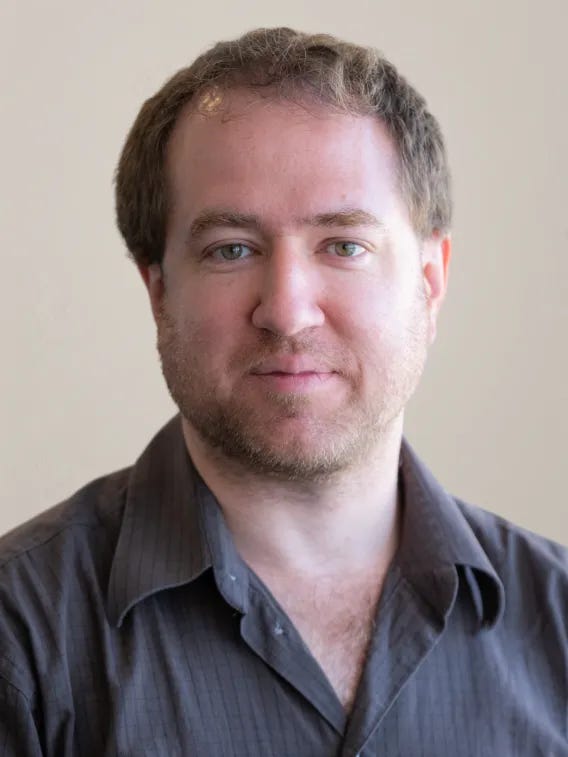

In this episode, Oliver Traldi and I discuss politics. We talk about why it’s such a hard word to define, the competing and complementary ways people use it, its significance within the history of political philosophy and the world of political action, and more. In short, we do some philosophy! I hope you enjoy it...
TRANSCRIPT
[This transcript was generated by AI, so while I’ve checked it over, it may contain small errors.]
REBECCA
Hi, I’m Rebecca Lowe, and welcome to Working Definition, the new philosophy podcast in which I talk with different philosophical guests about different philosophical concepts, with the aim of reaching a rough, accessible, but rigorous working definition. Today, I’m joined by Oliver Traldi.
Oliver’s a philosopher at the University of Toledo’s Institute of American Constitutional Thought and Leadership. I’m delighted that he’s also a Visiting Fellow with the Mercatus Center’s Emerging Scholars Program, which I have the privilege of directing, and which makes him one of my favourite colleagues. He’s previously held positions at Princeton and the University of Tulsa Honors College. His book, Political Beliefs: A Philosophical Introduction, was published by Routledge in 2024.
And today, he’s going to be talking with me about politics. Thanks for joining me, Oliver.
OLIVER
Thank you for having me.
REBECCA
As you know, the central idea of this podcast is to talk about these contested philosophical concepts. And with all of them so far — we’ve had transparency, democracy, freedom, privacy — I think it’s fair to say that everyday people use them in ordinary language, and they use them coherently. But they would also probably struggle to define them, as indeed we philosophers struggle to.
OLIVER
Yeah, absolutely.
REBECCA
But I was thinking about this, and I wonder whether politics might be the kind of paradigmatic example of this, in the sense that perhaps it’s the contested philosophical term that, relative to its regularity of use in everyday language, people would struggle the most to formally define.
I mean, these terms like freedom and democracy, people might just kind of bat them away as overly conceptual. But politics — it’s such an everyday word. But as soon as you say what do you actually mean, it’s really hard. Is that fair?
OLIVER
Yeah, I think it’s really, really tough. And yet everybody takes themselves to be doing politics at some point. Takes themselves to be talking about politics. And you get these debates about what is political? When has something been politicized? Is everything political? And it’s not quite clear what the stakes of the debates are, and the stakes of what we’re doing when we argue about the limits of politics.
REBECCA
What do you think if you just went and did a little sample of people on the street, and you said to them, you know, you use this term probably, what, 10, 20 times a day, maybe, at least in the modern age. What do you think their stab would be at summarising what they’re talking about?
OLIVER
Yeah, I think they would kind of gesture at politics being what happens in certain kinds of buildings, or with certain kinds of rules. Rules that come down from on high, in some sense. Rules that have a certain, maybe, authority to them.
But then when you ask what sort of authority, the answer is going to be, well, political authority. And you’re sort of back to where you started. [laughter] When you ask what kind of rules, the answer will be political rules, and you’re back to where you started…
REBECCA
Yeah, I think there’s a risk people might say something like: the political sphere, where politicians do political things!
OLIVER
Yeah, exactly.
REBECCA
And we are very quickly into this circular…
OLIVER
Yeah, exactly. You just sort of throw the word ‘politics’ out there as many times as possible, and eventually you hope that it looks like a non-circular definition, when it’s just gotten worse and worse.
So I think one issue is that there’s a lot that’s confusing about why politics works, and maybe that is part of what makes it hard to define. Obviously, political theorists and philosophers have thought about this for centuries. But there are these questions about why we follow the laws to begin with. And there are these enforcement mechanisms.
And you ask, is it the law that’s politics? Is it the enforcement that’s politics? Is, you know, is politics sort of everywhere? Because, in theory, you can make a law about anything, or you could try to enforce anything. There’s this movie that I really love called The Death of Stalin.
REBECCA
Oh, yeah, that’s a great movie.
OLIVER
I forget a lot of details about it. But one thing, this may not come as a surprise, it’s about the death of Stalin. [laughter] Although it’s highly fictionalized and very, very funny.
But whenever I watch this movie, which is several times now, they’re trying to figure out who’s going to replace Stalin. Who’s going to be the next secretary general, or whatever it’s called, of the Communist Party in Russia and the Soviet Union. And these people are striding around trying to run things and scheme against each other and such. And they always walk through doors that are guarded by men with large machine guns.
REBECCA
Yeah.
OLIVER
And often, when I watch this movie, I think, why doesn’t one of the men with the large machine guns try to become… you might think the large machine gun could be an asset. Whereas the men who are actually trying to become the next Stalin, they don’t carry large machine guns.
So there is a question, you know. I think an interesting political question is sort of like: why does the large machine gun matter less than, whatever, I think the kids would call it, aura?
REBECCA
Even in an authoritarian society…
OLIVER
Even in an authoritarian… maybe especially in an authoritarian society.
REBECCA
Because you might want to say, somewhere where it’s more democratic, we have good answers — it’s just not going to swing! But when you’ve got a place where everything is already very top down…
OLIVER
Right, you might think, okay, I’m the one with the machine gun now, that’s going to be enough. But yeah, so these are — I don’t really know how I got on that tangent — but these are interesting questions about politics, and what goes on in politics, and I guess why we care about it. But I don’t know if they help us get towards the definition.
So in the first chapter of my book, I throw out a few potential sort of families of definitions.
REBECCA
Yeah, I enjoyed reading this chapter. I should say I only read the first chapter, because I didn’t want to know… I didn’t want to wreck the episode, wreck the story! I want to find out what conclusion you come to in the rest of the book, but I’m going to save that until after we have this conversation.
But I enjoyed that first chapter. I thought it was very clear.
OLIVER
I tried my best.
REBECCA
It was a clear discussion about how to define things, aside from anything else.
OLIVER
Yeah, although certainly doesn’t come up with an answer…
REBECCA
No, but you tested out some of these…
OLIVER
I tested out a lot.
REBECCA
But actually, before we go on to these three groups of types of definition, or things that people claim politics is about, I think is how you put it at one point. I was just wondering about the relation between the word ‘politics’ and the word ‘political’.
Is this a good way to getting into thinking about what politics is — to think about the political? Are these two things the same? How do they relate? What do you see value being of starting with ‘the political’ rather than with ‘politics’?
OLIVER
Yeah, interesting. You know, in terms of the vibes of the words, if I heard somebody say ‘the political’, I might think they were a political theorist or a literary theorist. Somebody talks about ‘politics’ might be a sort of more ordinary person, maybe an analytic philosopher… [laughter]
REBECCA
We’re so ordinary, man!
OLIVER
And I think that certain definitions of politics are based on sort of construing it as an activity of a certain type.
REBECCA
Yes, you said off the bat — the first thing you said when I said about this term being hard, you said: people do politics. They’re doing — they feel like they’re doing politics.
OLIVER
Yeah. So I actually think I should walk that back.
REBECCA
I did wonder, because then you started talking about politics being from on high, yet you’d given this implication it’s something we all do. I do think there’s definitely a set of people, particularly from the 20th century onwards, who think everything is political, things are political, we’re doing political stuff all the time.
I’m not 100 per cent sure that’s what the person in the street — I mean, I’m not very good at knowing what the person in the street thinks. As you say, we analytic philosophers aren’t always very good at that, but…
OLIVER
I don’t think the person on the street thinks everything is political, for sure. I mean, among other things, if everything is X, then X is a pretty unfortunate term. It’s not helping us.
REBECCA
I thought in your chapter you put very short shrift to this idea.
OLIVER
Yeah.
REBECCA
In fact, you dealt with it in a couple of lines. I thought it was great.
OLIVER
I got rid of it pretty quickly, or at least I tried to deal with some of the arguments that you hear for everything being political. And they’re, you know, they’re very quickly dealt with. They’re not very good arguments.
In the book, I was interested in figuring out which beliefs are political, because I was trying to figure out how to talk about political beliefs. So I was interested in the adjective ‘political’. So I had to…
REBECCA
So yes, it does strike me it is an adjective.
OLIVER
Yeah, yeah.
REBECCA
And this gives it a kind of analogical quality, I wonder, maybe. So it qualifies or characterizes other things. So in the way that I might say, I don’t know, ‘Traldi-ish’ is ‘something like Traldi’. Traldi-ical. You get economical to economics, physical to physics. This makes me wonder. I mean, I’m not saying that those are perfect comparators, but...
OLIVER
Yeah, that’s interesting.
REBECCA
I wonder on some level if the adjectival version is broader, because they include this ‘stuff like’. Does ‘political’ work like that? So, “Hey, this dispute’s getting political” feels to me like some kind of analogy statement…
OLIVER
Yeah, so it’s not an exact attribution. It’s more…
REBECCA
It’s more expansive, I wonder?
OLIVER
Yeah. Well, so one thing I talk about in the book, I’m very — well, at least when I was writing that chapter, I was very interested in phrases like ‘office politics’, ‘academic politics’. And one thing that was super interesting to me about them is that whenever you say something like that, you’re always talking about the worst part of… [laughter]. Like, the worst part of being in academia is academic politics. And the worst part of working in an office is the office politics.
REBECCA
Although some people seem to love it. I hate that stuff…
OLIVER
There are some people who love it.
REBECCA
Those people are generally not the people you want to hang out with.
OLIVER
Yeah, I think generally, when you think about who are the people who love the politics of this or that sphere, they’re generally people who like, maybe, social manipulation, or power-grabbing, in the… You know, what do they say about academia: the something is so high because the stakes are so low. You know, people like winning one over on each other. That’s politics, I guess.
So this is why, if I had to pick a definition, I would say that politics is mainly about conflict, because I’m back to the activity. Precisely because when we use it to qualify other things, as you’re saying, in the analogical form, it just seems like an entirely negative enterprise, right? It’s not negative in the sense of contradicting something, but negative in the sense of emotionally unfortunate, right?
REBECCA
It’s interesting you say this. So, one thing — to get the historical stuff out of the way, so we can continue doing the philosophy — when I was thinking about this conversation, I jotted down what I saw as three very broad traditions in political philosophy and thinking about politics or the political.
So you have Aristotle and Plato thinking about some particular kind of political association or society, which is aimed at bringing about the good in particular ways. Obviously, they have different conceptions of the good, and of how you bring about that thing. So what’s constitutive of politics is different for them, and what this goal is is different. But on some level, it’s an association aimed to bring about the good. That’s one kind of tradition.
The second tradition is something like, the social contract theorists, who make this stark comparison between the state of nature — whether that’s historical or hypothetical — and a political society as a society with laws and institutions.
OLIVER
Right.
REBECCA
And then the third one is this kind of 20th century shift towards politics is everywhere, everything. It’s about language and identity.
And from each of those come many offshoots over time. So, for instance, I think your set of three groupings — and I’m just going to wreck the surprise — which are power, conflict, and order — I feel like that’s found in the Hobbesian part of the social contract tradition.
So if you want to split that into two, you get the kind of happy-go-lucky John Locke, trying to band together… the yeoman farmers in their field banding together for the good of gaining more prosperity and peace. Choosing to come together. And then you get the Hobbesian type, who are like, we’re going to kill each other, so we might as well submit to some rule. And then I see that coming through the political narrative within political philosophy, and it’s something like the state as a necessary solution to chaos. So you might get Machiavelli and Schmitt, Weber, monopoly on violence.
I feel like your three terms fit within that set. Was that on purpose? Do you see yourself as being part of this?
OLIVER
No, no, I hadn’t thought too deeply about this, about situating it within the whole history of thought, which I’m overall relatively unread in. I think it is interesting to think that all of these ideas find a home in the social contract theory, and maybe not in some of these other theories.
Although, you know, a lot of these notions are picked up by the more recent traditions as well, but maybe changed somewhat. So, for example, the notion of power. There’s this question about whether we mean coercive power, or whether we include power as, say, ability. If we include power as, say, ability, it’s I think pretty untenable to characterize politics in terms of power.
Even characterizing politics in terms of coercion — I think you and I have talked about this before. But we’re all kind of, like, coercing each other in little ways all the time, right? [laughter] And maybe that’s what people, when people say everything is political, maybe they have something, maybe they have a previous definition in mind, that is actually, like, there’s coercion everywhere, even outside of politics.
REBECCA
We have talked about this before. And I think, again, and maybe this just comes back to me naturally siding with the Lockean side…
OLIVER
Yeah.
REBECCA
I’m not sure we are! I mean, I know what you mean, and maybe we’re trying to. I feel like I’m more positive about the idea that, oftentimes, what some people want to characterize as us coercing each other, is us coordinating.
OLIVER
Right.
REBECCA
Or that we have the capacity to... So I, for instance, hate the nudge stuff. Some people on the freedom side love the nudge stuff, and think it’s good, and all…
OLIVER
The freedom side, I like that. [laughter]
REBECCA
…I just, I find it, partly I find it kind of incoherent. But also, I just think I constantly want to be pushing against this idea that we’re tools, or that we use each other. I have this endless, boundless, kind of faith that most people are good. That doesn’t necessarily mean… So, maybe it’s to do with moralizing coercion. Is coercion always bad?
My view, my just instinctive thought on that, is yes. It has a manipulatory element, and because I’m so big on the making our choices for ourselves, acting in line with our intentions, I don’t like the idea that we’re constantly being tricked into doing things without realizing it, or something like that.
OLIVER
Well, I don’t think coercion is a trick. I mean, if the government says, if you do this, then you’re going to go to jail… It’s very important for something to be a law, at least in, like, a liberal democracy, that it not be a trick, right.
REBECCA
Yeah.
OLIVER
We have to know what’s going to happen if we break the law. Otherwise, you know, otherwise we don’t have notice of it.
REBECCA
No rule of law.
OLIVER
Yeah, there’s no rule of law, if it’s a trick. So I don’t take coercion to mean something related to manipulation.
REBECCA
I guess there’s two meanings of manipulation. One is the secretive, the other is doing something because you feel like you don’t have other options.
OLIVER
Yeah, so I think maybe — and I think this is maybe a Hobbesian view — so Hobbes thought we could act freely even when we’re, in some sense, forced, right? So Hobbes thought, OK, somebody has a gun to your head. I think this is what Hobbes thought…
REBECCA
G.A. Cohen has a great line on this. He thinks you can’t be forced to do something unless you’re free to do it.
OLIVER
Yeah.
REBECCA
I think that’s true…
OLIVER
Yeah, and so…
REBECCA
Depending on what you take ‘forced’ to mean, obviously…
OLIVER
And so I think that’s my view on coercion, right. Like, the gun to the head is a very strong coercive element. And, you know, if I’m nice to this person, maybe they’ll buy me a coffee, that’s a very weak coercive…
REBECCA
Also, you can just accept the shot, right?
OLIVER
You can just accept the shot.
REBECCA
Or you can just take the bet that they’re not going to shoot you.
OLIVER
Exactly. So, a gun, a coffee, in both cases, we can go either way. In both cases, we do a kind of risk-benefit calculus. But if you think of coercion as just, like, really high numbers in the risk-benefit calculus, well, in every situation there are low numbers in the risk-benefit calculus, right?
REBECCA
I think I’d want to put something like an intention or a goal in there, though. I’m not sure coercive action can be coercive action unless it’s intended to a particular end. So, I don’t know, we go out, and I buy you a coffee, and you’re like, oh, why did Rebecca buy me a coffee? Maybe I just want to buy you a coffee: maybe I’m just feeling generous that day. My intention behind buying you the coffee can be different. Some of those indeed could be coercive. Trying to get you over to my new coffee company…
OLIVER
This is something they say about networking, right? They say, it’s only effective if you don’t have an immediate thing to ask for. You want to sort of build up a general sense. But that’s precisely so that it doesn’t feel, you know, manipulative in this way. But it still is… there’s an obvious sort of calculation about why we’re doing the things we’re doing. But anyway, so that’s part of why I don’t think you can define politics in terms of coercion.
So you were saying something different. That all these definitions would fall within, sort of, the middle period, let’s call it, of political thought.
REBECCA
Well, something like that. I feel, to me, like these three groupings — so, political in terms of power, political in terms of conflict, political in terms of order — they feel to me like they’re coming out of the Hobbesian strand of the social contract tradition.
OLIVER
Yeah, so the other thing to say about these three is, in my more recent work on this, which is a presentation I gave in Oxford about a year ago, where people just looked at me like I was crazy… [laughter]
REBECCA
That may just be people in Oxford, to be fair. It’s just how they look…
OLIVER
I think it’s this analytic philosophy versus political theory type divide.
But one thing that I was interested in then, there, was the question of whether power, conflict, and order are interdefinable. So actually, and I guess this goes with what you’re saying, it started to seem to me like these three theories are actually — if you really think about these terms — they’re like one theory.
So, power is what you use to win a conflict and create order. And conflict is settled by power, and is like the absence of order. And order is decided by power, and is the settlement of a conflict.
REBECCA
Can we just pause for one second, because early on in the episode... we’re not actually that early on now, because we got distracted talking about interesting things, which is exactly what I hope for in these episodes!
OLIVER
No, no, that’s good!
REBECCA
This is like the paradigmatic episode, so far.
But it’s quite nice just to bank a starting working definition, so that we do… I mean, the whole joke of the podcast is we’re philosophers coming up with a product, which I find hilarious.
OLIVER
Right, yeah, yeah.
REBECCA
So maybe we could have as our opening working definition attempt: politics is the use of power to win conflict and bring about order. Or something like that. That’s broadly what you just said.
OLIVER
Yeah, so I think that’s the sort of… If you do think of these things as interdefinable, then that fits.
Now, what I just wanted to say about the Aristotelian idea is… So the thing that I brought up, in this paper that I presented at Oxford, was that there’s what I thought was a fourth notion. And part of my question there, which I don’t think I expressed well there, was whether the fourth notion would also exhibit this interdefinability. Whether it would fit in a neat picture with the others.
And that was the notion of a group.
REBECCA
Yes.
OLIVER
And the notion of a group is something that, you know, Aristotle starts with the polis, whatever the heck that is. But there’s also groups come up in recent thought. You have the groups of class conflict, and of the other types of oppressor/oppressed conflict theories that came out. You also have the friend/enemy distinction of Carl Schmitt, whatever that means. That’s not a very clear…
REBECCA
No, agreed.
OLIVER
If you read The Concept of the Political, you still have to say, you know, you don’t come out with a concept of the political afterwards, unfortunately.
REBECCA
Yeah, I didn’t stick with it for very long…
OLIVER
Yeah, when I gave this, a very very nice guy… When I gave this paper at Oxford, one of the comments I got was, people thought, oh, this analytic philosopher is not really doing anything real in this paper.
REBECCA
What? An analytic philosopher criticised for not doing something real! [laughter]
OLIVER
Yeah, yeah, so they were very nice people, and so they were trying to be helpful. And a Schmitt scholar raises his hand and says, you know, Schmitt says that the individual evaporates into the state, so that might be helpful to you. [laughter]
So I wasn’t quite sure how this would be helpful, but it obviously had something to do with the notion of the group, right? That, in political analysis, maybe you’re thinking about how groups have conflict with one another, rather than individuals.
REBECCA
Well, certainly, when I read out that scribbled down conflation of what you said — politics is the use of power to win conflict and bring about order — my first thought, the first thing I thought, was I want to stick in a word like collective or group.
OLIVER
Yeah, yeah. And so I think that might be enough to…
REBECCA
I mean, just on the simple level that if there’s just one person on an island…
OLIVER
Yeah. Or if there’s two people playing basketball, you know.
REBECCA
Yes, I wanted to think about… you do a nice job in your chapter of ruling stuff out on the grounds of over and under inclusion.
OLIVER
Exactly, yeah. And I do think, you know, it was a textbook, so I think I’m… Hopefully I introduced the amateur reader to the notions of over and under inclusion. But even…
REBECCA
In fact, yes, I was telling somebody about your chapter yesterday. And I said, I think, if you want to think about defining, it’s good. And he particularly makes good use of these two terms. And then I explained to them what it was. And I think, rather than me having to explain to them what it was, I could have just given them your chapter.
OLIVER
Oh, that’s good. Thank you. That’s very flattering.
REBECCA
You do a nice job of that.
OLIVER
But I’m not sure if… So one of the counter examples I liked, that I came up with… so, okay, we have politics. It’s something like: politics is uses of power by groups to resolve conflicts and institute orders, or something like that, right.
REBECCA
Sure.
OLIVER
Well, okay, say there’s six of us who are trying to get together to play a card game. This happened on Saturday, actually. I played a card game with five other people.
REBECCA
Which card game?
OLIVER
It’s called Chinese Poker. It’s very hard to explain. But it’s a team card game.
REBECCA
A team card game…
OLIVER
It’s a team card game. You’re on teams of three.
REBECCA
But there are still winners, right? It’s not one of these annoying...
OLIVER
Yes, I went 5 and 0! Despite not having played in 15 years.
REBECCA
Good times!
OLIVER
So it was a very good day for me.
Okay, so three of these people think the card game should go from one till four, and you should begin by ordering pizza. And the others think it should go from four till seven, and you should end by ordering sushi. And you can imagine these groups engaging in various sorts of conflict resolution strategies, of varying ethical acceptability [laughter] to try to… You know, they could manipulate, they could lie, they could steal somebody else’s phone to make sure that they can’t vote in the group, or something like that.
It’s really hard for me to see any level at which this conflict would become political. It seems like there’s no way that this event could rise to the level of being a political event. And I think part of it is, if you go back to the person on the street, like you were asking at the beginning, they would say, well, no, politics is about, like, important things or big things, which obviously isn’t true.
REBECCA
Sure.
OLIVER
But…
REBECCA
No, I mean, the classic thing in Britain is about potholes…
OLIVER
Yeah, yeah. So there’s potholes…
REBECCA
Not to denigrate the importance of potholes. People die because of potholes!
OLIVER
Even potholes. There’s a lot of, like…
REBECCA
Card games are also important…
OLIVER
Yeah, there’s a lot of, like, the Senate votes to wish somebody a happy birthday, or whatever, I don’t know. I know the least of anybody in D.C, I’m just a philosopher. I don’t know how these things work.
REBECCA
I could well see them doing something like that.
OLIVER
But there are things like this and, you know, holidays.
REBECCA
In fact, filibustering is entirely premised on bringing non-substantive stuff into politics for a political reason.
OLIVER
Yeah, exactly.
REBECCA
There are rules about it. It’s part of a process.
OLIVER
So it’s hard for me to see… But then we come back to the old problem, when you say, okay, which are the… The card game isn’t the sort of situation that we would count as political. So in what situations, what kinds of groups, or what kinds of conflicts, or what kinds of orders?
And you want to go back and say, well, the political ones are the ones we care about.
REBECCA
But again, I do think one way around this is to go back to the Aristotle/Plato thing, and say, look, it’s not just about the kind of constitutive elements. It’s not just about where it happens, or what goes on. It’s about why it’s going on.
OLIVER
Like what end, as the Catholic philosophers say, what end it’s ordered to?
REBECCA
Exactly.
OLIVER
Whether it’s rightly ordered to the good?
REBECCA
That’s right. So Aristotle would say something like, descriptively, the state arises in order to secure life. And he takes the state being the particular kind of associational grouping that counts as political. So it comes about with the aim of securing the life of its members, and it persists to try to secure the good life.
So it’s aimed at bringing about this kind of eudaimonic living. And I think, for him, it’s the only kind of way of living in which this is brought about. And that’s partly to do with what it is substantively. So people are involved in bringing about justice, there isn’t force over them. But it’s definitely a teleological notion.
So it’s not just what are the conditions, or what’s going on, in the sense of the card game. It’s why. Why are they together in this group.
OLIVER
Yeah, so I think maybe Aristotle, in terms of… So I drew from an unpublished paper for this chapter by this guy, T.J. Donahue, who maybe teaches at Hopkins now. I have no idea why the paper was unpublished. It goes through 15 really interesting definitions, which I boiled down to these groups.
But one of the common counter arguments he had to some of these definitions is — there were definitions in terms of the state, and his argument was just that it seems like we can do politics prior to a state. It seems like you would have to do something that sounds like politics to establish a state.
REBECCA
Yeah, on some level I probably shouldn’t have said state. I mean, I think he’s just meaning the kind of — and also the Aristotelian state probably wouldn’t be recognized as the modern state — but he’s just using this term to mean the particular kind of association, particular kind of grouping, which he thinks counts as political. He just calls that grouping ‘the state’.
OLIVER
So any grouping that is there to… has these two qualities. It originates almost in the Hobbesian way to protect people so that they can live. And then, as it continues, it’s ordered towards them living well. Is that basically the idea?
REBECCA
Pretty much. And then he compares that with, say, the household, or with the slave master and the slaves.
OLIVER
Yeah.
REBECCA
And he says, look, these are useful comparisons, but they’re not just mini versions of the state. And that’s to do with what their goal is.
OLIVER
I think one of the issues with these types of definitions in terms of living well, where the morality is kind of sucked into the definition itself, I just feel like it would actually exclude a lot of... So, take an authoritarian state.
REBECCA
Yeah.
OLIVER
It doesn’t protect its citizens, and it doesn’t lead them towards a good life. It leads them to the bad life of being oppressed.
REBECCA
So again, I think we could, though, kind of zoom out from what Aristotle’s particular goal is that he appends to his notion of the state, which is political living, or something like that. And we could just say the missing element is some goal. The goal could be...
OLIVER
Okay. So are we saying it’s a group with a goal?
REBECCA
It’s a group with a particular kind of goal.
OLIVER
A particular kind of goal.
REBECCA
And the goal is relevant to making it the political.
OLIVER
Well, what is the kind of goal?
REBECCA
So, for instance, the goal in playing… What’s the goal when you play the card game?
OLIVER
To live a good life. [laughter] I mean, card games are part of the good life. It’s to have a good time, let’s say.
REBECCA
I think, I mean, I guess individually it’s maybe to win, or it’s to achieve. It’s to…
OLIVER
Okay, yeah.
REBECCA
But, yeah, to play, to have fun. I’m not sure that’s what you’d say the goal of doing politics is.
OLIVER
But do you think…
REBECCA
You might say it’s narrower than that. You might say it’s more specific. Anyway, I’m not even saying that this is necessarily…
OLIVER
Yeah.
REBECCA
To be honest, it’s not the definition I would buy. I have a much more dry kind of… I’m happy to just say something like: I’m comparing it to the state of nature. It’s a kind of grouping where we have institutions and positive law. I’m pretty much happy to say, for me, that’s what politics and the political are.
OLIVER
Yeah, I do think that you’re…
REBECCA
You don’t have positive law in the card game…
OLIVER
I do think that you’re going to leave a lot of stuff out. And yeah, you’re probably going to be over inclusive in some ways, and under inclusive in other ways, with the notion of positive law. I mean, I think… so, I want to go back to Aristotle really quickly. And I think you and I have talked about this a little bit. I have a lot of skepticism in general of goal-based definitions.
REBECCA
For sure.
OLIVER
I don’t know exactly why, but I just almost never think that they actually work. Hopefully we’ll have this debate about academic freedom, which also, I think, cannot be defined in terms of some goal.
REBECCA
Yeah, like a purposive…
OLIVER
Of the academy, yeah. And I think if you look at... So, okay, let’s think about this supposed goal of politics. And you look at everybody who’s doing politics, you think, what are they... Is the idea that every person has the same goal? There’s no way that’s true!
REBECCA
So, he early on says something — I was just rereading this last night — he says something like he just expects you to accept that every time anybody does anything, it’s with a good in end. You know, you play the game, therefore you have some particular good in end. And then there’s one reading in which it’s kind of relative, and it’s just the good that you conceive of it as. Or is the good something external and something objective out there.
I also just have a bigger problem with something like: I don’t buy teleological moral theories. So then you’re right, I think it’s potentially smuggling that in. I’m not sure I have a problem with that definitionally. I just — for me — I just think there’s a simpler way to do it.
OLIVER
Yeah. So okay, we’ve dispensed with Aristotle. So the simpler way is institutions and positive law.
REBECCA
I feel like, particularly if you were to talk to our friends the economists, the kinds of constitutional political economy dudes, those guys, they’re going to give you some kind of ‘rules of the game’ type answer.
They’re going to say something like, particular kinds of institutions. And again, coming back to positive law, can positive law — because I could see you thinking, when I said that, I think, something like, oh but the rules in the card game, do the rules in the card game count as positive law?
OLIVER
Yeah there are rules in the card game that might be… I mean, take this podcast, right. Nobody can come in, because there’s a rule, if it says ‘on air’ outside, in the cute red thing…
REBECCA
Yeah, I like that sign.
OLIVER
…nobody’s allowed to come in. So that’s a rule. It’s a kind of law. And there’s a kind of institution, in terms of, you know, the podcast room has a certain sort of setup. And your podcast has a name, Working Definition. And it has a certain sort of way of doing things, it has a tradition…
REBECCA
I mean, you’re right. I’m also smuggling in a load of other political philosophy things. I’m going think it’s about justified… like, the authority of law. I’m going to think it’s about who’s justified to make certain kinds of decisions in society.
OLIVER
Okay, so now we’re talking about legitimacy, maybe legitimacy and authority.
REBECCA
That said, I probably don’t want to — in the same way you said, what about the dictatorial state — I don’t want to say that it’s only politics if the law is authoritative. I already have a big problem with the idea of following content-independent law as a matter of moral obligation.
OLIVER
Yeah, I mean the question of the authority, what authority does the law actually have, is a whole… that’s another can of worms.
REBECCA
But I kind of feel I can take this non-moralized conception, on some level, of politics. On which it’s the stuff people do, in the kind of grouping of a sufficient set of people — again, I don’t really feel I’ve got to say, oh sorites, how many people? — a group of people, where to bring about — and again, there we go, I’m going to sound like Aristotle, again — but to secure, minimally, to secure some kind of safety, they coordinate. And they set up some institutions and positive law. And I’m happy just to smuggle in my other definition of what positive law is. And it’s going to exclude the rules of the card game and the rules of the podcast.
OLIVER
Here’s another type of worry about this, which I think also goes to the Aristotelian definition.
So I still believe in the card game objection and the podcast room objection. But another type of worry is: so, we have this one part of politics where it’s like we’re emerging from the state of nature, and setting up something better and nicer. Then we have this other part of politics, which is, like, the continuing existence of politics by the institutions that got us out of the state of nature. And it’s just, like, so much less grand. It’s like this pothole stuff. And I think another…
REBECCA
You can still compare it to the state of nature, though. In the state of nature nobody’s there sorting out your potholes for you.
OLIVER
No, that’s right.
REBECCA
And you can’t sort them out either, because you’re busy looking after your dog and your crops. Otherwise, someone will come and nick your dog and your crops.
OLIVER
But I guess the question would be, what do they have in common?
REBECCA
Yep.
OLIVER
Is it just that anything the institution that got us out of the state of nature does is politics? Or is the idea that… So here’s the type of idea that some people might have: to get us out of the state of nature, you have to be backed by something.
This is one of the ideas Donahue covers. I think he calls it a backing thesis. Let’s say backed by the threat of violence, maybe. And then maybe the potholes thing, or the ‘wish this person a happy birthday’ thing, maybe there’s some level at which that is also backed by the threat of violence, right?
I’ve been thinking about this stuff a lot, because I think I told you I have this situation where I live in Ohio, where I was just overcharged by my landlord, and they’re just refusing to… So there’s some level at which, when I think about what is this process I’m going to go through, there’s some level at which I think, to get my money back, there does actually have to be some Hobbesian sovereign, who is willing to do violence to my landlord if they don’t recompense me with the money they owe me.
REBECCA
Enforcement mechanisms, effectively.
OLIVER
So there has to be, like, enforcement mechanisms. So one thing they might have in common is there’s a certain type of enforcement mechanism that both gets us out of the state of nature and coerces people to follow the law. And it could be that this limits us to certain instances of coercion. The mere, like, here’s a bag of peanut M&Ms, thank you for being my friend, is not like a, you know… or a Cadbury Twirl.
REBECCA
Again, the Lockean types are just going to say we can be much more positive about this. We can say we’re choosing to come together for the good of all of us.
OLIVER
Yeah.
REBECCA
And it helps us on an individual level. It’s not just that we avoid dying nasty deaths in the civil war, or whatever. It’s that we also attain greater prosperity, greater freedom. And that’s not because it’s backed by violence. It’s because we’ve chosen to give away some of our… I mean, Locke would say something like our individual right to punish is effectively meted out collectively. But that we all get a say about this. We hold accountable the people.
So, this is the difference between the mighty sovereign who basically is unaccountable and is the kind of violence backer. The alternative, which I guess you can see coming through Aristotle through to Locke, through to modern ideas of democracy, is that it’s not really violence that backs it. It’s our collective decision — whether it’s done on the grounds of rationality, or however you want to cash it out — to live together, because we see that that’s better for us.
You of course then get problems at the edges, with how do you deal with the free rider? Do you shoot them? Do you stick them in jail? Do you just deal with them and subsume their costs?
OLIVER
But I also think the other thing, psychologically… So most people don’t, I don’t think, have a psychological process of feeling like they go from a state of nature to… Like, most of us are born into political society.
REBECCA
I do get it’s completely mental. I just, I’ve always loved the social contract stuff. That’s why I got into political philosophy. So I’m totally biased on thinking about this. I guess one thing I was wondering, when I asked you about the ‘do these three things come from Hobbes?’, you’ve mentioned Hobbes quite a few times. Do you think it’s, on some level… I mean, I think Hobbes is almost wrong on almost everything, but he’s an amazing writer…
OLIVER
No, no, he’s an incredible writer. But, in terms of my history. So I learned to read about two years ago, when I got to Princeton. [laughter] And then I taught Hobbes last year, having read very little Hobbes beforehand. I taught Hobbes at Tulsa, and I had already written the book long ago.
REBECCA
Yeah. So you may be just an instinctive Hobbesian.
OLIVER
Maybe I’m an instinctive Hobbesian.
REBECCA
Do you believe in free will? Where do you stand on…
OLIVER
Do I believe in free will? Wow, you’re taking me so far afield now. That’s a good question.
REBECCA
I mean, Hobbes is such an anti-freedom dude. I hate the fact that just because he’s in…
OLIVER
I think I have to believe in free will, because I believe in… I haven’t found a way to disentangle free will and moral responsibility.
REBECCA
Yeah, good!
OLIVER
And I do, I believe in… I’m a moralist, as you know. [laughter] I don’t understand why that’s a bad word.
REBECCA
Unless people have just baked badness into it, right?
OLIVER
But okay, so wait, where did we land on?
REBECCA
I think what I’m asking, and this is just some anthropological ‘who is Oliver?’ question. Do you think, in the same way that I’m just biased to thinking about what the political is in relation to the more positive strand of the social contract theory, that maybe you’re just a kind of secret Hobbesian.
And therefore you think politics is about conflict, and I think politics is about cooperation?
OLIVER
No, I think I’m not actually a Hobbesian…
REBECCA
Because I don’t think you are, knowing you.
OLIVER
So this aspect of my thinking comes from somewhere much more quotidian. Which is just probably from the times I’ve lived in, where politics is highly polarised and acrimonious. So that’s sort of the conflict. You know, I think about people turning their back on family members because they’re Trump supporters, or angry dinner table conversations, or cancellations, or things that happen at, you know, on university campuses.
REBECCA
Yes, good. Right.
OLIVER
And so when I think about conflict, I’m not really thinking about, like, the full state of nature. [laughter] I’m just thinking about the fact that people aren’t accepting a certain way that things are going to go, right. And so for me, it’s a much more contemporary and much weaker notion of conflict.
I do sometimes… You know, I think, in a way, thinking about Hobbes makes me more okay with that. Because it makes me think, well, maybe the alternative is the state of nature. If we somehow try to get past all these minor conflicts, maybe what we end up with is somehow a major conflict. And maybe we should accept it.
REBECCA
So on some level, these things are actually kind of luxury problems.
OLIVER
Yeah, it could be that this is a first-world problem, as they say, right? That oh I have to… If I vote for the wrong person, I might not be able to date as many people as I’d like.
REBECCA
GDP’s gonna go down! We live in the greatest time of all! Believe me, I don’t want GDP to go down, but…
OLIVER
Yeah, and if you voted for the wrong person in another world, maybe you would get shot.
REBECCA
Maybe you wouldn’t get to vote for anybody at all.
OLIVER
Maybe you wouldn’t be able to vote at all, yeah.
So I think for me, conflict… that’s actually really interesting. Think about it this way. So, thinking about conflict did not come from a deep understanding of the social contract tradition, unfortunately, which I still lack. It came from just thinking about more this person-on-the-street-type stuff that you were asking about.
Just, like, what is the average person’s experience of politics? It’s that it’s highly conflictual. It’s more conflictual than other aspects of their lives. And some, well, a pro-politics person will say, well, they don’t understand that you have to have this conflict, to make every other part of life go smoothly. And I think that’s probably right as well.
REBECCA
So one thing. It does strike me, this kind of contextualised approach, which I think we all do, whether we intend to or not… If you think about when we talked a little bit about Aristotle and how the ancient Greeks would have discussed this term differently, you could imagine pretty soon, I don’t know, the age of AI changes everything. And suddenly we think about politics differently.
Is that going to be a problem? Does this show the broad scope of the term? Or does it reflect a kind of changing concept? And how do you decide between these things?
OLIVER
Yeah, I mean, I think there’s a lot of… You know, we’re analytic philosophers, so we can use our imaginations, and we have imaginations. [laughter] You can imagine all sorts of thought experiments involving AI. You know, if there were an AI overlord that worked like this or this, would that still be politics?
REBECCA
I have this view that AI might just solve a load of what we think of as collective action problems, and suddenly politics will become more technocratic. You don’t just vote for the technocratic option, like, Tony Blair as opposed to the other dudes. Instead, a load of these problems have just kind of gone away, because they turn out to be information problems. I worry then there might be some big vacuum for the kind of ‘belonging part’ that currently lies within politics.
OLIVER
Yeah.
REBECCA
But that would be just a completely different notion.
OLIVER
I think the world of politics would feel different. I mean, you talked about the ancient world. So, Hobbes was the first English translator of Thucydides. Thucydides wrote about, for example, the Civil War at Corcyra. Hobbes lived through the English Civil War, I think. And, you know, experiencing a civil war, you see the breakdown of civil society. So you think about politics in this particular way.
I do think we have some people who worry about civil war now. And so you can imagine, I guess, in some sense the opposite with AI, where maybe the AI is just sort of solving a bunch of problems. And everybody feels that they sort of don’t have to do politics anymore.
REBECCA
So then, maybe politics, rather than being like conflict, is boring, or…
OLIVER
Yeah, it could be this sense of… I mean, I think there’s a question of whether that would still be politics, right?
REBECCA
Yeah, right, exactly.
OLIVER
If the way you saw the…
REBECCA
So, again, we come back to: is this broad scope, or is this a changing concept underlying the term?
OLIVER
Yeah, so let’s think about this. Imagine a world in which, how do you decide what to do about the potholes? You ask ChatGPT, what do we do about the potholes? How do you decide who to wish happy birthday? You ask ChatGPT who to wish happy birthday. How do you decide whether to go to war? You ask ChatGPT.
REBECCA
This is basically my life. I just have it open on my phone…
OLIVER
Yeah this is, like, parts of my life, let’s say.
REBECCA
Yeah, I exclude many… Like, I don’t want it to give me the answer to philosophical problems. I don’t know if you’re the same on this? I’m constantly on at it: I don’t want any rewrites, I don’t want any ideas. Although, then we get to what is an idea? I sound like John Locke again.
OLIVER
I don’t think it’s ready to write philosophy anyway.
REBECCA
I think it’s got great philosophical skill.
OLIVER
Whenever I give it an essay, and I’m like — I’ve done this — I’m like, write the next couple of sentences. I’m like, okay, you got, like, two words. I’ll keep two words. [laughter] But it’s actually good for… It’s good in surprising ways. Things like, I’ve occasionally asked it, “How do you read the tone of this text message?”. And it’s like, “That’s a little too confrontational. Maybe write this instead”. So I actually trust it much more in my personal life than in my philosophical life.
But, I mean, I guess I’m wondering what you think. Do you think this sort of AI technocracy, would that be a world without politics? Because that would also tell us something. Our instincts about this — and this is the way we use thought experiments in analytic philosophy, right — our instincts about this would tell us something about our concept of politics.
REBECCA
Yeah.
OLIVER
So if this would be a place that has civil society, that doesn’t have a state of nature, that doesn’t have constant war. But there’s a sense in which it would be a place without certain kinds of political activity.
REBECCA
I think for me it’d probably depend on how much stuff we delegated out.
OLIVER
Yeah.
REBECCA
Although again, I don’t really want to exclude, say, the authoritarian society — whether that’s our AI overlords, or whether that’s Stalin — from counting as politics. I think I’m just going to come back to this quite dry, institutions, positive law…
OLIVER
Well, what is an institution?
REBECCA
Yeah, I know. Rules of the game. I mean, no, that’s not right. I think I mean something like…
OLIVER
That could be another great… What is an institution?
REBECCA
It could be!
OLIVER
Bring one of the economists in!
REBECCA
Yeah, totally.
OLIVER
You would flummox them.
REBECCA
Because there is that sense of the North ‘rules of the game’ thing. But then there’s also the everyday sense, in which you mean something like the buildings on Capitol Hill.
OLIVER
Yeah. And, of course, words shift their definitions, right?
REBECCA
For sure.
OLIVER
But somebody running for office is doing politics. Like, the essential activity of a politician is getting a political job, right? It’s running for office, or trying to. I don’t even always know who counts as a politician. So, Trump’s chief of staff, is that a politician?
REBECCA
They’re probably doing something political. They’re not a politician. They’re part of the apparatus. I think for me, again, maybe it’s collective decision-making that goes on, enabled by these institutions and positive law. So it’s not the whole thing. If you have an association — to use the Aristotle term — that counts as political, it doesn’t mean everything within that association that you do, that its members do, is political.
You don’t want it to be the case that just because you’re part of the political grouping, therefore the stuff you do in your private life counts as political. It’s, like, particular actions, particular roles. And again, I would want to say it’s something to do with collective decision-making, or something like that.
OLIVER
But not of the sort that the card-game-playing team does.
REBECCA
Yeah.
OLIVER
Even though, I mean, that team can… You know, one thing that I like about the backing idea. Imagine this team, this group of people who are playing cards. They say, look, the rules are you’re here at this time. If you don’t show up at that time, and you show up late, sorry, we kick you out of the house, right?
Then, okay, I show up late. And they say, look, we have institutions and positive law, we’re going to kick you out of the house. And I say, no, look, I’m bigger than you. Obviously false, you’re looking right at me! [laughter] But okay, imagine I am. I’m bigger than you. I’m Jack Reacher, or Jason Momoa, or whatever.
REBECCA
I don’t know who those people are…
OLIVER
They’re on screens. I can throw you around, right, and so they can’t kick me out of the house. Maybe then they say, well, you’re trespassing. And actually the thing that is behind our ability to make these rules is actually a completely different kind of institution.
REBECCA
I mean, look, my answer is… I’m going to end up smuggling more moral stuff in, because I’m going to want to say it’s something to do with justice. It’s something to do with the kinds of decisions that you have the right to have some input in, around the way in which your life is run, around the way in which you’re able to go about pursuing the good life.
You’re probably going to say, oh, but that counts the card game, too. I’m going to find some way to say this particular set of rights. And then I’m just going to go right down into the social contract stuff, and say we have some rights, some moral rights, that obtain regardless of the conditions we find ourselves in. And then we have some moral rights that arise only when we’re living together in certain kinds of circumstances. And I would think of some of those as societal rights, some of them as political rights. The political rights would be to do with our involvement in the decision-making about the kind of ordering of the society, and maybe the content of the positive law.
But again, I’m smuggling in all of these other things that I’m going to have to come up with definitions for. And I’m trying to go down this dry kind of institutions…
OLIVER
Yeah, there’s a lot that’s coming in here.
REBECCA
But yeah, so I’m ending up… Again, I think it’s just going to betray the point where I’m coming at this from. Which is, on some level, because the other thing the person on the street might say — aside from, politics is what politicians do — they might say it’s something you study. They might say politics is a subject you do at school, and then political philosophy or political science or political history.
OLIVER
Yeah. Depends what street you’re on. [laughter] Some streets, nobody has gone to school, right?
REBECCA
But the same way as economics is a subject for study, and the economy is broadly the thing that…
OLIVER
So you think what we study in political philosophy and political science and political theory are institutions, and positive laws?
REBECCA
No, I’m saying more that I just think I’m coming at thinking about politics in this way because I think about it as somebody who does political philosophy.
OLIVER
Yeah.
REBECCA
That’s a very boring, just factual, thing about me. It doesn’t say much. But maybe it does come back down to this idea of everybody has their own kind of idea, and they use the term coherently. And they fit together sufficiently well.
OLIVER
Even for a lot of these… Like, take political psychology. Political psychologists study what they call political behaviour, right? Does that mean the behaviour of people who are in a state of nature trying to form a civil society? No, it means who votes and who goes to protest, right?
REBECCA
Yeah, same way as when you talk about political beliefs.
So actually, my final question is going to be…
OLIVER
Yeah, let’s do that.
REBECCA
The conclusion that you come to. So, I purposefully didn’t read the rest of your book. I will go and do so. And I highly…
OLIVER
The rest of it is very bad! [laughter]
REBECCA
I was just going to put out an advert for it! But hey, okay fine, I don’t want to associate myself with something bad! [laughter]
OLIVER
No, no, it’s excellent!
REBECCA
But you do conclude in that first chapter that you can accept that these three kinds of groupings of definitions — power, conflict, and order — all do have something to do with politics, without having to take any, or all of them in combination, as being what you call a real definition of politics.
OLIVER
Yeah.
REBECCA
So I was wondering, do you come to a further conclusion? Do you posit a kind of positive take?
OLIVER
I don’t have a positive take yet. I think when I wrote that, I think I had given up. [laughter]. I think I said something about Wittgenstein and family resemblances and cluster concepts and stuff like that.
REBECCA
Yeah.
OLIVER
So I was sort of like, the other thing is that political seems to be… There’s this nice little analytic philosophy move that I learned and that I like: it helps to think whether something comes in degrees.
REBECCA
Yes.
OLIVER
It does seem that one thing can be more political than something else. And when something comes in degrees, the stakes of having a really clear definition do seem to go down a bit.
REBECCA
I think that definitely would work with something like the office politics idea of “He’s more political than her!” I’m not sure I’d be so happy just to assume, though, that that’s the case within…
OLIVER
Well, so it’s clear that the Senate wishing somebody happy birthday is political, because it’s the Senate doing it. But it’s less political than them declaring war.
REBECCA
But you might just say it’s not political. I mean…
OLIVER
You might, but I probably…
REBECCA
Hey, they shouldn’t be doing those things!
OLIVER
I would probably say it’s just a little less political. And so I do think that we can stress out a little less about these things, if we think they come in degrees. I think I still believe that.
REBECCA
I think going to the idea of, though, something like politics as the business of those institutions and that positive law. You could just say it’s less of the business…
OLIVER
Well, the business! [laughter] I mean, this is another…
REBECCA
I know, that’s another philosopher’s word!
OLIVER
Business is a lot like telos, right? Like, business is a lot like… what made it their business?
REBECCA
And then I’m going to want to go… And again, I’m going to smuggle in all these other things again, about legitimacy, justification…
OLIVER
But then this is a problem… So, you know, another place that I came from in thinking about these things, when I was reviewing… My whole public writing career, I’ve reviewed woke and anti-woke books.
REBECCA
Sure.
OLIVER
And there was this move a lot of people like to make. Mark Lilla was a big committer of this fallacy, to my mind. A lot of people wanted to say, well, the problem with woke people is that they’re not… If you really think about politics, it’s actually not what they’re doing. They’re doing something that’s too symbolic, or too whiny, or whatever, or not effective enough.
And I thought that’s just… I don’t know, so call it something different. Whether or not they’re doing politics is very different than whether or not they’re doing something right or wrong.
REBECCA
Sure.
OLIVER
So I think that’s an example of, like, whether or not it’s the business of… I don’t think it matters to me that much whether it’s the business of the Senate to do X or Y or Z. Obviously, if they’re doing something unconstitutional, that’s bad for other kinds of reasons.
REBECCA
So maybe I do think… maybe I’m a secret Aristotelian on this.
OLIVER
I think you, it does sound a little…
REBECCA
Because I would want to say it’s more about reasons than goals, though. For me, it’s like, what are the reasons for the people doing the things? It’s not what is the intention. It’s to do with whether they have authority.
OLIVER
Well, I mean, we don’t have that much time. But I mean, you know, Rawls thought there were certain types of reasons that were and weren’t admissible in politics.
REBECCA
Yeah.
OLIVER
That, I’m very… I’m too much of a moralist to really accept that, right? I think if you think God will strike us down if we drop this bomb, that seems like a really good reason not to drop the bomb, right?
REBECCA
It could be a good reason without counting as, like, a politically legitimate reason.
OLIVER
Yeah. So now you get into this whole legitimacy... [laughter] I mean, legitimacy… I have to write more about legitimacy very soon, and figure out what people really mean by it.
REBECCA
I think there are these two broad senses. One is just justification. The other is this more hardcore sense about moral bindingness. But again, you see, the problem is we’ve just gone… We’re pretty much out of time.
Are you happy to bid for some simple explanation? The kid on the street comes up to you and says, “Oliver, I hear you’ve written this great book about political beliefs. Quick, tell me, what’s politics? I have to go back to school and give a presentation.”
OLIVER
No, I don’t think…
REBECCA
You’re going to let the kid down.
OLIVER
I’m going to let the kid down.
REBECCA
It’s so sad! All of my guests end up letting the kid down.
OLIVER
Well, because look, the two main things we talked about… Well, I guess we talked about three main things. We started with this kind of cluster of ideas.
REBECCA
Yeah. We had something like politics as using power — or the group using power, or some sense of collective use of power — to win conflict and bring about order.
OLIVER
Yeah. And then we talked about this notion that it had to do with a community being ordered to the good. I thought I had counterexamples to that, too. And then we talked about this notion of institutions and positive laws, but…
REBECCA
But I ended up smuggling in a whole load of things.
OLIVER
A lot of things got smuggled in. And I think it ended up being under-inclusive as well, because of this whole question of, like, oh, that’s not the business of politics. Oh, you’re not actually doing politics, you’re just protesting. Seems pretty political to me, right?
So I guess the main thing I would tell the kid is, you know, maybe it comes in degrees, and don’t worry about it too much. And also maybe the question of, is this politicised? Is somebody doing politics? You know, the whole question of something being politicised, the stakes of that question are very confusing too.
But anyway, that’s taking us to a whole other issue.
REBECCA
Well, thanks for politicising my podcast! This has been very fun.
OLIVER
Happy to! Thank you so much for having me. Sorry for not answering the question or resolving the issue.
REBECCA
That’s all right, I had fun.
OLIVER
Yeah, I had a lot of fun.
REBECCA
Thank you so much!