


This is the fifth in my series of short, quickly written, weekly philosophy essays.
I promised I’d give a short talk this week about the fifth chapter of John Locke’s Second Treatise, so I’ve been thinking about him today. I used to think about him a lot.
I say that. But I’m a very ahistorical analytic philosopher, so when I say such a thing, I don’t really mean I’ve spent much time thinking about the man called John Locke who was born in seventeenth-century Somerset and wrote the Second Treatise.
Okay, I have read some of his letters. I enjoyed in particular the following line he wrote to Isaac Newton: “I have been, ever since I first knew you, so entirely and sincerely your friend”. It’s one of the most beautiful lines I know.
I’ve also read some biographies of Locke, or at least some parts of a few. After all, he lived in an amazing time. I remember enjoying the chapter in the Cranston biography where you learn that Locke was writing to a whole load of women, claiming to all of them, “It’s only since I met you that my work has become so great!”. He was a bit of a dick, I guess.
But truly, when I say I used to think about John Locke a lot, I mean I used to think about his arguments. And even then, what I was really thinking about were the most charitable, idealised, versions of these arguments. Because what I was interested in was working out the answer to a problem, which I thought these arguments could help me with.
In general, Locke, qua his idealised arguments, is pretty great for this. He’s great for this because he spends his time addressing important questions, in important ways, and often, he comes to important conclusions.
Okay, he often goes around the houses in getting there. Sometimes, he’s like the kid who gives seventeen answers to the maths problem, in the hope of getting credit as long as one of them is right. Surely, for Locke, this is partly to make sure he persuades you in the right direction, even if you have different ‘priors’ from him, as the kids say. But mainly, I assume, it’s because he really wants to work out the truth!
Psychologising aside, however — and as I said, I’m not much interested in the man himself — there are many Lockean arguments that you should spend some time with. I wrote here recently, for instance, about the influence his social contract arguments had on the American founders. But today, I want to focus briefly on a smaller set of Lockean arguments I used to think about a lot.
These are the Lockean arguments about property, and they are most clearly set out in Chapter Five of the Second Treatise. I spent a lot of time thinking about these arguments back while I was writing my PhD, a while ago now. My overriding aim, back then, was to reconcile my natural hardcore commitment to capitalism with my philosophical uncertainty about the moral grounding of individual property rights.
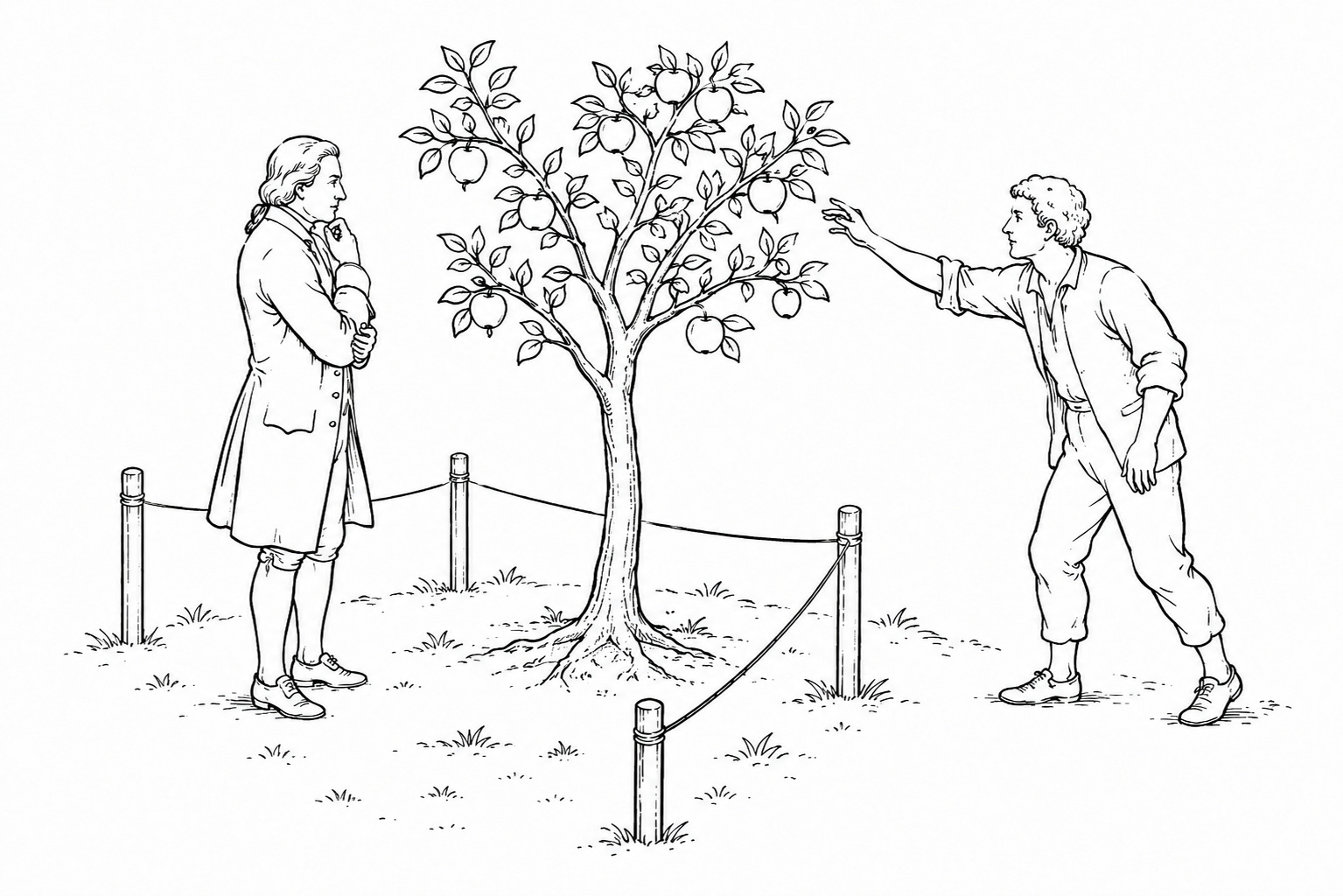
I mean, why is it that you should be able to exclude everyone else in the world — including the sick, the starving, and the seemingly well-deserving — from eating the delicious apples on your tree? What is it that grounds these exclusive and exclusionary individual claims you have over external things? What is it that generates these very serious and very costly moral obligations in everyone else? Locke asks these questions, pretty much straight up.
What answers to these questions could satisfy my deep liberal commitments to basic equal freedom and basic equal moral standing? Commitments I shared with John Locke!
After all, I don’t just mean ‘able to exclude’ in the sense of having the physical capacity to push other people away. Or the backing of the mob down the street. I mean, morally! Morally, on a world-view that’s committed to a liberal understanding of justice! So, what grounds moral property rights? What gives moral backing to legal property rights?
These were the questions I was obsessed with, back then. The permissibility of capitalism, which I really loved, depended on it!
One particular problem I faced was that many of the standard answers were either explicitly consequentialist, or, on examination, dissolved into consequentialist reasoning. You know the kinds of answers I mean. Things like, “But without property rights, we have no peace and prosperity!” Now, believe me, I’m into peace and prosperity. Yet regular readers will know my feelings about consequentialist reasoning.
One funny but useful thing about Locke’s approach is, of course, that he himself sometimes appeals to consequentialist reasoning! Even though, correctly, we generally remember him as someone who offered a different route. Thinking about this incoherence helped me to see the value, more generally, in dividing up arguments that can’t go together. It helped me to work out why you can’t be a little bit consequentialist. But I’ll return to that another time.
Back then, I divided up Locke’s relevant arguments something like the following way:
that the truths about the grounding of moral property rights can be found in natural rights;
that the truths about the grounding of moral property rights can be found in self-ownership;
that the truths about the grounding of moral property rights can be found in consequentialist reasoning;
that the truths about the grounding of moral property rights can be found in the common good.
And the conclusions I reached about these arguments were, broadly, the following.
First, that a Lockean natural right involving property only extends, at most, to the equally-held general potential right to acquire (some basic-needs-meeting kinds of) private property. And that this is most convincingly grounded, on a Lockean-liberal account, on a natural-law account focused on human reason and the human good.
Second, that while it makes sense, on a Lockean-liberal account, to conceive of people owning their selves and their bodies, it shouldn’t be assumed, as per standard interpretations of Locke, that this can be easily ‘extended’ to (help to) generate or ground the individual ownership of external things. Rather, that there is a convincing argument for this in only a very small set of cases. (Basically, umm, some separated body parts.)
Third, that while consequentialist reasoning is inimical to Lockean liberalism on various grounds, this doesn’t mean that the consideration of good consequences, such as those relating to societal prosperity, must be ignored in the Lockean-liberal case for private property. Rather, good consequences should be taken into account, but cannot suffice for justificatory purposes.
Finally, that while certain natural rights and obligations, grounded ultimately in urgent human need, do important work regarding a limited range of private-property relations in any societal situation, the power to justify an extensive system of private property, within political society, can depend on the moral obligations that correlate with legal rights instituted through legitimate positive law.
In other words, by recognition of a Lockean notion of the common good, cashed out through legitimate democratic processes, it is possible to justify a much more extensive property-rights system. A system that caters not only to concerns of urgent need, but also enables the Lockean dream of societal prosperity involving the meeting of an incredibly wide range of preferences.
Having come to these conclusions, I mostly stopped thinking about property rights. And I mostly stopped thinking about Locke. Okay, I’ve used some of this stuff in my writing about space. I’ve written various times, for instance, about the value of using insights from Lockean property theory to help to design an effective and morally justified property rights regime on the moon.
But the deeper problem I was struggling with entirely went away, and it no longer bothered me. I solved it, at least to my own satisfaction, with quite a lot of thanks to John Locke.
A few points on that chapter (on a plane, so I don’t have my books or notes):
1. One important premise of the chapter is that God gave the Earth to mankind, so that we’d have the necessities and conveniencies of life (as they used to say). Locke therefore thinks about the issue as a kind of interpretation. What’s God’s plan here? It can’t be that we’re simply forbidden from ever using the commons—then it would be a useless gift. So when are we permitted to consume/acquire? This is where the common good reasoning becomes important. It’s like a criterion for figuring out how God would have wanted it. It’s not an independent axiological principle.
2. The self-ownership argument is a non-starter for all the familiar boring reasons.
3. There’s a totally separate strand of argument that recurs in the first part of the chapter: an argument by elimination. Clearly, we may eat acorns and apples and such from the commons. The acorns and apples start out as common property and end up metabolized as part of our own bodies—so, private property. When does the transition happen? The only plausible moment, says Locke, is when you actually pick the apple or pick up the acorn or what have you—the moment of mixing labor. But notably this doesn’t tell you why labor should be special.
4. Why is labor special when it comes to letting you acquire? Again, self-ownership is a red herring. The deeper argument, which gets revised as he reworks the material, has to do with scarcity. God wants us to eat the acorns if nobody else would eat them (a Pareto improvement, in modern lingo). But what if someone hoards all the acorns, so that others starve? Scarcity creates a conflict of interests. This problem is sort of deferred by happy coincidence in early societies, where there’s no currency and trade, and thus no reason to hoard more than you can eat. But in a modern society, when the conflict is real, when should anyone get to own more at others’ expense? In a way, Locke’s answer is: never. You can own the land only if you improve it, thereby increasing the “common stock of mankind.” (Here Locke may be assuming that, if you own a lot of stuff, you’ll be willing to sell it to others, who prefer that opportunity to buy nice apples from your orchard to the pre-existing opportunity to forage the land for themselves.) So the special sauce of labor ends up being the contingent fact that Locke is always harping on: labor is how you improve your private holdings, and by sharing some of the improvements, that is how your having private property can “increase the common stock of mankind”—or as I’d put it, promote the common good.
Anyway, clearly I have some Locke thoughts bottled up. Thanks for the excellent, stimulating post!