


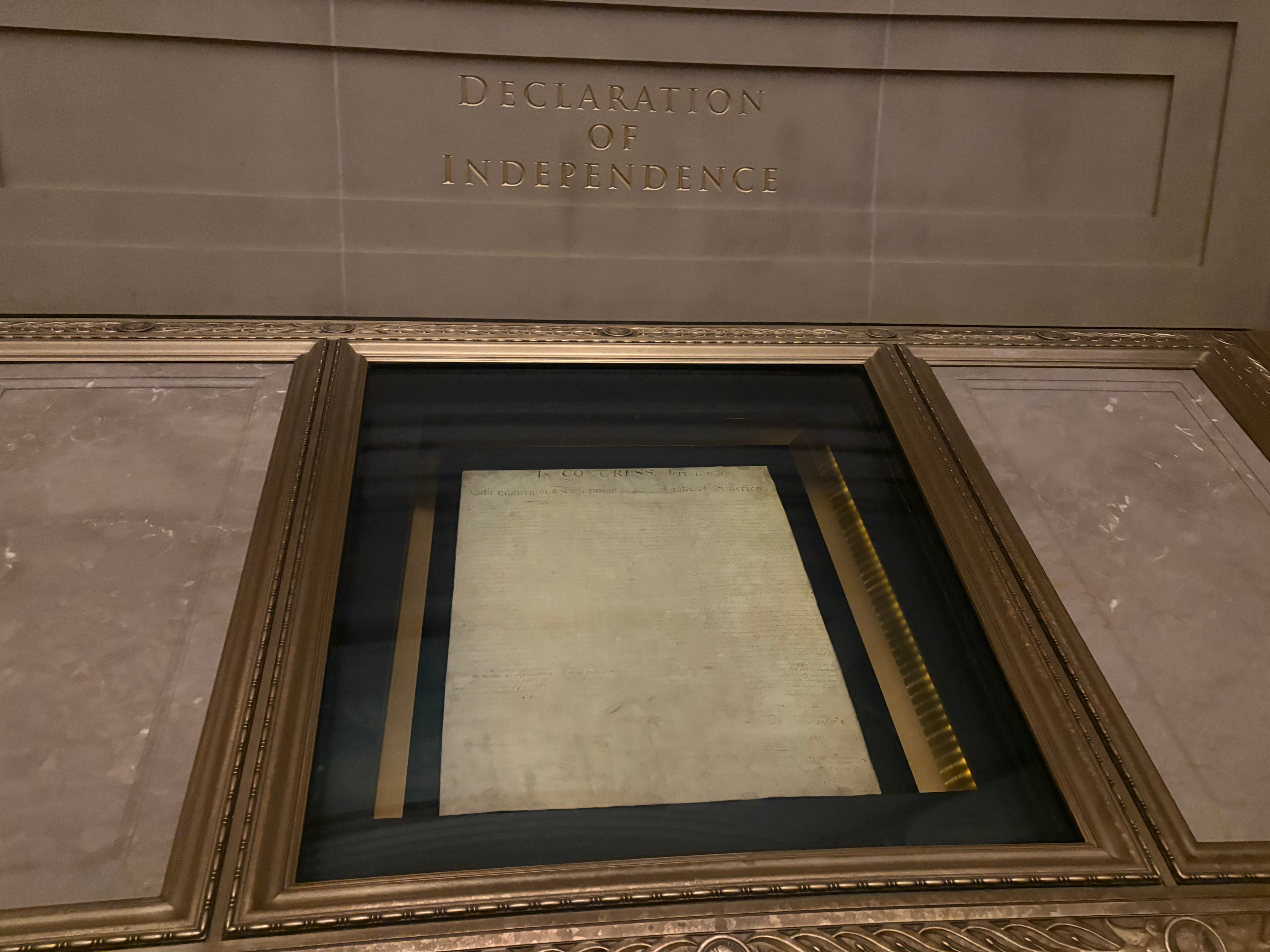
This is the lightly-edited transcript of some brief opening remarks I gave yesterday during a Mercatus debate about the Declaration of Independence.
I’m going to admit something to you, openly and freely. I’m going to admit that I love America.
This is hard for me — not because I’m an English person! But because I’m just not into the love of countries. I don’t buy the idea of patriotism. And, more generally, I’m a reluctant supporter of the state. I do think the state can be a force for good, but I’m persistently anxious of the overbearing state. I’m a pretty much a classic classical liberal, to this end.
I would never say that I love England! I’d never say I love the UK. So it’s kind of surprising to me, but here we are: I love America. How does this work? I was thinking about it today, and I have three brief points to make.
The first one is something like this. I love a load of stuff in America, which makes me want to live here, rather than in any other country in the world. Particularly, I love the pursuit of excellence. I love the enthusiasm. I am done with British cynicism and pessimism! So there are these things, these facts about America — particularly cultural norms — that I really love. And that means that I love living here, and I want to live here.
The second point, which you might tell me makes what I’m saying kind of trivially true, is that of course I love living here, because I’ve chosen to live here. I didn’t choose to live in England. I had it thrust upon me — like the rain there, every day! So maybe it just doesn’t really mean that much that I love America.
That said, this point about me choosing to live here brings me, I think, to my most important point.
I love America in large part because I love the social contract theory tradition. This is the theory that John Locke, I think, is the best exponent of. I find social contract theory exciting and interesting. It was the first thing I really got into in philosophy. I also think, though, that it’s good, and I think a lot of it is right. Particularly the John Locke stuff.
The central idea in the social contract theory tradition is that political authority rests on the consent of the governed. Or, as it’s put in the Declaration of Independence, “deriving just powers from the consent of the governed”. Now, I don’t want to be another of those English people coming here and telling you that your great founding document is actually just the work of John Locke! But he’s everywhere in it.
That fantastic phrase “the pursuit of happiness” doesn’t come from the Second Treatise of Government or one of the other political works. It comes from the great epistemology tract. It comes from Locke’s wonderful Essay Concerning Human Understanding.
But you see him everywhere in the Declaration of Independence. It’s got the natural rights talk. It’s got the right to revolution — I reread that bit in the Second Treatise last night, and it’s, like, practically word for word. I mean, guys, this is John Locke, all over the place!
I want to emphasise something, however, rather than going on about John Locke, anymore. Because in a similar way to how I don’t love countries, I don’t love particular philosophers. I want to emphasise that, yes, John Locke wrote about these things. But they are not John Locke’s things. Any more than they are America’s things.
The values underlying the Declaration of Independence — freedom, equality, justice — don’t belong to any place. Yes, you might find them here in America more than you find them in other places. That’s one reason I live here. And you might find them in John Locke’s work more than you find them in other people’s works. But they reflect truths about humanity; about what it is to be human. They reflect moral truths. So they are John Locke’s, and Americans’, only in a loose descriptive sense.
I love America, and I love the Declaration of Independence, not because of great phrases like “the pursuit of happiness”. But because America and the Declaration of Independence represent a commitment to the pursuit of moral truth. And there’s nothing more important to me — or for all of us.
Excellent post, but I have always wondered about the extent to which British cynicism is largely feigned, as a kind of guard against disappointed expectations etc.
An excellent examination of what comprises a country by Rebecca Lowe. It reminds me of Ursula K. Le Guin's Left Hand of Darkness, "How does one hate a country, or love one?"
Le Guin and Lowe are both exploring that the country is not the border, the boundary, or the land. It is the social contracts between people, and the organizations they create.
I am working on a piece about the forms of government humans will develop in space - subscribe so you don't miss it! What values will off-Earth people enshrine, and will they be foreign to what some hold now?