


Terminally Ill Adults (End of Life) Bill and Tobacco and Vapes Bill
Dying, Robert Nozick
Plants can sense the sound of rain, a new study finds, Jennifer Chu
Boutique Faith, Jeremy Waldron
Migration Series, Jacob Lawrence
This is the sixty-seventh in a weekly series. As with previous editions, I’ll move beyond things I’ve been reading, toward the end.
1) I spent some time this week thinking about two big UK political developments. First, the news on Friday that what’s generally referred to as ‘the assisted dying bill’ had failed to become law in England and Wales. This news came as a great relief to me.
I’ve written here several times about my strong opposition to the bill. In particular, I wrote a long piece about why I think it’s wrong to characterise the legalisation of assisted dying as furthering individual freedom, and another about how hard it is to protect against the so-called ‘slippery slope’ when designing such bills.
Here’s an extract from the former piece:
“The second reason I think it’s wrong to characterise last week’s parliamentary developments as furthering individual freedom is because they threaten a concerning increase in state power over the individual. Of course, overbearing state power is not the only threat to individual freedom. But it is a long-standing and serious one. And last week’s parliamentary votes threaten a concerning increase in state power because the directly consequent instances of assisted dying and full-term abortion they augur would be new instances in which the state endorsed, provided, or regulated the termination of human life.
This is clear in the case of assisted dying, at least as presented in the assisted dying bill. If the bill becomes law, then state-regulated medics will become causally responsible for the deaths of the people in England and Wales who undertake assisted dying. Of course, this causal responsibility will be jointly-held with the dying people, unless we shift to a Canada-style euthanasia model. This is because, as I’ve written about here before:
1) suicide is self-directed, 2) euthanasia is other-directed, and 3) assisted dying is both self-directed and other-directed. That is, all cases of both ‘assisted dying’, and ‘euthanasia’ involve the relevant physical actions of another person (or people) aside from the person whose death is the goal. But whilst in cases of ‘euthanasia’, it’s the other person alone who undertakes these actions (which is what happens in almost all instances of Canadian MAID), it’s always a joint enterprise in cases of ‘assisted dying’.
In this context, while discussion about assisted dying often centres on questions like ‘shouldn’t people in pain be allowed to end their lives?’, and ‘why should the state prevent them from doing so?’, those questions are really better suited to discussion about suicide. Whereas, the fundamental question to be asked in relation to both assisted dying and euthanasia is ‘do you have the moral authority to permit someone else to end your life?’. And only if the answer to this question is ‘yes’ can we then move on to whether such matters should be outsourced to the state.
As it happens, my view is that I can no more permit someone else to end my life than I can permit them to enslave me. But I don’t need to make that argument here. Rather, all I need is to emphasise that if the assisted dying bill becomes law, then the state will increase its involvement in the termination of human life, in terms of both provision and regulation, as well as effective endorsement.”
I won’t write any more on this topic today, except to say how much I hope this might be a moment of recalibration — and not just for people in England and Wales.
The other UK political development I spent time thinking about this week did not bring me relief. I’d almost forgotten the insane idea, first proposed by the Conservatives back in 2023, to introduce a year-of-birth-determined prohibition on smoking. Yes, you thought that through correctly! If you were born in Special Year X, and your friend was born in Special Year X plus 1, then it would fall on you to buy the cigarettes from the corner shop, even if you were both over the age of 100!
Or as a Reuters piece describes it:
“The Tobacco and Vapes Bill raises the legal age for buying tobacco by one year, every year, starting with people born on or after January 1, 2009, meaning affected age groups face a lifetime ban.”
Insane!
Now, I say I’d almost forgotten this idea. But it’d be more accurate to say that, even though I did know that Labour had taken the policy on, I had mentally relegated it away from the realm of real life, and into the camp of “Hey, this’ll make you laugh! Here’s the craziest piece of UK policy thinking ever!” So I was caught off guard, therefore, a couple of days ago, to learn that it is about to become law.
Here are my thoughts on the matter from 2023, which still hold. And which will continue to hold when I am 100. Unlike, I bet you a lot of money, this insane law.

2) Back on the topic of death, last night I read the Dying chapter from Robert Nozick’s The Examined Life (1989). Regular readers will know how much I enjoy reading Nozick. And this chapter, while light on through-composed argumentative value, is what the English People call ‘a real treat’. I mean, okay, if you want to read a short but properly serious philosophical inquiry into death, then turn to Nagel in What Does it All Mean? (1987). But Nozick is much more fun!
Anyway, here are a few thoughts on the substance of Dying. To his cost, Nozick ties together his thoughts about death with his long-time interest in project pursuit. You should be more “willing” to die if you have met your most important goals, he begins by suggesting. And, more convincingly, you should be less willing to die if you have not. He saves his most novel big idea for the final page of the chapter, however.
This is the idea that towards the end of an “ample life”, you might valuably consider choosing to do “more dramatic and risky” things to help younger people to further their ends. This idea, while building on several themes from the preceding pages, comes as a real kicker. That said, as with other moments in the chapter, it feels as if Nozick here is being both defeatist and undermining of the equal value of all human lives.
Don’t you know we’re going to live forever? (Okay, he does briefly discuss this possibility.) Why focus so hard on when the end will come? All these calculations based on time-limited predictions about the length of life! All this quasi-deterministic talk of “timeliness”! A moment of relief comes when Nozick remembers that we might, just sometimes, set ourselves new goals. But a question looms heavy, across the chapter, about the value of the lives of those unable to engage in project pursuit. A similar question looms in the moments where Nozick slips, without acknowledgement, from ‘what you think is important’ to what objectively counts as such.
Of course, Nozick didn’t live forever. He didn’t even live for as modestly long as he predicts in this chapter. That part is hard to read.
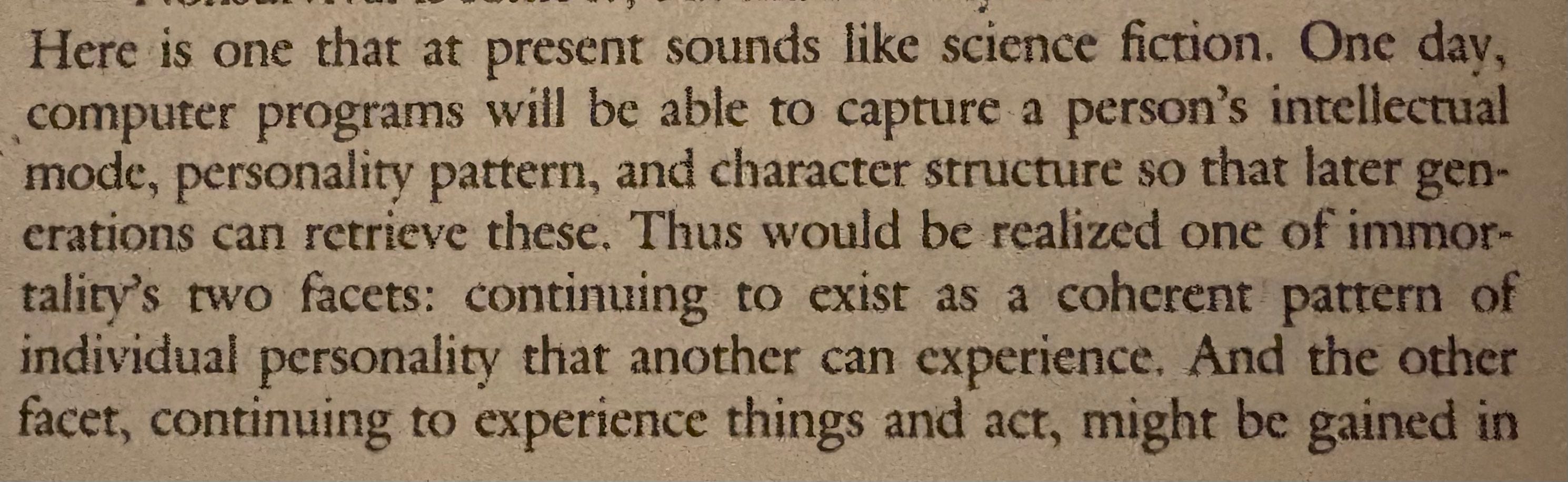
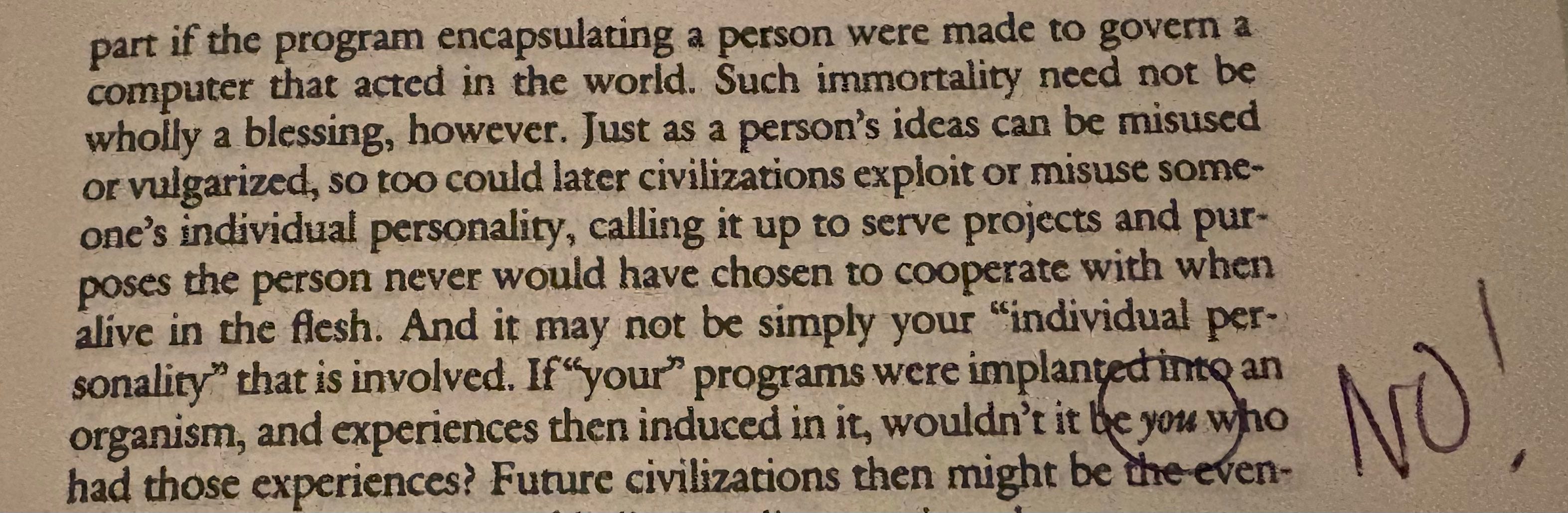
Dying is otherwise notable for this neat prediction about contemporary AI:
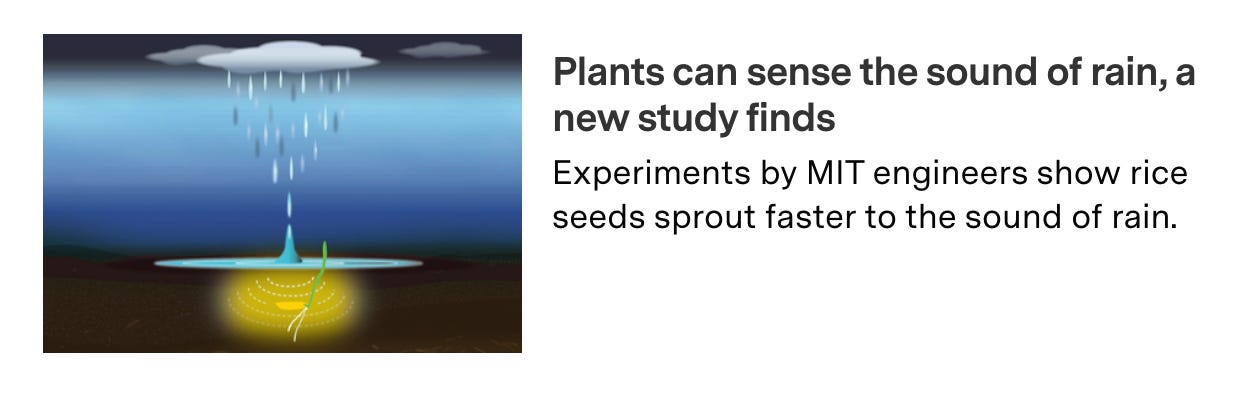
3) As I wrote here recently, I think we don’t talk anywhere near enough about our obligations to plants. I was excited, therefore, to read a recent MIT News story entitled Plants can sense the sound of rain, a new study finds. Sometime soon, I will read the study in question. But the news story annoyed me so much that I need time to recover. A plant seed being “jostled” by vibrations caused by sound waves is not the same as a plant seed “hearing” or “perceiving” or “sensing” sounds, even if the jostling causes the plant seed to grow!! Come on, guys.
4) A few days ago, I published the latest episode of my philosophy podcast, Working Definition. This episode is on the topic of equality, and it stars my excellent friend Teresa Bejan. Nozick makes a couple of appearances in the episode, including in this section:
REBECCA: […] That said, thinking about conceptual analysis, you just mentioned putting this stuff in historical context. How do you find, as a historian of ideas who is interested in conceptual analysis — how do you go about assigning weight to the different ways people have thought about concepts across time? And to historical definitions more generally?
So I mean, one concern I think I would have if I got really really excited about all the historical stuff is, I might fall into that trap of making historical facts into normative grounds. That’s something that I think, you know, Nozick in the theory of entitlement is entirely guilty of, for instance. I mean, it’s sort of the is-ought problem. But I guess my first question is something like how do you differentiate between the different historical conceptions, if one of the things you’re interested in is the historical context?
TERESA: It’s such a good question. And it’s something I’ve really struggled with in the writing of this book. And I, you know, I like to think I cracked it, but you know, maybe readers will disagree.
REBECCA: I have faith in you. My money’s on you.
TERESA: Well, because one of the things that attracts me to the history of political thought, because I’m not really — I wasn’t trained as a historian. You know, my undergraduate degree was a great books degree. I then did a master’s degree in intellectual history, but then did a PhD in political theory. I mean, I’ve always been happily in the kind of normative presentist camp.
But what attracts me to the history of political thought is just, I think often, is that it helps us recognise the not just conceptual change over time, but also the ongoing kind of politics of language. So one of the things that really interested me in the book was thinking about equality talk, if you will. So, sort of, what are we doing when we’re reaching for the language of equality? What is that language doing for us?
And so I’m trying simultaneously to keep one eye on kind of this, the development of equality talk. And then also to get ahold of all of these different conceptual relations that are being folded under that umbrella.
We also touch on Jeremy Waldron’s book, One Another’s Equals (2017). I’ve read quite a lot of Waldron, and particularly like his discussion of Locke on democratic deliberation (an under-discussed topic!) in The Dignity of Legislation (1999). My copy of this book is currently somewhere in the Atlantic Ocean, however, so you’ll have to wait for my substantive thoughts.
Meantime, while thinking about Waldron’s work today, I came across this 2006 LRB review piece by him, mostly focused on the question of whether we should value being exposed to ‘hate speech’. Waldron criticises the writer whose book he’s reviewing for lacking analytic rigour in addressing this topic. But while he, Waldron, sketches out the scope of such an approach, he doesn’t offer much by way of strong conclusions. It’s refreshing, however, to read a UK-press book reviewer explicitly engaging — indeed, prioritising engaging — with the book being reviewed.
And I enjoyed Waldron’s frustration at the cashing out of the First Amendment.
“It’s a strange dichotomy because, in other contexts, American civil liberties scholars have no difficulty at all in seeing a connection between speech and the possibility of violence. They point to it all the time as a way of justifying restrictions on citizens’ interventions at political gatherings. If Donald Rumsfeld comes to give a speech and someone in the audience shouts out that he is a war criminal, the heckler is quickly and forcibly removed. When I came to America, I was amazed that nobody thought this was a violation of the First Amendment. (Shouting comments at public meetings was another of my favourite pastimes when I was young and irresponsible.)”
5) Last weekend, I went to the Phillips Collection in DC. It’s one of my favourite galleries, anywhere. I love the Rothko room. But the room I value the most is the one with (half of) Jacob Lawrence’s Migration Series (1940-41). The series depicts the internal migration of black Americans from the South to the North of the United States, in the first half of the twentieth century. Lawrence shows landscape, industry, and transport, through careful geometric layouts and bold but dulled colours. He shows hardship tempering hope.

