


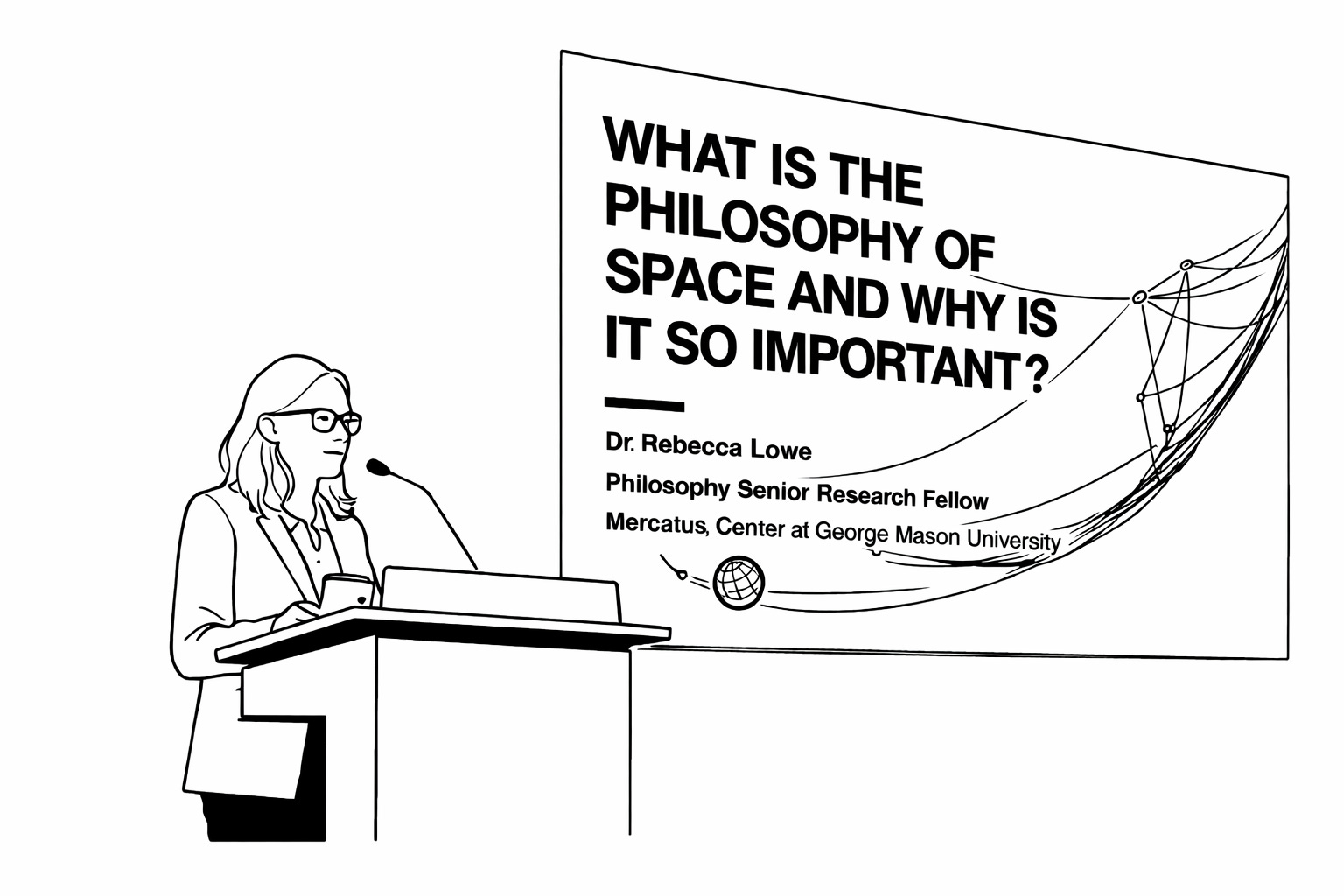
This is the lightly-edited transcript of a keynote talk I recently gave at the Flight Software Workshop at Johns Hopkins APL.
What is the philosophy of space, and why is it so important?
So yeah, I’m a philosopher. I don’t know how many of you are interested in philosophy, have studied philosophy, have thought about philosophy. As I’ll talk about in a moment, one definition of philosophy — or at least one definition of what it is to be a philosopher, or one approach to thinking about who counts as a philosopher — sorry, we philosophers fuss a lot about our language! But one answer is to say that everyone does philosophy. I think this is true on some level. I think as human beings we are interested in the kinds of questions that we philosophers think count as philosophical. But I’ll talk a little about some other ideas of what makes somebody count as a philosopher.
I’m also going to talk about what I see as an emerging field within philosophy — I’ll talk about what that might mean, too — which I think of as the philosophy of space. I’m going to talk about why I think it’s particularly exciting. And when I ask why is it so important, one answer to that could purely be that it’s intellectually exciting. Or it’s particularly intellectually exciting.
How do you become a space philosopher?
But let me start by telling you a little about how I got into doing this thing I like to think of as space philosophy. To calling myself a space philosopher! I was associated for a short amount of time with a very cool space firm that my friend Gabriel in England runs, and I had this title, Consulting Space Philosopher. One of the reasons I agreed to get involved was I thought I’m never going to get an opportunity to have such a cool job title ever again. So, I like to have this on my website, on my CV: Consulting Space Philosopher.
So, how did I get into this? Well, I’m a philosopher. I have a philosophy PhD. I have a philosophy job. Most of my friends who are philosophers have these cool origin stories about how they got into philosophy. It’s usually things like, I was on a train — sorry, this is a British person’s story — I was on a train, and I saw this beautiful girl reading this book by Nietzsche — it’s always Nietzsche, particularly if it’s a boy reading the book — and I thought maybe I should go and chat to them.
Another of my friends was, like, oh I bought this book — again, at a train station! I mean this tells us something about at least the kinds of British people that go on to be philosophers. So, I bought this book at the train station, and it was Plato’s Republic. They have these great stories. Or, you know, there was this visionary professor at college, and he told me I should take a philosophy class.
I don’t have one of those stories because both of my parents were philosophers. So I don’t really remember not knowing this term ‘philosophy’. Of course, knowing the term is very different from knowing what it means. And one of the really big questions in philosophy is ‘what is philosophy?’. We’re going to come on to that in a minute.
So I was always interested in philosophy, because I guess as a kid you have some kind of interest in what your parents do. Also our dinner conversations were highly philosophical. I grew up thinking that showing respect is making objections to your friends’ arguments, because that’s what you should do. I learned relatively quickly, when I got a little older, that sometimes your friends don’t like that. Which maybe then is a good way of choosing who your friends should be, at least if you’re like me and you like talking about philosophy.
So I rebelled against this — the family tradition, the family business — in the most middle-class English way you can imagine. By going to Cambridge to study music. This didn’t end up being much of a rebellion, however, because the thing I was interested in then was the philosophy of music, which is a branch of aesthetics. And then eventually some years down the line, I gave in entirely and did a PhD in political philosophy. I’m now lucky to work at the Mercatus Center at George Mason University, as a philosopher. I’m Philosophy Senior Research Fellow there, and amongst the cool things I get to do is run a philosophy working group. In fact, I gave a little preview of this talk to my colleagues, the members of the philosophy working group, yesterday. So any of the things I say that are wrong, you can attribute to them.
How did I get into doing the space philosophy, though? Whatever this thing is. Well, when I finished writing my PhD, which was on moral property rights — I might talk a little later about the distinction between legal obligations and moral obligations, similarly legal rights and moral rights. Back then, I was very interested in this question about why one particular person can be justified in owning something to the exclusion of everyone else. It seemed to me this was a very important question if you wanted to think about things like capitalism. I’m a massive instinctive capitalist, but I had this doubt about why is it that this particular person can be justified in excluding everyone else from this thing that they own.
Because it’s oftentimes not just the thing that you own — the particular thing — that you might be excluding people from. It might be access to that set of things. So, say there’s only one tree in the village, and you own the tree. It’s not just that the other people can’t own that particular tree. It’s that, at least if they stay in the village and want to own a tree, they can’t own any tree. There are some objections you might raise to that. But these are the kinds of questions I was very interested in.
So, I’d written this PhD on this stuff, and then a friend of mine at a British think tank — I used to work for various British think tanks — said, “Hey Rebecca, do you want to write something about property rights in space?”, because he knew that I loved space. One of the other cool things about having philosopher parents was that whenever they had an interest, or I had an interest, we’d have philosophical conversations about it. And my dad really loved space. He started off studying science, also at Cambridge, but then he shifted over to history and then philosophy. But he retained an interest in space all of his life, and he knew much more about the science of it than I do. I try to read that stuff, but he actually fully got it — as much as any philosopher does. We need help from the scientists most of the time, even him!
Writing about space as a philosopher
So I retained this interest in space, and remembered these great conversations I’d had with my dad. I also just think that if anything is inherently cool, it must be space. So my friend said, hey do you want to write something on property rights in space? You could apply some of this philosophical theory you’ve been thinking about and developing? And I was, like, yeah sure.
So I wrote this quite philosophically heavy paper for this British think tank, the Adam Smith Institute. And then because it was a bit of a ‘quiet news weekend’ — it was a weekend in the summer, with nothing going on politically — it got on the front page of a few newspapers, with these funny headlines. They said things like, ‘Economist says we should sell off the moon!’. Of course, my problem with that was not that the model I was proposing was actually a highly nuanced Lockean and Georgist renter supply and demand model, rather than the idea that technically we should sell off the moon. I was just annoyed that I got described as an economist rather than a philosopher. But most of my best friends were economists, so I thought I guess I’ll take that.
Then, good things came out of this. Aside from the fact that I have these copies of The Daily Star with my paper on the front page. If you know anything about the Daily Star, The Daily Star is famous for having celebrity gossip. It’s not a very serious newspaper, in the usual sense of serious. But because it’s the Daily Star, it turns out it actually has some pretty good stuff on space! Which is kind of funny, but anyway they wrote some stuff about my paper on the front of their newspaper. And then the FT, and some other more quote-unquote serious places started showing an interest.
And then from this I got invited to do some more space philosophy stuff, I wrote some more space philosophy stuff, and I made it a little part of what I do as a political philosopher. I think that seems like a reasonable thing, but even if it wasn’t reasonable I find it quite amusing.
You can see on the slide some of the other things I’ve written. I recently wrote a paper for the economics journal, Economic Affairs — I’ll talk about that in a moment — on the value of space activity. That is, what might be valuable for humans in doing stuff in space? I then wrote a piece for the American Philosophical Association blog on the value of private companies doing stuff in space — that is, people who are parts of private companies doing stuff in space. Also, my friend Casey at the Planetary Society, who gave a keynote here last year, invited me to be on his cool podcast. We talked a lot about philosophy in space. He’s a very philosophical guy, and you can see on the slide how to find it.
And then, a bit of the practical stuff I’ve done. When I worked for this investment company in the UK, I ran something we called a policy forum. This was an opportunity to get interesting people — politicians, academics, people from the companies that the investment company invested in — to get them around the table and talk about interesting things. So, I did one of these on space. That was kind of fun. And then at Mercatus, I’ve been running some — okay, so far I’ve only had one, but I’m going to run some more — space policy lunches. So, doing a similar kind of thing. Bringing people together, across what you might think of as the space community, to talk about interesting policy and philosophical topics. So, that’s a bit of stuff about me. I’m now going to turn to what this thing might be that I’m referring to as ‘the philosophy of space’.
What are the core philosophical domains?
First, just quickly to run through what we might think of as core philosophical domains. This, of course, is a massive topic of contestation for philosophers. People who do philosophy are just like people who do other things, in that they tend to have an over-interest in their particular interests. It’s a bit like, you know, you ask a problem about the world to a lawyer, and they give you a lawyer’s answer. If you ask a philosopher what the core philosophical domains are, they’ll say the domain that they work on.
But the traditional way of approaching this would be to say that the core philosophical domains are the following. Metaphysics — this is this question of what kinds of things exist in the world. Epistemology, which is usually described as the theory of knowledge. So, stuff about what does it mean to know something? What’s the difference between knowing something and believing something? Then, philosophy of mind, which is broadly the relation between the mind and the body, sometimes thought about in terms of the mind and the brain.
Then, logic. Wilfred Hodges, who wrote a very good book on logic — I looked at it this morning, to see how he defined logic. I’m sure some of you will have a much better definition than I could possibly give on this. I’m not a logician, although like most philosophers, I took some logic classes when I was studying. Wilfred Hodges says logic is the study of “consistent sets of belief”. I can think of some objections to that. It’s what we do as philosophers — we think about objections all of the time.
Then, ethics and moral theory, which is broadly how we should behave to each other. There’s a famous distinction, which the great English twentieth-century philosopher Bernard Williams talked about, here. He wanted to say that ethics and moral theory are different things. Whereas, a lot of people think they’re the same thing. That these terms can be used interchangeably. But broadly, some people think something like: morality, or moral theory, is around our obligations to one another; ethics has also these questions about what it is to live a good life. I’m personally pretty happy to use the terms interchangeably.
Then, political philosophy, which I guess is the heart of what I do, which is broadly questions about political society. There’s a lot of stuff about how do we get into a political society? What is the difference between being in a political society, and what some philosophers have called a ‘state of nature’? These kinds of questions are very interesting if you’re interested in thinking about space.
Next, aesthetics, which is broadly the study of beauty. It’s also to do with value. Sometimes, you group some of these philosophical domains in terms of what we call ‘value theory’. And then philosophy of language, and philosophy of science, bring us on to some of these ‘philosophy of X’ things. Philosophy of language, you can tell what that is straight away. And philosophy of science.
There are some other classic ‘philosophy of’ domains. Some of my jurisprudence friends would be a bit annoyed that I didn’t include philosophy of law in the core philosophical domains. Philosophy of law deals with things like what is the difference between law and morality. It’s a great philosophical domain. Then, philosophy of religion is about arguments for God, that kind of thing. And then I’m very interested in the philosophy of economics. On some level, my stuff about property rights you could think of as philosophy of economics.
Then, there are some newer topic areas of interest. I’m sure you’ll all know — have read stuff, even — about AI ethics. Sometimes, we think more broadly of the philosophy of AI. And there was a field which became quite popular in the last couple decades of the twentieth century called bioethics. Now, there is some debate about whether we should really think about these things in these ways. So, is bioethics something separate from ethics, or is this just ethics being applied to biological fields?
You can ask the same kind of thing about philosophy of space. In fact, one of the philosophers I talked with about this yesterday said, “Oh, but Rebecca, don’t you think that philosophy of space — i. e. the questions about stuff in outer space, stuff to do with outer space that is philosophical — aren’t they just exactly the same sets of questions that you’d ask about what goes on on Earth? Why do you need to call this the philosophy of space?”
So the flippant answer to this — which I actually think is a sufficient answer — is, look, I’m not trying to argue for a new field in the sense of, say, every university should have people doing this! Or indeed to say something interesting about some logical argument about the particular sets, and that there’s space for this set, or something like that. All I’m saying is that there is a particular set of coherent and interesting questions that obtain when we think about space, which can be called philosophical.
That said, I think there’s a better response to my friend’s good objection to me, which is that there are clearly some things that are quite different in space from on Earth. So, science fiction often tells us, for instance, about — or at least it describes, or tries to describe — what it might be like to live in space. I forget the name of it, but I’m sure you all remember the classic sci-fi book where there’s this interesting question about this set of people who’ve grown up outside of the laws of gravity, and they look different, they move differently, they have some other sorts of psychological characteristics which are different. That kind of thing, I think, points us towards why it might be useful to think about the philosophy of space.
But I think the point my friend was broadly getting at is that a lot of these ‘philosophy of’ domains depend on disciplines in themselves: science, law, economics. Whereas, the philosophy of space is a more locational thing. It’s a philosophy of a particular kind of place. So, a better comparison might be a ‘philosophy of America’, or a ‘philosophy of Spain’. But I’m not really sure we get very far going down this rabbit hole. So I’m perfectly happy just to say that space is something that people are increasingly interested in, and that we get new information about it at a very high rate, and that this poses a whole load of philosophical questions that people have not thought about before, which pertain particularly to space.
But what is philosophy?
At this point, however, I think I should roll back a tiny bit, because I’ve been using this word ‘philosophy’ a lot, and I already suggested that there’s quite a lot of debate about what philosophy is. As I said, I can’t remember learning the term ‘philosophy’. But I’m not really sure I could give much of a better answer, at least in a simplistic sense, to what philosophy is, than I could have done when I was seven or eight. I probably would have just given some answer my parents had said.
When my friends at school used to ask what my parents did — you know, their parents were doctors, or they had a shop, or they were lawyers, or these ordinary professions that everyone knows what they mean. ‘Ordinary’ is a sign of respect from a philosopher, by the way! At least if you’re an ordinary language philosopher like me. But I used to say, “My dad’s trying to work out what time is.” I used to like saying this, but generally the conversation stopped at that point. So it didn’t necessarily turn into a very good way for making friends.
So, I think three quick standard answers, at least to what is it like to be a philosopher — sorry, that’s a philosophy joke — or, who counts as a philosopher? This is a better question maybe to start with. I think three standard answers are the following.
First, there’s the very very narrow, philosophically elitist answer, which sadly quite a lot of philosophers hold. When you ask them, who’s a philosopher? Who counts as a philosopher? They’ll say, like, five people, working on metaphysics and epistemology, at about two or three universities. Probably American universities mostly, and they’re probably men. This isn’t a normative claim I’m making about this, by saying it in that way. So there’s a very very narrow sense, at least within philosophy, about what truly counts as a philosopher, who counts as a philosopher.
There’s also this very general sense that a lot of people would hold, which is that we’re all philosophers. Everyone’s a philosopher, because part of being human is to think about these philosophical questions. I don’t really have a problem with that.
But I tend to think a more useful kind of answer would be some kind of mid-ground. And it’s something like, who’s a philosopher? Well, it’s people who have philosophy jobs. And what is philosophy? It’s the thing that the professional philosophers do, and have done over the centuries since Plato and Aristotle, and some guys before them. It’s about a particular set of questions. A particular set of focuses. Particular kinds of methodology. I’m quite interested in that kind of answer. It seems to me quite useful. It might help us to scope out what the areas of inquiry are. I was implicitly doing this when I told you earlier about these core domains.
We can also look to some great philosophers, and see what they’ve said. So Thomas Nagel — a very important contemporary American philosopher — he said, and I wrote it down, because I wouldn’t remember it otherwise, that “the main concern of philosophy is to question and understand very common ideas that all of us use every day without thinking about them”. I quite like that, but I can think of some very obvious objections to it. I mean quite possibly there are philosophical questions which pertain to things that we use every day and we do think about them!
Then, my friend Robin Hanson, who’s written some interesting things about aliens and other space stuff, has said to me a few times that he thinks philosophy is kind of what’s left over from the other academic disciplines. I balked at that, when he first said it. But I think, on some level, this also gets into this idea of the ‘philosophy of’ thing that I mentioned earlier.
So, if it’s the case that you could actually imagine a ‘philosophy of’ of every other discipline — a philosophy of chemistry, a philosophy of biology, and so on. And this pertains to the kinds of questions which are interesting within those fields, but aren’t really the business of those people doing those things. Maybe questions about the concepts, for instance. So, I don’t know, if a physicist tells us some things about atoms, tells us some things about electrons. Philosophers might be, oh, but what kinds of things are these? How do they fit into the fundamental ontology of the world? The physicists might be, well, that’s interesting, but I actually just want to get on, and try to measure them — or try to tell us how they relate to each other in this more pure scientific sense.
I think this is getting on to something. Bertrand Russell, one of the greatest philosophers of the twentieth century, said some things about this in his great book, The Problems of Philosophy. So this is the first philosophy book I ever read. I say ‘read’ — I read it when I was about seven or eight, which means I read a few pages of it, and got very excited thinking about what a table is. Does a table exist? This was my first, I think, real experiment into doing philosophy.
So, Bertrand Russell says that philosophical questions are “questions to be studied not for definite answers but for the sake of the questions themselves”. I quite like that. He says these philosophical questions “enlarge our sense of what is possible”. This, to me, speaks of the kind of excitement you get from innovation, from entrepreneurship, from the idea that our knowledge expands, that there are always new things to be learning. As we start to learn more about our universe, we can ask interesting philosophical questions about that. I think that touches on why I find space such an interesting area of philosophical inquiry.
Russell also talks a little about this idea of when a scientific matter becomes a philosophical one, and vice versa. I think he says something like, there are these philosophical questions about all of these domains. At that point he’s talking about science. And the scientists kind of bat them off to the philosophers. The philosophers think about them for a bit. They solve them, and send them back to the scientists. I’m paraphrasing, but this is very very funny because, of course, philosophers rarely solve anything! The idea that we’d solve these questions, and bat them back to the scientists makes me laugh.
Although, I do think it gets on to something. And it also comes back to this idea, I think, of this mid-ground answer to who counts as a philosopher. The idea that there are certain kinds of questions, maybe certain kinds of methodological approaches, like conceptual analysis. I love conceptual analysis. What is this thing? Whether it’s justice, or equality, or consciousness. Sometimes, I think all I really do is think about concepts and how they relate to each other. I love that. It makes me very happy. One of my friends messaged me last night. He’s writing a book about liberalism. He said, “I’m going to send you my first chapter, if that’s okay?” I was like, “Yeah, I’d love to read it.” He says, “It’s very boring. It’s just full of conceptual analysis. But you’re the person I know who loves conceptual analysis more than anyone else.” I think this was an implicit criticism that I’m boring, but I’ll happily take it!
Why are there so many philosophical questions about space?
So why are there so many philosophical questions about space? I already gave some kind of answer, which is something like: we’re learning new stuff about space at a really high rate. Almost every day, you read new and exciting stuff about space. And, at least if you buy some of the stuff I’ve been saying, then there are new philosophical questions that are going to arise about this new knowledge, this new information, that we get.
I also have this idea — and I wrote a little bit about this in my piece for the American Philosophical Association blog — which is something like the following. If you were trying to think of something that every human being who’s ever existed was intrigued by, I think it’s hard to come up with a better answer — maybe you have a better answer, I’d love to know if you do, because then I need to address that in my future work — but I think it’s hard to think of a better answer than the stars.
It’s hard to think of any human being who’s ever existed, who was capable of going outside, looking up, and seeing the stars, who didn’t have some sense of intrigue, some questions about what these things are.
Of course, we know much more these days than the ancient humans. But if you think about comparable things — like, maybe you think, no, you can say the same thing about the sea or the mountains! Well, quite clearly some people existed who never saw the sea, or never saw the mountains. So, it seems to me that if you want to think about something that everyone who’s ever counted as a human had in common, then it seems to me like some point of universal intrigue might be the stars or space. Of course, some of those earlier humans didn’t get that the stars were in space, at least in the sense that we think of as outer space.
I think there’s also a very prosaic answer to why there are so many philosophical questions about space, which is it’s just very far away, and it’s really hard to know stuff about stuff that’s very far away. Therefore, we have all of these questions just about, like, where is it? What is it? How big is it? So that’s a simple answer.
I think also it allows us to do what we philosophers call thought experiments. This is this idea of coming up with some little scenario, to test some idea. Space poses really cool thought experiments, particularly for those of us thinking about property. I’ll talk about this in a moment. But I think probably the best answer is just this point about how we’re gaining new knowledge about space all of the time. And this enables us to come up with new and interesting philosophical questions.
Some philosophical questions about space
So what are some of these philosophical questions about space? Well, I mean, within the history of philosophy, we can think of some pretty good answers which track some of these domains. So, for instance, one of my friends at the philosophy group yesterday emphasised Thomas Aquinas’s cosmological argument for God’s existence. This is something like — this is very much paraphrasing — you can’t have something from nothing. It’s a very simplistic paraphrase, but that’s quite clearly an argument which has within it some sense of something bigger than Earth, some sense of the universe, some sense therefore of outer space.
There are also interesting questions about what some of the scientific discoveries of the 20th century — stuff about relativity, stuff about quantum theory — mean for some of these philosophical ideas like determinism. Determinism is the idea that, in some sense, for some reason, everything was determined, pre-ordained. There are very interesting questions about why that might be. So, some people are interested, for instance, in can you really control your actions in a world with physical laws? And some people are interested in even more, kind of, deep versions of this. Things like, if you act in some way because your beliefs have some impact on your actions, that seems like some kind of causal mechanism, therefore, do you really have control over your actions, if it’s your belief that’s determining them?
These kinds of questions, we philosophers are very interested in — particularly those of us who are interested in freedom. Are we ever really truly free to reason on things, and act on our reasoned outcomes? Quantum theory, and all of these interesting ideas which people got more of a handle on in the twentieth century, pose some interesting and important questions for those areas of inquiry.
There are also questions about translation. So one of the great twentieth-century American philosophers, Quine, made an argument about the indeterminacy of translation. Can we ever really know what people mean when they speak in different languages from us? This, of course, poses very interesting questions about what would happen if you ever met an alien!
And then, of course, as I already suggested, if you’re a political philosopher, and you’re interested in any sense about what the alternative to political society is — if political society is a society with laws and institutions — then what would the alternative to that be? This concept of ‘the state of nature’ — whether it’s a historical state or whether it’s a hypothetical state — space seems like a pretty good representative of a state of nature. So this is very very interesting for political philosophers.
Then, of course, there are these questions which track core areas of space development that we might think of. So, questions about the space economy. In my paper for Economic Affairs, I talked about why it’s so hard to work out the size of the space economy. Beyond that, space law is a developed field of law. And then, of course, space exploration: important philosophical questions come from this. There are some good people writing on these things, space law in particular. I like the work of Henry Herzfeld, who’s in DC. He came to my Mercatus policy lunch last year. That was great; I’ve enjoyed reading his stuff for a while. On the economics side, there’s a new book I’ve just been asked to review — I haven’t read it yet, so I can’t recommend it — by a guy called Rainer Zitelmann, who writes a bit about space economics.
That said, as I already implied, it’s a new and emerging field. And sadly, the world’s greatest philosophers have yet to really show much of a substantive interest in space, or at least at the moment. Although, as I’ve said, some of the great philosophers of the past did at least touch on this stuff. Things like spacetime and the universe. Einstein and Moritz Schlick, of course, thought about these things. David Lewis — a very very important, again, American philosopher of the twentieth century — thought a lot about possible worlds. I mean, in some sense, this is engaging with outer space, but that seems a little further away. Then, Carl Sagan, of course, the great hero of my friend Casey at the Planetary Society who talked to you guys last year. There are also some of these effective altruist philosophers, people like Nick Bostrom and Anders Sandberg, who think about existential risk and the value of living in space.
So there are some of these other kinds of questions. But the most stuff that’s being written from a philosophical angle around space is stuff about economics, law, and exploration.
Three particularly interesting and pressing questions
I’m going to finish by talking about three particularly interesting and pressing questions. These are particularly interesting and pressing at least to me. But I think more broadly they should be treated in such a way. The first one, which I already discussed a little, is this question about how property ownership should work in space. The second one, and this might seem like a bit of a leading question: how should human space experience be regulated? And the third one: what obligations do humans have to non-human life in space?
These are three questions that I’ve thought a little about, that I’m keen to continue thinking a little about, and that I hope more people will come to think about.
1) How should property ownership work in space?
So, property ownership in space. When we think about property ownership as philosophers, there are a couple of basic questions that typically people begin with, or focus on. Things like, what you need to do to own something — what you have to do to count as being the owner of something, philosophers might say. Then, to transfer something. Do you need to own something in some particular way to be able to legitimately transfer it to somebody else? One big problem here is what we think of as ‘initial acquisition’, or justified initial acquisition.
This is very central to all of the great works of philosophical theory about property. If you think about John Locke, if you think about Robert Nozick — another great American twentieth-century philosopher — they focus a lot on this idea of initial acquisition. And what they really mean by this is: what do you have to do to count as the owner of something that’s never been owned before, or at least never been owned by one particular person? There’s big debate about whether the things that have never been owned by anybody are therefore unowned — nobody owns them — or are commonly owned, in the sense of owned by all of the people in common. It’s a big distinction!
Nonetheless, the problem that arises, of course, at least if you’re going to think about this in any practical sense — and practical stuff is important, even for philosophers — is that everything on Earth has been claimed by somebody. Most of it has even been what we think of as owned by somebody. So even if you think about the grains of sand at the bottom of the Challenger Deep, the laws of the sea will tell us some stuff, or the outcomes of those things, about who, at least by some people, were deemed to own it, or at least to have made some claims over it.
And the problem is, of course, that when you try to get on to the later stuff like transferring stuff, you get all these little chains of ownership. This is a problem for thinking about justified ownership on Earth. So, let’s imagine that your granny gives you a painting. You’ve always loved this painting. It’s been in your granny’s house since you were a kid. You always wanted it for your house. You go to see her, and she says, “Hey, I’m giving you the painting.” You’re very happy. You invite your friends around to see it. And then a year down the line, you discover that your granny’s brother stole it from the next-door neighbour! This is problematic. It’s problematic because did your granny ever really own it? Should she have counted as having given it to you? Do you own it?
And, of course, there is almost a bigger problem, which is that we sometimes don’t even know about these things. So maybe her brother didn’t steal it. Maybe her brother bought it from somebody, and maybe they bought it from somebody else, and they bought it from somebody else. But then you just don’t know what happened before that. Maybe you know that originally it was painted by this person back in 1723, but you just don’t know what happened for about a hundred years. This seems problematic, at least if you’re saying that initial acquisition is important to ‘just transfer’.
One of the great things, of course, about space — as you might have guessed, this is where I’m going — is that, at least in terms of land in space, nobody’s ever legally owned anything. And you can argue that, at least for a lot of land in space, nobody’s even got any moral claims over it. The legal point arises from the big Outer Space Treaty, which I’m sure you know about, from 1967. This came about because JFK was increasingly concerned about things like nuclear testing in space, and the development of nuclear weapons in space. He gave a big speech to the UN, and then effectively this became the kind of grounding of this big Outer Space Treaty, signed by all the important spacefaring nations. It’s been in place since then, and it famously outlaws the ‘national appropriation’ of space — or at least of the ‘physical domain’.
There is a lot of debate about what this means, but if you believe that international law holds — and a lot of philosophers have questions about that, or what it really means, what it is to be morally binding under international law — at least technically in a legal sense, you can’t appropriate land in space. Now, of course, since then, we have all kinds of new technology that wasn’t even conceived of back in 1967. And all kinds of incentives to own land in space — for economic gain, for the advantage of innovation, for the advantage of acquiring new knowledge. But it’s outlawed. Okay, let’s change the treaty! Well, that’s pretty hard. As you might have noticed, some of these spacefaring nations are not exactly friends at the moment. Some of them are at war. Some of them are in proxy wars with each other.
There is one other way that you could change international law, rather than just making a new treaty, or changing an existing treaty. And this is something that international lawyers think of as developing peremptory norms of international law, jus cogens norms. This is the idea, broadly, that if enough people do stuff in a certain way, or enough nations do stuff — okay, nations don’t do things, but people from nations do stuff — in particular ways, then international law can change. So there’s a cynical argument which says that this is the goal of the Artemis Accords. If the Artemis Accords mean that people start behaving in certain ways, then international law might eventually change.
There are also some interesting points to be made about comparators with space law, like law of the sea, which I don’t have time to discuss. Beyond that, I’ve written a little about how space, as this kind of natural thought experiment where people don’t own things morally or legally, can enable us to think of alternatives to the ways in which people have claimed stuff on Earth. It could offer us some alternatives, for instance, to ‘first come first served’, which has some philosophical problems morally, but also economically. If it’s just the case that you are the first person to land on Mars, therefore you get to own everything on Mars, there might be some pretty serious economic opportunity cost, because we know that competition over stuff can drive up standards, can enable us to innovate. So, there are some very interesting philosophical questions that arise with this kind of blank slate.
We also might think that this would enable us to test out the value of the ways we do stuff on Earth. So, if there’s another way to go about justifiably owning stuff, then we could compare what we do on Earth, and it might teach us some things about the flaws of the ways in which we do stuff on Earth. But really, we’ve got a small amount of time as philosophers — as interested people in the world — to think about how you might go about setting a justified and effective property rights system in space. And that’s really because pretty soon — you might even argue, already — people are just going to land grab. And once people have grabbed the land, then you’re going to get all of these questions that you have on Earth, about these chains of ownership. And you might think that land grabbing isn’t justified, but those people are still going to have some claims. And then we get into some of these problems about transfer.
So, I think there’s a small amount of time for people on Earth to think philosophically and deeply about what it might mean to justifiably own something in a place where nothing has ever been owned before. In my Adam Smith Institute paper, I come up with this Georgist supply-demand rental model. You can read it, if you’re interested. This is not me suggesting this is the way to do it. It’s me suggesting, hey, here’s one way you might go about doing this. But my main argument really, in that paper, is that we need to think about this stuff now. What would be justified? We’ve got a limited amount of time to do this.
2) How should human space experience be regulated?
The second set of questions I’m particularly interested in are these questions about how human space experience should be regulated. What do I mean by this? What I mean is, are there questions about how we should behave in space, or even behave in terms of doing stuff that enables us to go into space? And who should be in charge of controlling that?
Now, you might think I’m posing a leading question here, implying it should be regulated. But, of course, while when most of us hear the term ‘regulation’, we think of state actors imposing some standards, there’s also just the most standard and simplistic and ordinary sense of regulation, which is self-regulation. So when I see my friend and they look a bit of a mess, I self-regulate. I don’t say, “hey, you look a bit of a mess!” I might instead say something like, “how are you feeling? How you doing?” Because maybe I’m concerned about them. So regulation isn’t just at the jurisdictional level of the state.
But why does space experience matter? This seems like a prior question to ask, to the question of how should human space experience be regulated. So, in this paper I wrote for Economic Affairs, I argued that doing stuff in space, being in space, doing stuff which enables humans to get into space, can enable us to access some basic human goods. Things that are irreducibly, objectively good for human beings — things like knowledge, achievement. People might also say something like, well, we’ve got an interest in space. They might even say we have a right to experience space — a right to go into space. Then, of course, I already touched on the vast economic value of doing stuff in space, which only grows as new technologies enable us to do more things. Then, there’s a whole big set of questions about the militarisation of space technology.
All of these things point to space experience mattering in some sense for human beings, individually, and as a group. And this comes on to this question of how we should regulate this stuff. So, I already implied that there are different levels of regulation, in the sense of who, if anybody, should be setting some controls — some limits on what we do in space. The most obvious and important jurisdictional layers here are the self, and the group, and then the community, the nation, and then of course the international level. So, all of humankind! It’s hard to think about how we reason together as all of humankind. International law, and its institutions, at least attempt to try to do that.
Now there’s something my lawyer friends love to talk about which they call ‘law of the horse’. This is the idea that — it comes back a little to my friend’s question about isn’t philosophy of space just philosophical questions from Earth in space? So similarly, lawyers sometimes say when people come up with new laws, hey, but there are already laws that cover this! So, imagine somebody for the first time kills somebody intentionally by putting a banana skin on the floor. They put the banana skin on the floor, knowing that the person has bad eyesight or it’s dark. They slip over on the banana skin and they die. Someone will say, “We need a law banning people from killing people using banana skins!” And the lawyer is going to say, “Law of the horse, man. There’s already a law against killing people.”
Similarly, you might think, well, a lot of this regulatory activity already happens, it already pertains to the kinds of activities on Earth, therefore can’t we just apply that to activity in space. Some of these questions arise again, though, about things which are, or seem, different in space. I read a paper about a year ago — it wasn’t a very good paper — about sex in space. And the broad argument of this paper — I’m very much paraphrasing and trying to make fun of it — was that because we don’t really know what would happen to people who are conceived in space, therefore people should be banned from having sex in space! Hilarious. There weren’t any philosophers, I think, involved in writing this paper. Philosophers really like thinking about stuff like unintended consequences.
But it seems quite clear nonetheless, even though this wasn’t a very good paper, that there are different questions that arise, different problems that arise, if somebody is conceived in space than if they’re conceived on Earth. Therefore, you might at least want to think about the possibility of whether some regulations, some new regulations, are relevant.
There are, of course, some classic costs at least to over-regulating, in terms of constraints on experimentation, on innovation. Sometimes, some places — the EU, which is a thorny area for British people at least — but the EU, if I can be allowed to make one critical comment of them. They sometimes like to say things like, we specialise in regulation! Regulation is our special thing! You want to come to Europe because we do such good regulation!
Now, there are of course some advantages to stuff being regulated. Sometimes it enables us to access opportunity, in the same way that systems of property rights can enable us to trade better, have more information. Regulation sometimes prevents us from being exploited, when we don’t have access to good information. But nonetheless, it can be the case when things are over-regulated that there are costs to experimentation and innovation. Particularly, this can be a threat to emerging technologies. People think about this a lot in relation to AI. Of course, they think about this a lot in relation to space.
3) What obligations do humans have to non-human life in space?
And then finally, a third set of questions I’m particularly interested in are about the obligations we have to non-human life in space. So, we have new information or we’re increasingly gaining new information, about whether there could be living things in space. So the more we learn about water sources on Mars, the more we learn about the shrimpy things, the potential shrimpy things, on the moons of Saturn, the more it seems that we should take seriously the questions about whether there could be living things in space, or whether there are.
Now, one of my philosopher friends said to me yesterday, “Oh, but Rebecca, come on! The kinds of yeast and bacteria you are really talking about, you know, are you really going to suggest we have obligations to those things?” Well, aside from the fact that if those things exist, it seems to give us some kind of indication that other kinds of things could exist — well, yeah! Actually, I think one of the most, maybe controversial, but I think very reasonable views I hold, is we don’t think enough about whether we have obligations to plants.
I don’t really mean by this that I think I need to apologise to the plant when I tread on it. But it’s a living thing. And we very rarely think about what this really means in terms of our interactions with it. So, for instance, maybe you cut down the tree in your garden, and you’re thinking about what does this mean in terms of obligations. You might think of things like, well, there was this family before who planted the tree, and they have some interest in that tree existing. You might think, well, is this going to have an impact on my neighbour’s view? Maybe it’s a nice view, seeing the tree from the neighbour’s house. But rarely, in these kinds of deliberations, do we take into account what we might think of the interests of the tree. Most people probably don’t even think the tree has interests.
I think there are some philosophical questions about that. And I think the same kinds of questions arise about all kinds of living things. Philosophers often go on to second-order matters when they think about obligation. They think about things like, does something have to be intelligent for us to have obligations to it? Does something have to be sentient? Does something have to have consciousness? But I think there’s something much more fundamental, which is what does it mean to be a living thing? Are all living things within the domain of obligation?
Some useful comparands to non-human life in space could be non-human animals, natural resources — so the living parts of them, so the bacteria in the river, the trees in the park — and AI, of course. These comparands are useful partly because they can also help us to learn stuff about being human. Oftentimes, like I said, philosophers spend a lot of time thinking about the relations between different concepts. If we want to think about why do I have to behave towards humans in a certain way, you might want to think, well, why do I not have to behave towards non-humans in that way?
If I push you off the cliff, it seems like I’ve done something bad and wrong. Wrong, at least if I was intending to. If I push the rock off the cliff, most of us are going to think, I haven’t done anything bad. I haven’t done anything wrong. Why is that? The basic answer we might start with is the rock isn’t alive. But then we start to think, well, what about the insect, the wasp in the jar, the beetle in the box as Wittgenstein liked to think about. Am I doing something bad and wrong, if I throw the box with the beetle in off the cliff? It seems to me like a whole new set of questions arise that didn’t apply to the rock. But maybe we want to say that some of the questions that arise when you push the human off the cliff don’t apply to the beetle. Non-human life in space is going to give us another comparand.
Then, we can come on to these distinctions between different kinds of obligations. So I already implied that there’s a difference between a legal obligation and a moral obligation. Legal obligation is an obligation that is imposed upon us by positive law, human-made law. Moral obligations are things that relate to truth of the matter about morality. This comes back to our question of regulation. If we come to think that these non-human living things, if they exist in space, are the kinds of things we have obligations to, does that then mean that we should, that we’d want to, enshrine some of this stuff in law? A whole new set of questions then arise about what kind of law, who determines the law — we need our jurisprudence friends back!
Why does the philosophy of space matter?
I’m going to finish by coming back to the question I posed at the very beginning and in the title of this talk. Why does the philosophy of space matter?
So, I think just as a matter of fundamental human interest, this thing that Bertrand Russell said about philosophical questions “enlarging our sense of what is possible” comes back to this point about natural human intrigue and interest in space. It’s just interesting in itself. If we believe that knowledge is one of these basic human goods, there are certain kinds of questions, philosophical questions, that arise when we learn more about what there is in space. Philosophers are good — or are supposed to be good — at certain kinds of thinking, certain kinds of thing like, as I said, conceptual analysis. So we can bring something to these conversations. And some philosophers, at least, have a particular commitment to searching out the truth.
I think there’s also a sense in which good philosophical thinking can provide a counter to the conflation between descriptive matters and normative matters. Descriptive matters are things about what there is, what is the case. Normative questions are about what should be the case. Sometimes you see these conflations when, for instance, somebody says something like, “Look, in that country they kill children on Friday. They’ve always done it.” That’s a descriptive matter. Some people then are like, “Well yeah, therefore that’s okay.” There are some arguments you can make which transfer from saying it is the case, to it should be the case. But sometimes people just assume they’re kind of the same thing — that because things do happen like this, have always happened like this, therefore they should. This is a dangerous conflation.
I’m very interested philosophically in a set of questions that arise about emerging technology in terms of the relation between possibility and permissibility. I’ve written a few times on my Substack about things like if we had artificial wombs, what would this mean in terms of our obligation to foetuses, to women? Suddenly, something becomes possible, and we have a whole new interesting set of philosophical questions about permissibility. And if we conflate those two things, we’re at risk of doing bad.
Substantively, the philosophy of space matters. And I’ll use my three sets of questions as examples here. First, it matters because space is a source of world-changing opportunities and threats. This comes back, for instance, to the property rights questions. Second, because space is a special source of human goods. This comes back to these questions about why is it valuable to do stuff in space. And finally, because it’s a test of human boundaries. So, in this sense I said that if we can have a new comparand with what it is to be human, in terms of non-human life in space, this might tell us some things about what it is to be human.
There are also a couple of inside-baseball things about why the philosophy of space matters. It’s an opportunity for us philosophers to apply philosophical theory, and to test and develop philosophical theory. This makes us very excited. Non-philosophers might be slightly less excited by that, though!
Thank you.
Q&A
Question: Can you comment on the utility of rigidly defined areas of doubt and uncertainty?
Rebecca: Oh wow. I mean, I’m pretty much a broad philosophical skeptic in the tradition of David Hume. I’m very uncertain about certainty. There are very very few things I’d be happy to say I know them. But David Hume also teaches us that maybe you just have to accept some stuff, otherwise you never get on and do anything. So rigidity around certainty and uncertainty, I’m kind of happy to leave that broadly to the epistemologists. I like reading their stuff, but particularly if I want to do political philosophy, I just have to take some philosophical stuff on some level for granted.
In the same way that if I want to think about, I don’t know, interesting economic questions about payloads and rocket ships, I need to believe that the rocket ships exist. There are interesting questions for the metaphysicians, and believe me I love metaphysics. But if I want to get on to the economic questions and the politico-philosophical questions about rocket ships, I’ve kind of got to believe they exist. Similarly, if I want to think about this idea of new domains of knowledge, I probably have to think knowledge exists, or at least some particular special kind of belief, which has some extra purchase in terms of giving us access to truths about the world.
I also think I think it’s very important to note the distinction between believing that there are truths of the matter about certain things, and believing you have any kind of purchase on that. Believing that there are truths of the matter, for instance, about morality does not give you any special purchase into knowing what those truths are. This distinction between metaphysics and epistemology broadly is very important. But we don’t get very far, particularly in terms of these important questions about how we should treat each other, if we don’t think that there are truths, if we don’t think there’s knowledge.
I can’t really give much of a better answer than that. This is a question that has perplexed philosophers forever. If someone in the room can tell me what knowledge is, I will be very grateful. So I think that’s the best I can do to that.
Question: Thank you for space philosophy 101. I know you kind of talked a little bit to this when you mentioned the law of the horse and maritime law, but how do you generally feel about using things like philosophy of European expansion in the new world, or later American Western expansion, as like a first pass first base? And then quick question, did your dad ever figure out what time is?
Rebecca: You know, man, I wish he had. Sadly, he died when he was kind of in his philosophical prime. He had a lot of questions still to answer. He was starting to write about essence and all kinds of things. He did have some interesting complicated views about time, which I like reading. His name was Jonathan Lowe, E.J. Lowe. You can go and read his stuff. I think it would be wrong for me to say he solved this question. But maybe he got a little closer than when I was a kid.
In terms of the analogies with the frontier, with expansion, European expansion in the new world, these kinds of questions. Yeah, I think these are very important analogies. One important difference, of course, though, is this point around there were already human beings there. So a good starting point, I think, in some of these questions can be considered the difference between Australia and New Zealand. Australia famously was thought of as terra nullius. For these very horrible reasons, people thought that the people who lived there already didn’t count, to do with what their activities were and, the kinds of things that they were producing. Whereas expansion into New Zealand treated the existing people in a different way.
Like I say, one advantage, at least until we know the truths about these shrimpy things on the moons of Saturn, is at least for now we think that there isn’t life at least on the moon, for instance. I think this enables us to bypass some of those problems in a way in which no human being has pretty much ever been able to do before. Whoever the original person on Earth was — I guess this comes back to these questions about something from nothing — maybe they didn’t have this problem. But some of the moral atrocities that took place owing to certain humans thinking that other humans didn’t count in terms of their property claims, in terms of their interests and their rights, I think we can think more sharply about that when we have the comparator of a place where nobody has ever lived, before. So yeah, I think it’s very important and I’m glad you brought it up.
Question: Next one is actually a compliment and comment that your slides are simple, clean, and elegant, before we go to the next question.
Rebecca: Oh, that’s so nice. I mean, no better compliment can ever be given to a philosopher than simple, clean, and elegant. We like to make our arguments as clear as possible because then we’re most likely to win the argument.
Question: It would probably take a whole lecture, but just curious to hear a few words on your thoughts on where we should go for space property rights. Where we should go?
Rebecca: Well, I mean, I’m biased towards the solution I put forward in my Adam Smith Institute paper. That said, it was very much just a basic philosopher’s attempt at answering this. I came up with this idea whereby people can effectively, or people from certain nations can effectively, temporarily rent plots of land on the moon. I came up with some kind of system for determining how you’d price this. I mean very very, simplistically — the economists would need to work out how you’d cash that out. That’s a philosopher’s joke. The lawyers would need to get involved in terms of — I mean, I kind of just snuck into my argument — we philosophers sometimes smuggle stuff in — the idea that it would already be divided up into areas where certain nations had some kind of degree of control. I also have this idea of this fund that you’d effectively pay rent to. Again, I’m going to need my international lawyer friends to work out how you set up such a thing, or at least they’re going to want in on that. So I think there’s a lot of work to be done just on my particular answer.
I’d love to hear substantive alternative answers. Not so much in terms of the details of cashing the stuff out. But just how do you fundamentally go about doing such a kind of thing. And particularly I do have this particular interest in some of the costs of the standard ‘first come first served’ model, and how you would address other alternatives at a time when nobody has claimed anything. I find this very philosophically interesting. I’m really surprised that more philosophers aren’t interested in this stuff, particularly the people who are interested in property theory.
I’m more generally surprised that philosophers aren’t interested in this stuff. I had a philosophy intern at Mercatus last year. I found this very funny — I’ve never had an intern before, as a philosopher — I’m not sure many philosophers have had interns. Oftentimes, interns help academics or other theorists with their research. The idea of philosophers even doing research sometimes sounds kind of funny. But one thing I did ask this guy, who was absolutely brilliant, to do for me, was: can you go and find me some good philosophy about space? And I said, David, the conditions you need to meet are I’m interested in good philosophers writing about space, not non- philosophers doing good philosophy about space. And it was very very hard to find any leading philosophers writing anything about space.
This bemuses me. I mean, maybe there’s the unknown works of Bernard Williams on obligations to aliens. I haven’t found it yet. So I’m hoping that as the scientists, the engineers of the world, take us further into space, help us to acquire more knowledge about space, that the best philosophers in the world will become as interested in this as I am.
Question: So the question has two parts. Can you speak to the ethics of terraforming Mars? And the second person is asking a related question: given possible economic activity in space, for example the moon and Mars, what do you think about the question of colonialism? Can we live and work in space and avoid colonial issues of the past?
Rebecca: Wow, big questions. The ethics of terraforming. One thing I haven’t actually touched on, of course, is whether we have obligations to the environment — to the world around us, the non-living parts of it. Typically, when this is addressed on Earth, you probably think about it in terms of other humans. So, you might say things like, you shouldn’t build on the Grand Canyon, because humans have the right to go and see it, or humans have an important interest in seeing it.
But there are also just some interesting philosophical questions about whether, in some sense, we can owe stuff to the natural environment in itself. If you’re religious, you might say God designed the Earth in this way, therefore you should respect it. Of course, there are interesting questions about the ways in which animals, non-human animals, relate with the Earth. But most of the questions that arise are in terms of how we should change the Earth. So, when we think about terraforming places on the Earth, these are questions around our obligations to other humans or other living things.
Therefore, when people change or leave stuff, alter land mass in space, or indeed put stuff out into space itself, like the big space junk question — I haven’t addressed that at all today, though I’m very interested in that — we tend to think really about our obligations with humans. You might say, look, this debris is dangerous to astronauts. It makes it harder for astronomers to view stuff. This is a thorny question. So most of the questions that are going to arise about, for instance, terraforming Mars, as the questioner asks, are going to be questions about what that will mean for other humans. Unless, of course, we discover that that water on Mars has living things in it. And then we’re going to also have to think about what that means for them.
And then the second question: economic activity in space and colonisation. Well, like I say, the one advantage to this is, at least as far as we know, nobody’s already there. I’m very hesitant about making historically contingent arguments — these ideas that because things have happened in the past, therefore they’ll happen, again in the future. Partly because of some of my shared views with David Hume. I don’t normally find myself agreeing with David Hume, but I’m going to agree with him on this. There’s the problem of induction. Just because the sun always rises, does that mean the sun will rise again? Just because every time you hit the billiard ball it moved in this way, doesn’t mean it’s always going to do that.
I think particularly thorny, though, is the idea that just because humans have behaved in one way, therefore humans behave in the same way. Unless you’re some kind of determinist, although a pretty complicated determinist. So, I think the questions about what we should do are still very very live. They’ll remain live even when we do more stuff in space. It’s never too late to change our behaviour. But we have a particular opportunity at the moment to think about what we should do. And as humans, I think this is an obligation, partly to prevent bad behaviour of the kind we have seen on Earth in the past and today.
Question: Sometimes I’ve heard from friends, why are you going to space? We could be spending these billions of dollars on curing world hunger. And to which I’ve sometimes responded, why are we going to Taylor Swift concerts? We could be spending these billions of dollars on curing world hunger. As a philosopher of music past, could you comment on maybe an overlap between doing things like music and space exploration?
Rebecca: That’s a great question. I mean, of course, one of the great human arguments for knowing more about space is that space is beautiful, as is music. Maybe we have some natural instinct in doing things that produce beauty, or enable us to experience beauty. There’s something called the naturalistic fallacy, which means just because something’s natural doesn’t mean therefore it’s valuable. But I think there are interesting comparisons with music and space, in terms of beauty.
Although, of course, an important distinction is that most of the things we think count as music are intentionally created. They’re created by humankind. They’re artefacts of some aesthetic sense. Whereas, the beauty of space is natural. I was reading the other day this very good paper by my friend Tim Crane, who’s an excellent English philosopher, about whether wine counts as an art object or an aesthetic object. And he makes these nice distinctions between things that are artefacts that are beautiful, and things that are non-artefacts that are beautiful. So I think there’s something there.
I should probably wrap up, but we could talk some more. I think it’s a great question. And you’ve helped me to think about how my early interest in aesthetics can be relevant to my interest in space philosophy, so thanks for that.
I am going to give this a fuller reading bc it sticks in my head that there's a lot to be sayd about the topic, as much as that what you're talking about is not philosophy of *Space*, but philosophy of *Place*, which dissolves the discrepancy imo. That puts the philosophy in scope of our relationships to space, not space per-se.
Philosophy of space can be summed up as such:
Actuality - the universe as it is beyond the perception of a mind, is infinite undifferentiated change. The experienced, usually measured, aspect of that change is time. Space is an aspect of time - how much change is required to move between stable patterns.
Together, time, space, and scale are the three primary dimensions. Scale is an aspect of space - how much space is encompassed within a stable pattern.
Philosophy of property rights, which, like all things, inherently has an aspect of space involved, is not a philosophy of space. Likewise ethics of space is not really philosophy of space.