


This is the tenth in my series of short, quickly written, weekly philosophy essays.
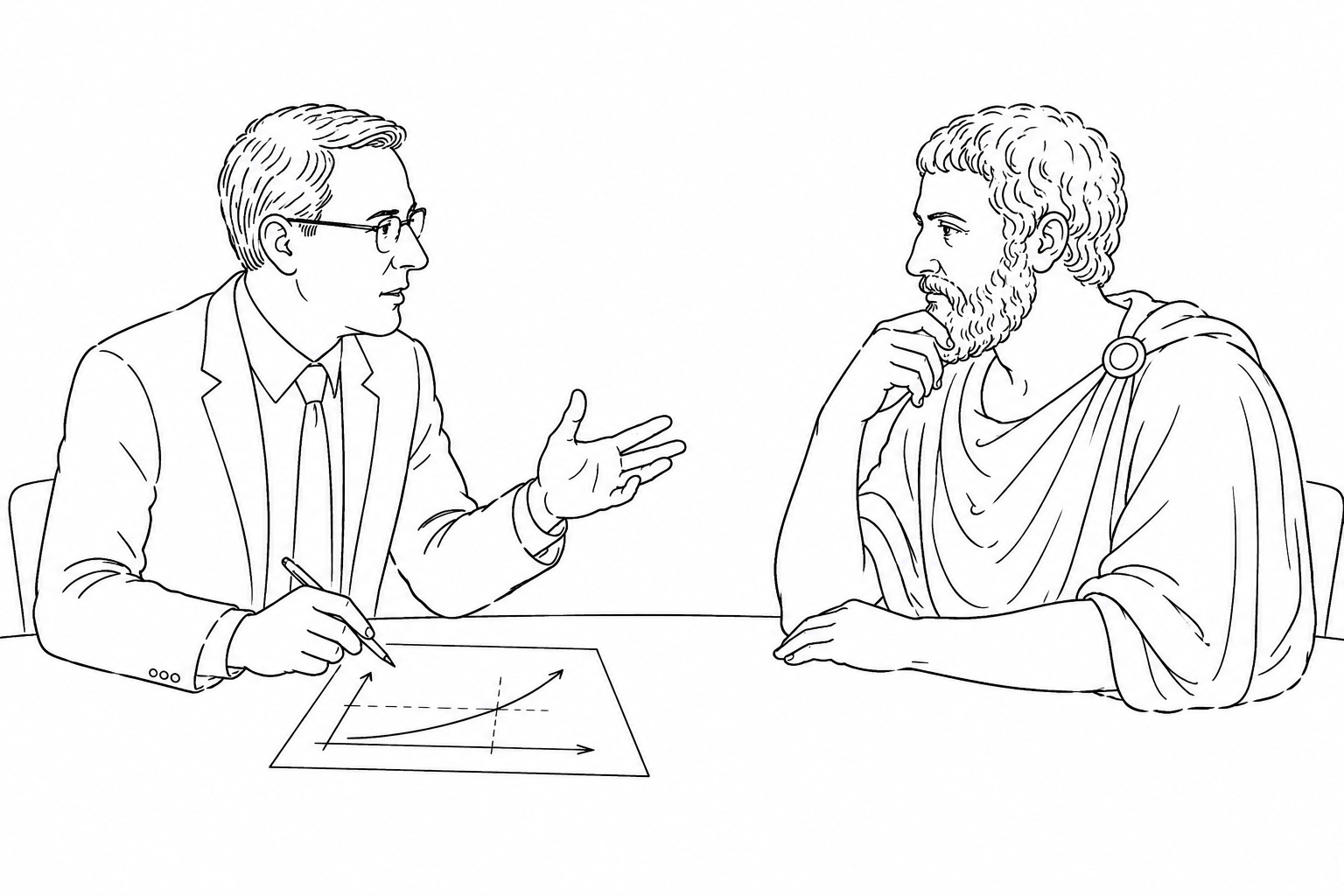
I enjoyed reading my friend John Tasioulas’s review of Daron Acemoglu’s new book on liberalism. John is a good philosopher — easily one of the best I know — and his review is unsurprisingly full of important, interesting philosophical ideas. My view, however, from having read just a few short extracts of the Acemoglu book, is that there’s not much point in philosophers engaging with its philosophy qua philosophy.
It is simply not worth one’s time. And Acemoglu should have been much better advised and supported, to this end, by any philosopher friends he has, while writing the book. You can see this, in particular, in his engagement with the social contract tradition. You can see it in the extract that John quotes and discusses in his review, but even more so in Acemoglu’s recent interview about the book with my friend Tyler Cowen.1 Acemoglu seems to me deeply confused and off-target on the topic of social contract theory, to a really quite embarrassing extent.
Now, of course, if I were to read the whole book, perhaps I would come away thinking entirely differently about Acemoglu’s philosophical talent! And none of this is to deny his skill as an economist, or to hide the fact that I’ve enjoyed and valued reading economics papers by him over the years.
John’s review gives me the chance, however, to state a very simple boring view that I hold quite strongly, but which I don’t think I’ve written down before. John says:
“But why foreswear the idea that Acemoglu’s three goals are justified by considerations of individual rights (e.g. a right to an adequate standard of living or to individual participation) and human flourishing (e.g. the ability to live a life that instantiates values such as achievement, knowledge, autonomy, friendship, etc.)? I suspect that Acemoglu resits this further step because the discipline of economics, like many other domains of our culture dominated by those with a university education, is allergic to the very notion of objective ethical values, to the idea that we can reason about the ultimate ends of individual and collective life. Indeed, this sort of subjectivism about value may play a non-trivial role in the new forms of elite thought- and speech-policing that Acemoglu justly decries, since they often rely upon curbing speech that is found merely subjectively offensive, without concern for whether the taking of offense is rationally warranted.”
My simple boring view is the following. Economists often make a misstep that goes something like this: “We economists have worked out, over the centuries, that accounting for subjective preferences plays an important part in good descriptive analysis of value assignment, qua pricing and understanding demand, etc. We’ve moved away from the labour theory of value, don’t you know!? Therefore we are subjectivists.”
In other words, it seems to me that a conflation-type misstep is taking place: that two different kinds of ‘subjectivist about value/valuing’ are being confused or jammed together. There’s the first ‘descriptive’ sense, and there’s the second ‘non-moral-realist’ sense. (Of course, subjectivism, per se, is just one kind of non-moral-realist position, but no need to go into that here.)
This interpretation is supported by the fact that, as implied, the final bit — the “therefore we are subjectivists” — often comes in the form of a jump, rather than any kind of argument. And also by the fact that, when you question one of these economists about what’s going on, they sometimes either say, “Oh I hadn’t thought of it like that!” or, “I don’t know what you mean by subjectivism about value in that other sense.”
In other words, for some of them, it simply ends in a confusing use of language. But for others, it leads to an almost blind — or at least non-fully-thought-through — denial of moral facts. In some cases, this is accidental and surface-level, and shouldn’t be taken seriously. But sometimes, the person in question tries hard to double down on the mistaken conclusion, and ends up going round in circles.
I won’t go into further downstream analysis here. And, of course, I’m not suggesting that all economists fall into these kinds of traps! But if my simple ‘conflation-type misstep’ analysis is correct at any general level, then this could strengthen my position that we philosophers have let the side down, over the past decades, by failing to play our part in the division of intellectual labour.
We’ve failed at this in public, and we’ve failed at it in the academy. We’ve become insular and exclusionary. And this, to return to the topic of Acemoglu’s book, has had particular costs to the defence of liberalism. We philosophers who believe in the value of liberalism have allowed overly thin economistic arguments to take hold — arguments that urgently need the bolstering of good philosophy.2
Perhaps, therefore, I should end by accepting that engaging with the bad philosophy of good economists might be worth our time, after all…
Tyler is a nice example of a good economist who is also a good philosopher.
If you agree, check out The Pursuit of Liberalism…
Your piece gets to the heart of the 'common good' debates. When economists wade into philosophizing, ideological or personal preferences can end up cloaked in the analytical rigor of economics. The reverse is also true. Non-economists often discount or twist the analytical insights of economics in support of a particular set of moral or policy ends. I like the art in this piece! I think a good first step is for each to be in dialogue, respecting the limits of their expertise and methods. then true interdisciplinary work MAY emerge. Many examples of this being poorly done.
Yes, philosophers have failed, but true interdisciplinary engagement is very hard. And the social status differences between philosophers and economists (which vary from culture to culture) create a special complication. Look at the way Harvard Law School seemed for decades largely impervious to the goings-on of a Harvard philosophy department that included the likes of Rawls, Nozick, Scanlon, Korsgaard, etc.