


This is the eighth in my series of short, quickly written (in this case, very quickly written), weekly philosophy essays.
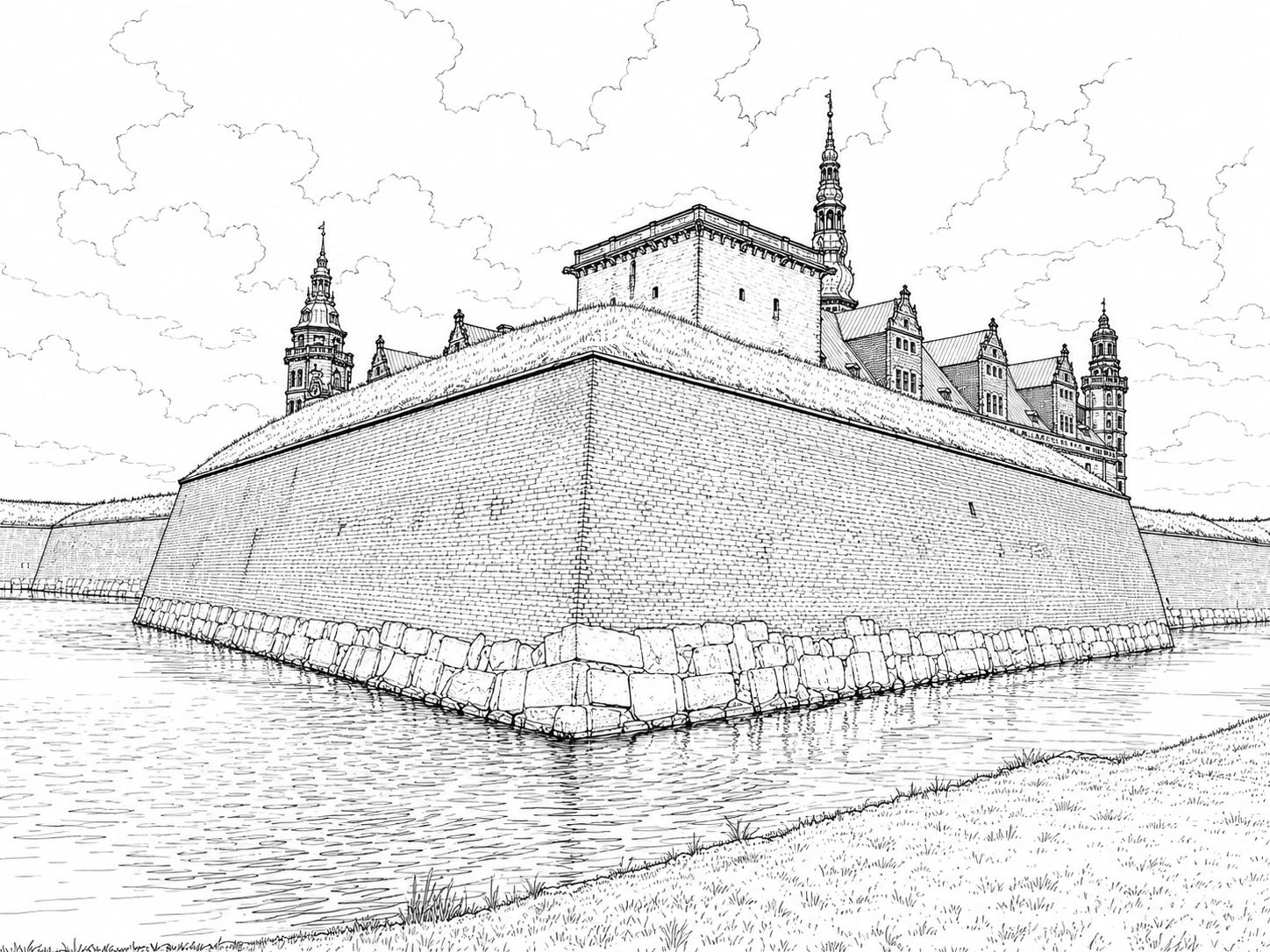
Today, I went with some friends to the real Elsinore Castle! You know, the place where Hamlet lived and loved and killed and died. We also saw his grave! Both the castle and the grave are in the seaside town of Helsingør, an hour’s train ride from Copenhagen.
Visiting these things reminded me of a fun argument, which I recently got into with an audience member at a panel event, about what it means to predict the behaviour of fictional characters. The other panellists and I had been discussing whether AI has things like desires and goals, and can do things like choose and know. Regular readers will be aware that I strongly believe that AI does not have these things and cannot do these things!
As it happens, I’m writing a paper at the moment arguing that groups can’t bear knowledge, in which I also argue that it’s much more costly to liberalism than many liberals acknowledge to over-expand the set of the things that can bear knowledge. On my view, this over-expansion applies to AI and fictional characters as well as to groups.
On topic, you may remember that I’ve made an analogy here before between the idea of AI being able to do such things and fictional characters being able to do such things. I like this analogy for many reasons, and think it’s underused. And being at the real Elsinor Castle (!) today gave me the chance to think about these matters some more.
I should probably clarify at this point that one of the many reasons I’m enjoying calling it ‘the real Elsinore Castle’ is because the real name (!) of this castle is Kronborg Castle. But if anywhere real is the real Elsinore Castle, then surely that’s it!? Good old conditionals. (All this reminds me of the fantastic chapter in J.L. Austin’s Sense and Sensibilia on ‘real’, which I wrote about recently.)
Thinking about Hamlet’s real grave (!) also got me on to thinking about when it was that Hamlet died.1 Did Hamlet die when Shakespeare first conceived of the narrative of the play? Or when he wrote it? Or each time the play is performed? Or when? On some level, this overlaps with the great aesthetics question ‘where is Beethoven 7?’. On another, it overlaps with ‘what does Hamlet know?’.
Now I could, of course, conclude that Hamlet is not the kind of thing that could bear knowledge,2 but that Hamlet is (! or was… after all, I just saw his grave!) nonetheless the kind of thing that exists (or existed! or will exist!). Although I don’t conclude that. You can probably guess what, instead, I actually (!) conclude.
Anyway, visiting the real Elsinore Castle — rebuilt some time after Hamlet died, if Hamlet died either when Shakespeare conceived of the narrative, or when he wrote it down, or during many of the earliest performances — with its disorientating underground tunnels, arras-lined bedroom, and views over the plain rough sea towards the Swedish Helsingborg (!), helped me to understand better why Hamlet felt (feels? will feel?) quite anxious.
Poor chap. If he hasn’t yet died, then maybe one of us can do something to help him.

It took us ages to find it, and I got to the point of really (!) hoping the fictional grave was fictional..
In a not too dissimilar (but also quite different) way to how I don’t know what the particular thing AI is that could bear knowledge, I’m not too sure what the particular thing is that is Hamlet..
Every candidate date on that list is a date in somebody else's life. Shakespeare's, the printer's, an audience's on a given Tuesday.
None of them are dates in Hamlet's, because there is no Hamlet to have one.
Same with the machines. Ask what it wants, and every honest answer turns out to be about whoever asked.