


This is the fourth in my series of short, quickly written, weekly philosophy essays.
I’ve written here before about the idea of living forever. Back then, I asked you to consider the possibility of your mind persisting endlessly after your bodily death. Today, I want to discuss the possibility of avoiding bodily death, in the first place.
I’ll begin by assuming that the avoidance of bodily death is, indeed, a possible thing. By this, I don’t mean I think there’s a possible route to ‘bringing you back from the dead’ after you’ve fallen off a cliff, or had your head chopped off. Rather, I mean I think we could become invincible against disease and ageing.
And as such, absent things like falling off cliffs and having your head chopped off, I think it’s possible we could live healthily, forever. I’ll even admit to thinking this is ‘nearby possible’. (Hey there, AI-driven medical advances!)
Okay, maybe I should accept that these two notions of ‘avoiding bodily death’ are closer in possibility than I assume. I mean, perhaps once the problems of disease and ageing have been solved, we’ll consequently find ourselves newly able to solve problems like falling off cliffs. I’m happy to accept that for current purposes, even though my metaphysical convictions set me strongly against it.
Mostly, however, I want to focus on what it’d mean for humankind to gain this newfound invincibility against ageing and disease. It seems to me likely, for instance, that it would radically change how we go about planning for the future. For a start, I assume most of us would think very differently about investing. Not only in the sense of where you put your money, but also about how you commit to your long-term development.
Think about it. If there were no certain end in sight, then how would you choose which skills to build, which career to pursue, who to marry, and so on? More generally, how would you undertake the activity that Nozick refers to as “formulating long-term plans for [your] life”? This is something he tells us — and surely you’d agree — is a particularly distinctive and valuable part of being human. These seem like important questions to me!
Now, perhaps you’re tempted to think that notions such as careers and marriages would fade away, outside the shadow of death — that our new ‘timelessness’ would destroy any urge or reason to make long-term commitments. Or perhaps you think that our longest-term commitments would simply shift from being ‘for life’ to being the stretchiest links in a never-ending chain. “Ah yes, my fifty-year relationship with so-and-so!”, you might fondly reflect, a thousand years down the line.
Or perhaps you assume we’d all be hiding away, locked in our houses, wrapped in cotton wool, terrified at the thought of the accident or assault that could end our otherwise endless lives — thus squandering our supposedly endless opportunities.
I have many thoughts on these matters, some of which you can probably guess if you’ve read my previous piece. But what I want to emphasise today is that such a life would not truly be a life of ‘endless opportunities’. In particular, it would not be a life of ‘endless opportunities’ either in the sense that: a) every possible opportunity would arise for every person at some point; or b) every possible opportunity would last for everyone endlessly.
For a start, it’s easy to see that these two conceptions are in tension! What I want to draw your attention to, however, is how neither of these conceptions is alive to the fact that particular opportunities depend on particular sets of conditions.
It might be tempting, that is, to think that an endless life would be a life in which you’d be able to do every single possible thing in every single possible combination. That such a life would be a life correlative to the idea that, at some point during ‘infinite time’, the monkeys would write the works of Shakespeare. Okay, I’ve never bought the Shakespearean monkey claim, but again, I’m happy to accept it for current purposes.
One key difference between the Shakespearean monkey claim and the ‘every possible opportunity’ conception of the infinitely-long human life is that many of the opportunities we value in our lives involve other people. Take the paradigmatic example of having the opportunity to enter into a romantic relationship with someone you really like. Well, surely, imagining that living forever would always entail having the opportunity to be in a romantic relationship with whoever you really liked is crazy down many lines!
I mean, just because the girl you currently like is going to live forever doesn’t mean she’s going to like you back at some point. And just because you and the guy you currently like both have the possibility of living forever doesn’t mean that the two of you can risklessly delay getting together, even though you both currently feel the same way about each other!
It’s not only, therefore, that the risk remains that you might fall off a cliff or have your head chopped off. Even if we could survive those kinds of events, the girl might never like you back, and the guy might change his mind!
This kind of logic applies to most other valuable opportunities you would face in a possibly endless life. And that’s because other people — indirectly, as well as directly — would play a part in those opportunities, too! And those other people would be people, just like you, with changing goals and preferences, as well as locations and resources, and so on, and so forth.
Of course, as you might have guessed, all this is really just an attempt to reconcile my excitement at the idea of getting to live forever with my instinct that it’s valuable to live with some sense of urgency.
That is, as things stand, I believe it’s generally useful to think ‘life is short!’ when valuable opportunities arise. Doing so forces you to weigh up your options, and helps you to be productively innovative in the ways you live your life. Without such a heuristic, it can be hard to value what you have, as well as what it’s possible for you to gain.
In that context, my argument says that while the life in which you could live forever would be a life with infinitely more opportunities than the life you currently lead, it would not be a life in which anything you ever wanted was always yours for the taking.
I’ll end by emphasising that I assume many people would be scared by the possibility of ‘endless life’. They would be scared, not least, about what it would imply for their chance to find meaning. I attempted to address this anxiety in my previous piece, by arguing that some insulation against the downsides of ‘being alone in the dark forever’ can be found in trying to make yourself as interesting as possible. And moreover, that the inherent value of such an approach might even tell us something about the ‘meaning of life’.
Well, I think a similar kind of ‘getting on with it enthusiastically and evaluatively’ approach can be taken to addressing the potentially stultifying news — the news that I believe could arrive any day now! — that bodily death has become avoidable.
Think about it like this. The life in which you lie in bed all day, hiding away, wrapped in cotton wool, because taking an opportunity could mean ending the opportunity to take any opportunity is a life in which you don’t really value opportunity. And the life in which you assume that ‘endless time’ means that every possible opportunity will arise at some point and will also always exist is a life based on bad math.
Rather, the value of the ‘life is short!’ heuristic would persist even when ‘shortness’ had less application to our ‘whole lives’, in general. Thinking in this way would still help us to make good plans. But whether or not you agree with me, you’d better start thinking about these things. The new constraints of endless time may be upon us sooner than you think!
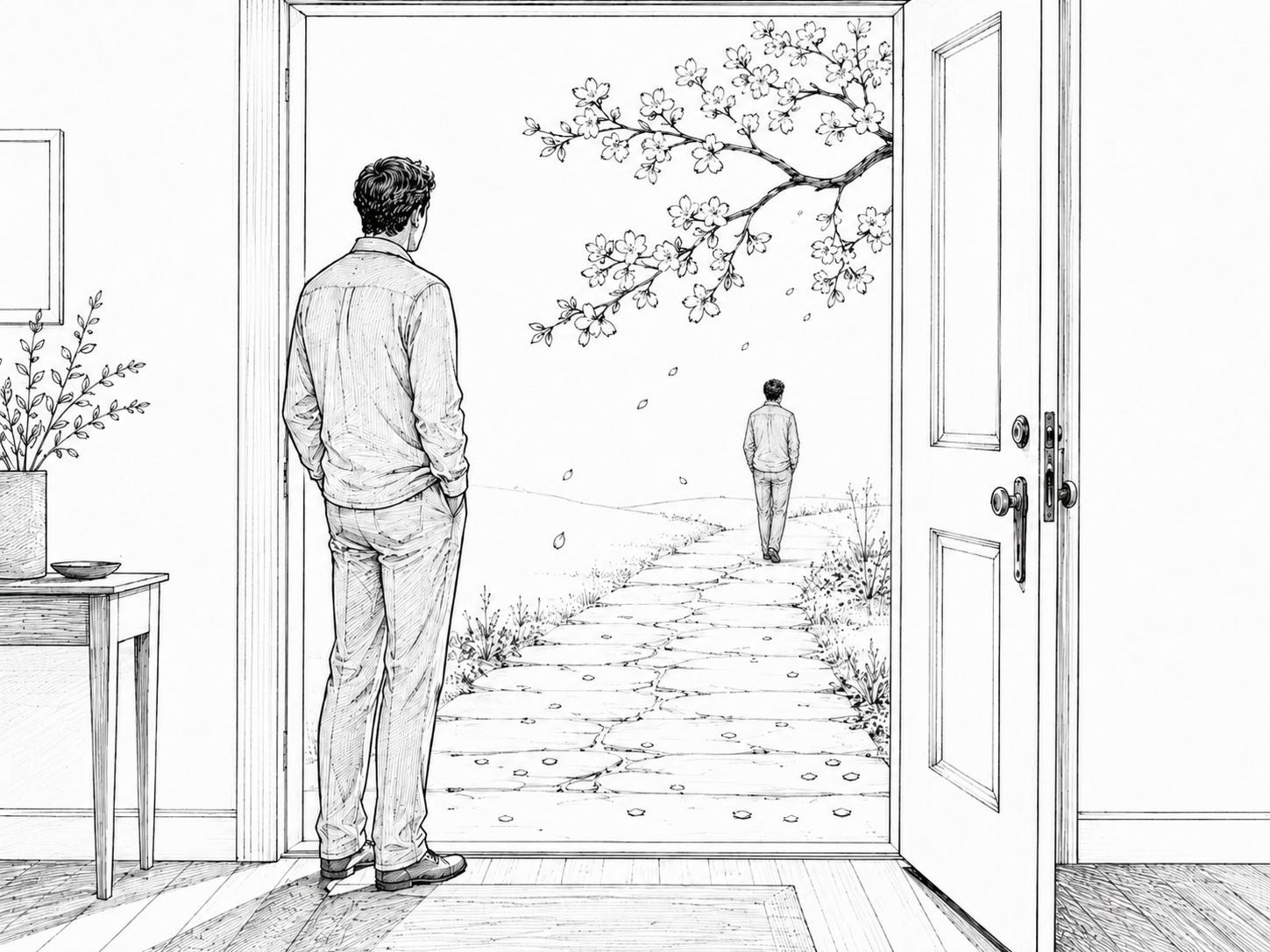
Thanks to GPT for the picture.
"Time to play B sides"
Whatever you would still do today if you had forever is what you actually value.