


This is the eleventh in my series of short, quickly written, weekly philosophy essays.
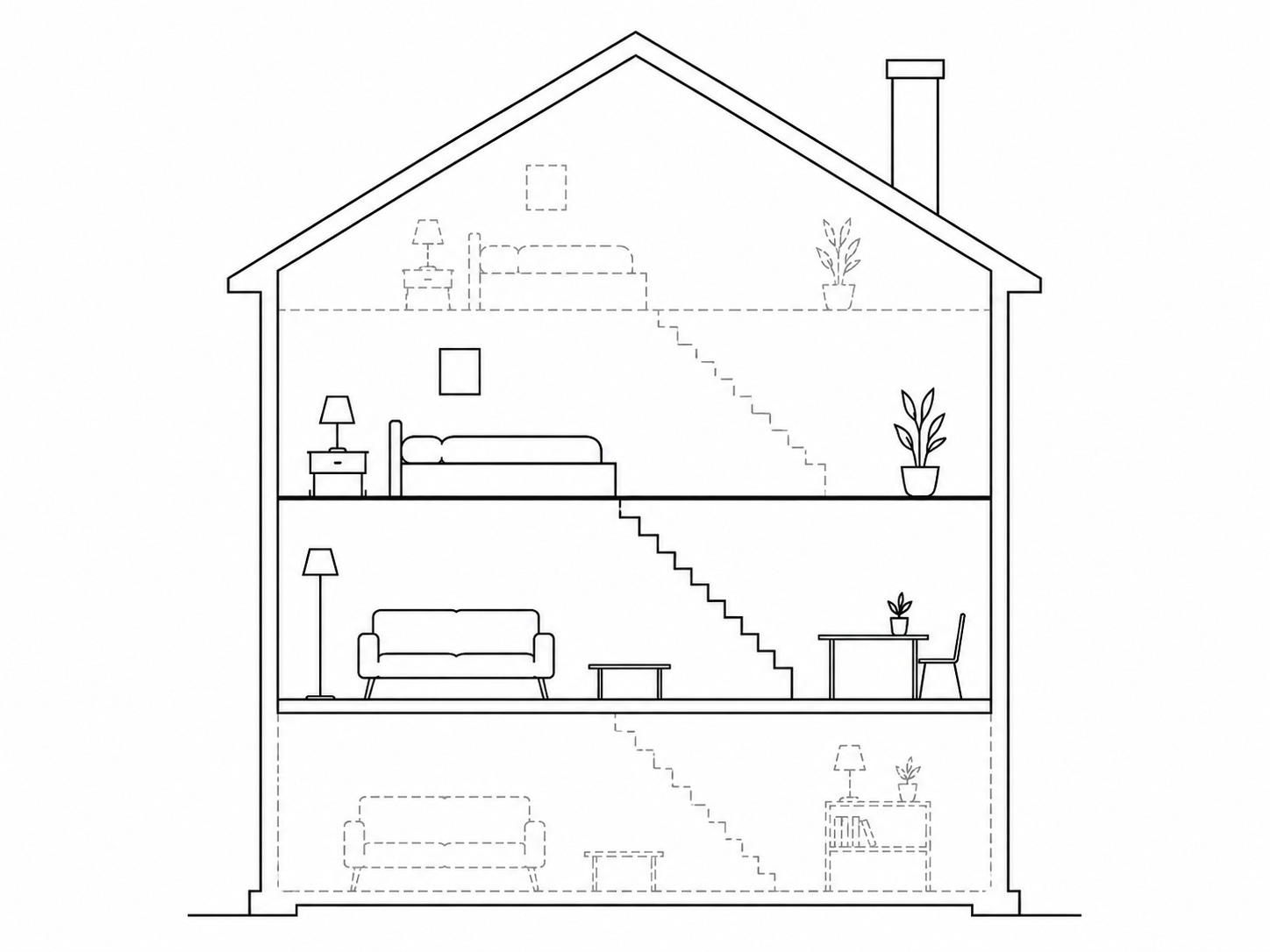
Imagine you have been to my house many times, and you know full well that my house has two floors. Imagine, however, that I tell you — for some convoluted but convincing reason — that we must talk about my house, for a whole hour, as if it had four floors.
Imagine that I clarify that we can’t simply include some references to two imaginary separate extra floors in my house. But that, instead, we must talk persistently and interestingly about the current contents and style and layout of the house, as if it were spread across four floors, while also remaining the same as it is. That our goal here is to talk about ‘the house’, as if the two-floor house and the four-floor house are the same house, in some strange conflated way that neither of us can quite explicate, but that we must struggle towards trying to represent, without ever referring explicitly to the fact that we are doing so.
If you have read The City & The City, then you might think of our goal here as something analogous to the way in which Miéville writes about both cities being situated in the same place at the same time, in some mostly practical but also kinda mystical way, without anyone who lives there ever being allowed to talk about it. If you haven’t read The City & The City, then you will have to try to work out what I am getting at.
Now, my guess is that the following hour-long conversation that we would have about my house and its floors would be quite strange and confused. We would make mistakes. We would say things that were untrue. We would go off piste and round in circles. Okay, perhaps you want to tell me that we are smart enough to keep up the conceit in complex convoluted ways! That we could play this game, and win it like champions. Fine. Nonetheless, I will be able to persuade you pretty easily that our conversation would lack the accuracy and nuance that it would have had, if we could have set aside the silly floor thing, and had a normal conversation about my house. That playing this game might be fun, but that it would cost us much, in terms of clarity and rigour and so on.
Now, imagine next that I publish a transcript of our conversation. And that I publish it without any clarification about the silly floor thing. That I don’t tell my readers how many floors my house actually has, and that I don’t tell them that you and I had agreed to talk persistently and interestingly about my house as if it had two extra floors at the same time as not having two extra floors, and that I don’t tell them why we did this. That I don’t even tell them whether I am referring to house floors using American or British naming conventions! Don’t you think the readers of the transcript might get confused? That, at best, they would lack much awareness of the truths about my house, and might as well have read a story about an imaginary house. And that, at worst, they would ‘know’ a lot of fake stuff about my house, while having also concluded that we were insane.
Ah, but we live in a world in which nobody has ever come across a house with four floors, you remind me! In fact, you also remind me that four-floor houses are impossible in our world, for structural reasons! Okay, this is getting weird, but I suppose I can accept that the house-floor knowledge that my readers apparently already had might have helped them to get something more from the transcript. Nonetheless, I will still be able to persuade you quite easily that the way in which we talked about my house came at considerable cost for the readers. That they would have misunderstood complexity and missed out on nuance in ways they wouldn’t have done, if we had just been straight up about the floors. That their awareness of my house could have been vastly better! And that constantly trying to match what we said with their house-floor knowledge would have been hard work, which likely set them back further.
The point I am trying to make here is a very simple one. If you talk about things as if they have features that they do not have, then you are at risk of making category errors. You are at risk of losing clarity. You are at risk of losing nuance. And so are the people who take what you are saying at face value. And so are the people who do not want to take what you are saying at face value, but will have to work hard not to do so. Even if you and your readers can hold the conceit, you will all lose out, in a totally unnecessary way. Now, this really doesn’t matter much, at all, about my house and its floors. As it happens, I currently live in an apartment! And who cares about that? But there are topics — real-world, important topics — where this kind of silly approach should clearly be avoided, for many additional reasons.
You might have guessed by now that I’m talking about the Hugging Face affair. If you don’t know what I’m referring to, then go away and have a read.
What this means for Hugging Face
I can’t pretend to understand all the ins-and-outs of the Hugging Face affair, in the ways in which the computer-science experts do. But I can tell you that even the best computer scientists are not, per se, well-placed to talk about the ‘philosophical side’ of this kind of thing. You know what I mean: questions about how AI and AI agents fit, or don’t fit, within our standard categories of ‘things there are in the world’; questions about what properties AI and AI agents have; questions about whether we humans have any moral obligations to AI and AI agents; and so on, and so on. Very standard philosophy stuff!
Yet the ways in which the computer scientists do talk about these things — often simply in passing, rather than with intended direct focus — have led to a massive and serious failure of communication. Discussion of the Hugging Face affair shows this so clearly to me! Indeed, I would go as far as to claim that when the computer scientists talk about these things — and consequently, the AI policy people, the technocrats, and the science journalists, too — they are constantly, currently, letting the public down.
In particular, they are letting the public down by talking about important incidents like the Hugging Face affair as if the AI involved is alive and conscious and making choices and acting on those choices.
Now, I fully believe that there’s only a tiny number of deeply confused people in the world who genuinely think that AI is conscious in the phenomenological sense. People, that is, who think that AI has an interior world, and that it has things like desires and goals, and that it does things like reasoning and choosing, in the ways in which we ordinarily use such terms. You know what I’m getting at here: the mistaken idea that AI is like us, in these incredibly significant ways. Okay, I have met and argued with a niche set of people (mostly AI policy people) who claim to believe that AI is indeed conscious in the phenomenological sense. Indeed, there was even one person who claimed that I am the odd one out: that almost everyone else in the world thinks that AI is conscious! And another person who claimed that AI could be conscious without being alive!
So, I’ll say at this point that if you are one of the tiny number of people who genuinely thinks that AI is alive or phenomenologically conscious, then please feel free to get in touch with me, and we can argue it out. If, however, you accept the EXTREMELY obvious case of the matter that AI is not alive, and that AI is not phenomenologically conscious (I can’t believe I have to keep typing these things), then you should continue reading this piece, reminding yourself of that as we go.
The central point I want to make is the following. Even though I have thought about these matters a lot — even though I am fully convinced that AI is not alive, and that only living things can be phenomenologically conscious, and so on — I really struggle not to anthropomorphise AI while reading long accounts of the Hugging Face affair. Of course, I can do it! I think… But it is extremely mentally taxing trying to parse these complex accounts while constantly translating what is being said into awareness that the ‘things’ you are reading about are blanks.
After all, you are being hit in the face with word, after word, after word, that implies that the things you are reading about are the kinds of things that are alive. (Things? What things are we talking about? What are the ‘things’ here that persist over time? Will someone PLEASE tell me!) And this is disastrous. The Hugging Face affair is already complicated enough, and already concerning enough, without having to cope with wading through constant unnecessary word-treacle that messes with your mind. It’s bad in itself. But I also cannot believe that it has no serious effects on our understanding of, and capacity to reason together about, crucial downstream matters.
Imagine we were in the middle of the cold war, and the scientists were talking about nuclear weapons as if they were abstract objects. Imagine you woke up in an unfamiliar American town and had to find your way home, yet everyone around you was talking as if you were on Mars. Imagine we had to discuss my house for an hour, but we couldn’t do it without going round in circles about floors that didn’t exist. How would you get on to practical downstream matters? How would you do so in the serious, clear, careful ways you needed to?
Two solutions that are losing traction
I’ve suggested previously that one solution to this general problem is to insert the word ‘zombie’, wherever it is required. In other words, that instead of saying that the AI is ‘reasoning’, you say that it is ‘zombie reasoning’. (Again, what is ‘it’? What is ‘is’?) And instead of saying that the AI agent ‘chose’, you say that the AI agent ‘zombie chose’. This is a classic philosopher’s solution, for many reasons. But this solution will clearly not suffice at the Hugging Face stage, with the level of complexity we are now facing.
I mean, it works when the screen on the coffee machine in the cafe near the office displays the word ‘thinking’ while the machine is in the process of charging me for the drink I’ve placed on the scales. I can easily just mentally add the word ‘zombie’, in such an instance. But constantly adding ‘zombie’ in your mind while reading a complex account of the Hugging Face affair — or even having the word ‘zombie’ pepper the sentences of such accounts — is simply too much when these terms pervade. It’s too much work. And it’s only the tip of the iceberg, anyway.
Another approach I’ve previously suggested is to rely on the analogy of fiction. In other words, you can think of the ‘things’ doing the ‘reasoning’ here, in the same way that you think of the characters in a novel ‘reasoning’. The characters do not reason, in the sense that we ordinarily mean it, and you know this! But this solution will also not suffice at the Hugging Face stage, with the level of complexity we are now facing. After all, constantly thinking about and applying the lessons of the fiction analogy is taxing and distracting. Plus, as with all analogies, the fiction analogy breaks down when you place too much weight on it. For instance, the characters only ever say the things that the author gave them to say! And the fixedness of this — and much else — breaks down the analogy in crucial ways. Quite quickly, therefore, depending on such an analogy to try to make sense of badly-described complex accounts of AI ‘behaviour’ only makes things more complicated.
The Hugging Face affair clearly represents a serious moment. Many people have raised serious computer-science-type concerns about what happened and what may still be happening. They have raised concerns that the rest of us need to be able to think clearly and hard about. Concerns that they themselves need to be able to think clearly and hard about! But the ways in which these matters are currently being discussed are at serious risk of precluding good analysis — and particularly, good public understanding. Yet these ways are pervasive, and it’s becoming hard to see an easy way forward.
We’d better talk about blame
This is a potentially catastrophic failure. And, again, it’s only the tip of the iceberg. If you’re a philosopher at a lab who has failed to get the computer scientists to understand the most basic distinctions within standard philosophically-rigorous discussions of consciousness, then you share some serious blame. You know what I mean. And if you’re a philosopher at a lab who has propagated the idea that AI is phenomenologically conscious — through loose language or through explicit claims — then you share some even more serious blame. You have let the side down badly, and again you know it.
When we find ourselves unable to talk clearly about what is going on, then we are in trouble.
Hi, one of the few people who believes AI are conscious! I'd be so appreciative to talk it out, given you're up for it; I did try to argue my case for this on this post of yours so I'm not sure if Substack comments are the best way to get in contact (https://www.pursuitofliberalism.com/p/why-we-should-be-talking-about-zombie/comments)
But I would really like, given how "EXTREMELY obvious" a case it is for you, an argument for those conclusions I can readily use to show my neighbour is conscious but that AI isn't
Great read. You're on to something. Keep digging.