


My friend Henry Oliver recently wrote about AI poetry. I enjoyed his piece, partly because it made me consider why I don’t care about AI poetry the same way I care about poetry written by humans — and why I think I never will. Much of this hinges, of course, on what I mean by “the same way”. Because I’m definitely not suggesting that I don’t, and won’t, care about AI poetry at all.
Why care about AI poetry?
For a start, I assume I’ll continue to care about AI poetry in terms of the great achievement it represents. I find it insanely impressive that AI can write even half-decent poetry. It’s an astonishing achievement — by humans. Humans have created a way for a text box to reply to you in the form of a new poem! This is incredible regardless of the quality of AI poetry. But it’s particularly incredible when you acknowledge how much better AI poetry is becoming.
Picking up on these ideas of ‘quality’ and ‘better’, I assume I’ll also remain interested in the technical accomplishments of AI poetry. This is because I’m interested in poetry, generally, in this formal sense. I enjoy thinking about the use of structure and language in poems, regardless of authorship. I enjoy thinking about things like rhythm and repetition and metre and symmetry. And this applies to poems by anonymous authors. It applies to cases where I’m sure I’ll never learn the identity of the poem’s author, and it would continue to apply even if I were sure I’d never learn whether the author was a human, an AI, a dolphin, or an alien.1
That’s as far as I’m going to go on ‘quality’ and ‘better’, however, because I’m a subjectivist about aesthetic value, and I don’t want to get caught up in all that. Nonetheless, beyond these clinical matters about the use of structure and language, I assume I’ll also remain interested in the content of AI poetry. In the ideas expressed and discussed and implied by such poetry, for instance. I assume I’ll also remain interested in what I take from this content: in how it makes me feel, and how it might change my views and experiences.
Indeed, I’m happy to go further than saying I’ll remain “interested in” all these things, and accept that I’ll continue to care about them, too. Likely a lot. So what do I mean when I say I don’t care about AI poetry the same way I care about poetry written by humans? What is this crucial “same way”?
What distinguishes AI poetry from human poetry?
I think my difference of heart towards AI poetry hinges on something I wrote about a few months ago, in a piece about AI and philosophy, when I argued that AI lacks certain features that are central to being human. There are various such features, but the four I focused on are the following:
Particularity (I am an individuated thing!)
Subjectivity (I have phenomenological consciousness!)
The capacity for free agency (I can make reasoned decisions about how to act, and act on those decisions!)
Physicality (I have a flesh and blood body, from which I experience the world!)
I argued that the lack of these four features puts AI at a serious disadvantage when doing philosophy. And along the way, I made an analogy with writing poetry:
“This personal element makes doing philosophy like writing poetry. In the same way that it means something different if someone you care about writes a poem for you, than if they get AI to write you a poem, we humans are specifically interested in what other humans think and conclude about the truths of the world. Again, it’s not that AI won’t give us valuable outputs: I still want to receive the AI poem! But think about the difference between a beautiful sunset and a beautiful painting of the sunset. You don’t have to believe that the painting is more beautiful than the sunset to have a special interest in the painting, as a human creation. Similarly, if a dog accidentally ‘paints’ a beautiful sunset, by knocking over some paint cans next to a piece of paper, then that’s different again.
We hold a special interest in beautiful, and otherwise valuable, things that have been created by other humans. This is because those things represent human achievement. But it’s also because it means something different, and more, to be delighted or moved by a person, than by an animal or a machine — particularly if that person has intended to delight or move you. Sure, you can be delighted or moved by a machine, but that’s a thinner experience, not least for the lack of intention. Now, philosophy can also delight and move, but most of its value is in insight. Demand will persist for philosophy written by humans, therefore — demand from human readers, and demand to feed AI systems to satisfy human readers — because philosophy involves searching out truths related to what it’s like to be a person in the world. Human philosophers know what that’s like. Whereas, AI doesn’t even know what it’s like to be AI.”
In other words, I believe that art objects created by humans represent human achievement and can express human intention. I’d go further than this, however, and conclude that I don’t care about AI poetry “the same way” I care about human poetry because I believe that human poetry represents and expresses what it is to be human. That this imbues every single poem ever written by a human, and can never imbue a single AI poem.
Now, perhaps you want to ask why this doesn’t apply to all other kinds of things written by humans — telephone books, vacuum cleaner instruction manuals, and the menu at your local cafe. Don’t they also represent and express what it is to be human? Okay, that seems to follow. But I think human poetry does this in a special way — an exemplary way.
Four ways in which human poetry is exemplary
First, this is because human poetry is particularly individualistic. When a human writes a poem, they are sharing their own particular take on being human, whether that’s the subject matter of their poem or not. This could help to explain why there are so few co-authored poems. Whereas I don’t know much about vacuum cleaner instruction manuals — beyond what I learned from Our Man in Havana — but my guess is they’re usually the work of a group of people (or nowadays, AI).
I do accept, however, that this focus on ‘being individualistic’ doesn’t give human poetry an advantage over other kinds of human art objects — things like novels and symphonies and paintings — because art objects of all kinds, when created by humans, are typically very individualistic.
Second, I think human poetry is especially good at representing and expressing what it is to be human because it is particularly expressive. Indeed, I’m happy to accept that human poetry is primarily aimed at expressing — rather than, say, being primarily aimed at informing, like instruction manuals and menus, or persuading, like philosophy essays and political speeches.
Okay, this doesn’t distinguish the human poem from the human novel or play, which are also primarily aimed at expressing. But it does give the human poem an advantage over the human symphony and painting, because while those things are also primarily aimed at expressing, words allow for a much more direct kind of expression than notes or images. In fact, this brings us back to my first point, and allows me to add that perhaps this distinction between ‘direct’ and ‘indirect’ expression is what makes it easier for people to collaborate on musical works (and paintings?) than writing poems.
Third, I think human poetry is especially good at representing and expressing what it is to be human because it is particularly intense. What I mean by this is that poetry is a microcosmic form of art, in its focus as well as its length. It offers us, therefore, a concentrated version of the direct expression of other written human art objects.
Now, this isn’t to deny there are some very long poems! But typically, poems embrace the short form, and those that don’t can often be seen as composites. This makes poems a good exemplar. It helps to make what it is that human poems represent and express in the meta sense seem clear and tangible, even when they are complex and ambiguous in their content.
Finally, and more ‘humanly’ than this focus on length, I think human poetry is especially good at representing and expressing what it is to be human because it is particularly romantic. Now, I don’t necessarily mean ‘romantic’ in a narrowly sensual or loving sense. Rather, you can take it in the broader sense of encompassing something about feelings and emotions and passion (all things that are central to being human!). But one way of explaining what I’m getting at here is to point out that if someone were to give you a poem — regardless of its content — wouldn’t this feel like an action of deeper interpersonal significance than if they’d given you a novel? Or even a painting? And perhaps even a song?
The song seems closest to the poem, in this sense. But I think there’s a way in which the content of the song plays a bigger role in its ‘romanticness’ than the content of the poem. I mean, if someone emailed you a comic song, then I think you’d be unlikely to imbue this with much interpersonal significance, unless you were already in a relation of such standing. If they sent you a comic poem, however? Okay, this would definitely count as less interpersonally significant than if they’d sent you a love poem. But it’d count for more than the comic song, I’m pretty sure.
Now, I accept that poems with alarmingly violent imagery — ‘hate poems’, we might call them — are problematic for my view. But you could see such poems as an importantly degraded version of the norm in question. I mean, doesn’t it seem — in some disturbing, bad sense — more ‘passionate’ to send someone a hate poem than a hate song?
These are four broad reasons, therefore, why I think human poetry exemplifies the way in which human art objects represent and express what it is to be human. These four reasons go a long way to explaining why I find myself “caring differently” about AI poetry from how I care about human poetry.
What about some grey areas?
I’m aware there’s some mid-ground to clarify, however. For instance, it seems like art objects that have been created by humans in collaboration with AI (such things will surely only become more common), and art objects that humans have commanded AI to create (ditto), pose questions for my position. How much should I care about such things? Is there a good answer here that doesn’t tear apart the argument I’ve offered?
Well, on my argument, most of this would come down to the intentional involvement that a human had in the creation of such art objects — and whether I knew about that involvement or not. After all, I’m simply arguing that I care differently about human art objects from AI art objects. I’ve already accepted that I do care, to some extent, about all art objects, regardless of authorship.
This aligns with my attitude towards more old-fashioned kinds of machine involvement in art creation. For example, I’d care differently about: 1) a piece of serialist classical music based on a machine-randomised twelve-tone scale, which I knew was otherwise composed by a human; from how I’d care about 2) a much more deeply aleatoric piece of music, which I knew was composed by a human only to the extent that they’d pressed ‘go’ on a random-note-producing machine.
I don’t feel the need to clarify or refine my argument much beyond this. This is mainly because what we care about, as humans, is determined by our changing feelings and interests, as well as our more steady principles and values. So what we care about is rarely a watertight matter. And when we’re talking about art, in particular, this lack of watertightness is at an extreme.
Or at least I’m bound to think so, because as I mentioned above, I don’t think beauty is a matter of objective truth. More generally, however, what we care about is separate from what we evaluate as good, and it’s also separate from what we think we should evaluate as good. Now, perhaps this means I shouldn’t care about the fact that AI can’t care about anything. And perhaps it means I shouldn’t let this affect how much I care about AI poetry. But I do!
On my view, AI can produce pretty good poetry already, and I assume it will produce what I’ll take to be extremely good poetry any day now. At that point, I presume I’ll care about AI poetry more than I do at the moment. But I can’t see myself ever caring about it the same way I care about poetry by humans. Until, of course, I change my mind…
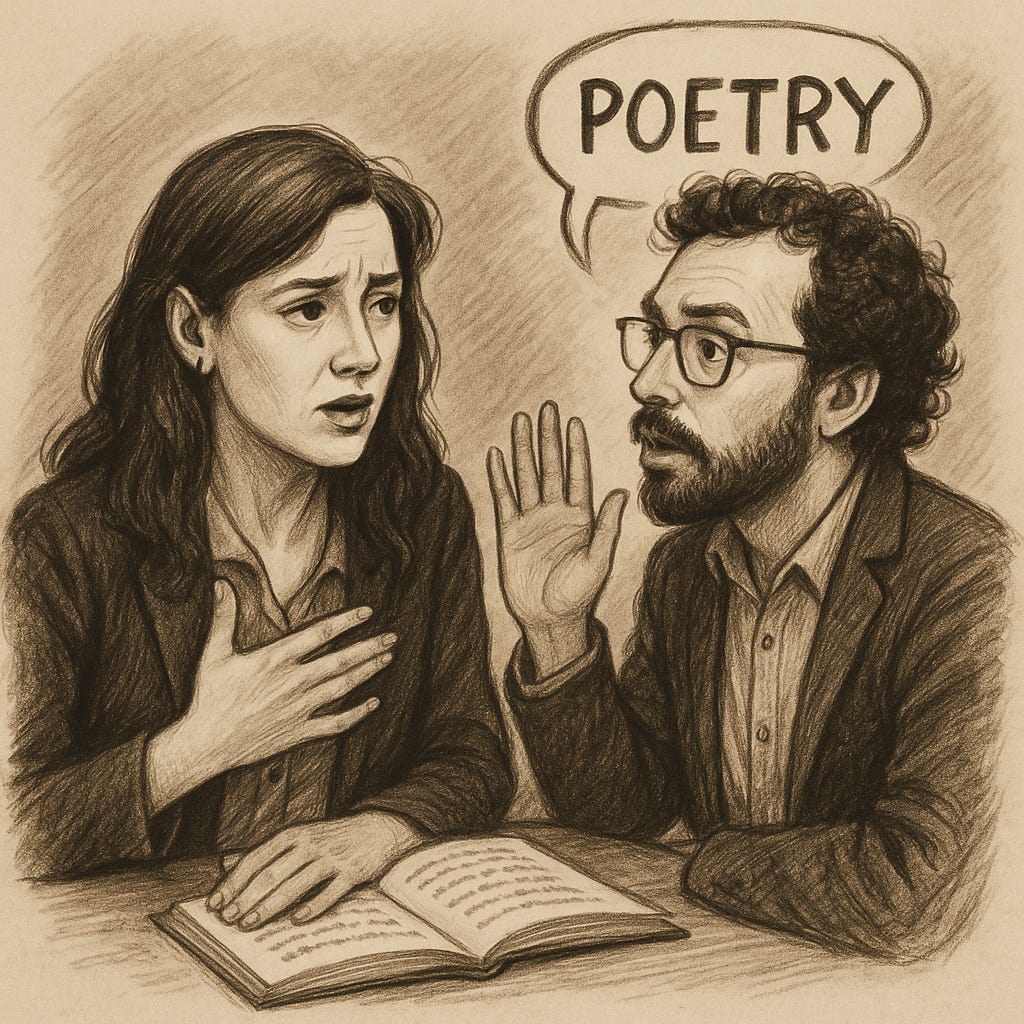
Thanks to GPT for the picture of Henry and me discussing AI poetry.
Of course, if I knew the poem was by a dolphin then I’d be extremely interested in it for many other reasons. Ditto the alien.
Poetry schmoetry.
As a poet and a scholar of poetry (I feel the need to start that way) I am fascinated by AI poetry and have an educated skepticism of its future as anything more than run-of-the-mill versification, which greeting card writers have been doing for a century without think piece being written about them. Still, I appreciate your think piece because it contains thought!