


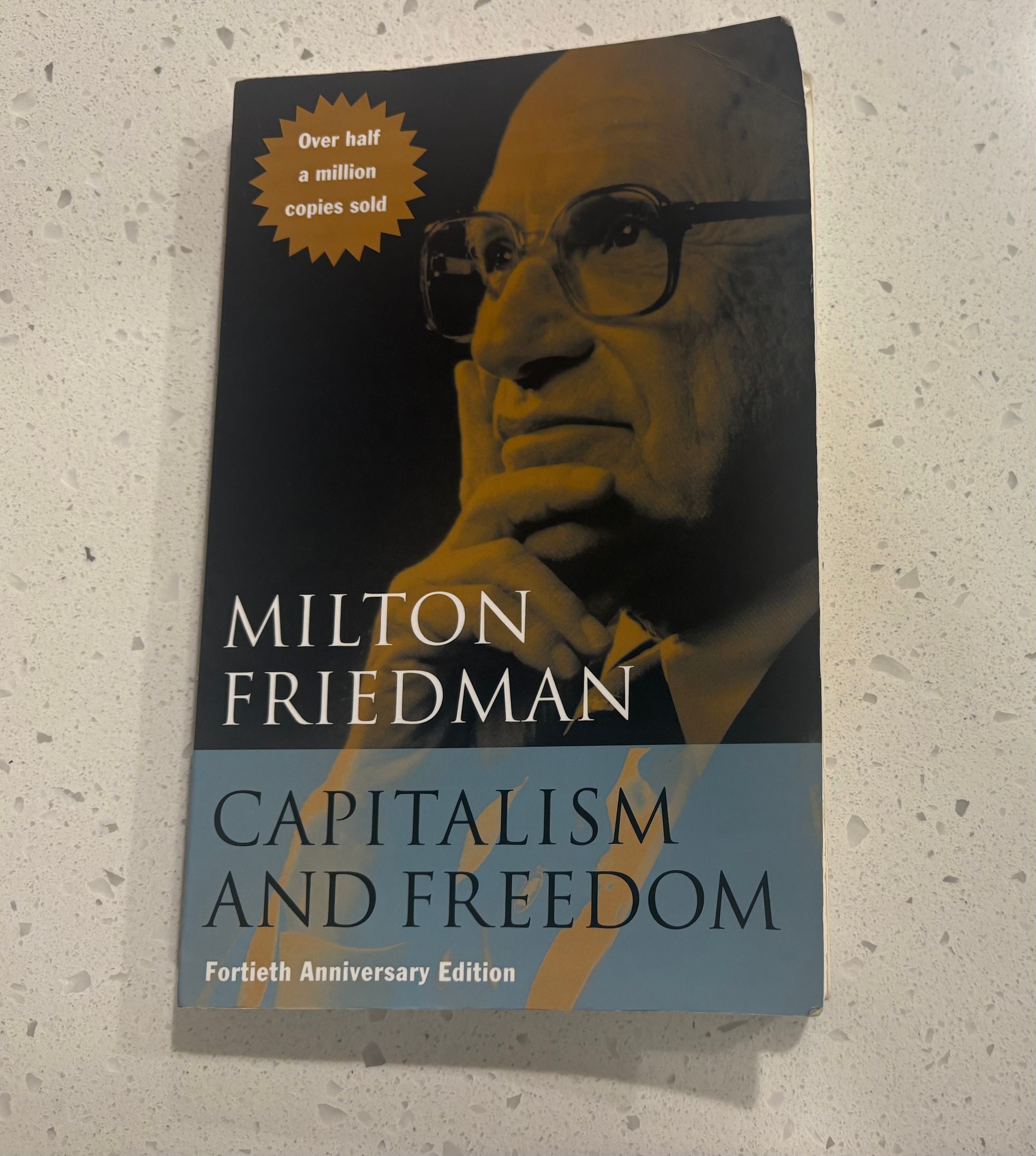
Last weekend, I went to a conference in Chicago on the topic of Milton Friedman, organised by my friend Sam Enright. I led a session on Friedman’s philosophy of freedom, as presented in the first chapter of Capitalism and Freedom.1 Since I enjoyed thinking about this, I thought I’d write up my notes here.
I began the session by outlining what Friedman does in the chapter, before setting out some topics for discussion by raising some objections to his arguments.
Outline of the chapter
In the first chapter of Capitalism and Freedom, Friedman considers which kinds of economic and political arrangements can and do protect and further individual and societal freedom. He begins by stating his opposition to a standard view about the conjunction of freedom and societal arrangements. He describes this standard view as combining the following four claims:
that politics and economics are “separate and largely unconnected”;
that “individual freedom is a political problem and material welfare an economic problem”;
that all political arrangements are compatible with all economic arrangements;
that democratic socialism is an example of this compatibility (e.g., that Russian-type socialist economic arrangements would be compatible with American-type democratic arrangements).
So the standard view, as Friedman presents it, consists of two big claims (1 and 3), and two respective examples (2 and 4).
Friedman focuses on the two big claims, and claims instead:
that there’s an “intimate connection between economics and politics”;
that some combinations of political arrangements and economic arrangements are not “possible” (and indeed that democratic socialism is an example of an incompatible combination, at least if democracy involves “guaranteeing individual freedom”).2
The rest of the chapter is aimed at persuading us of the superiority of the Friedman view.
The main arguments Friedman makes in favour of his first claim involve showing the effects of economic things on political things, and vice versa. So, he discusses the causal relevance of interactions between economic arrangements, political arrangements, economic freedom, political freedom, economic power, political power, and so on. He presents various of these things as overlapping.
In his first few arguments, Friedman appeals to history. For instance, he argues that it’s been shown that times of political freedom can lead to times of increased economic freedom (e.g., when voters vote for “laissez faire”). The biggest conclusion Friedman draws in this ‘historical’ section, however, is that it’s been shown that capitalism (as the economic arrangement that “directly provides” economic freedom) is a necessary condition, but not a sufficient condition, of political freedom. So, Friedman believes that history shows us that political freedom depends on economic freedom, but that economic freedom doesn’t depend on political freedom although it can benefit from it.
Friedman then attempts to make some additional non-historical arguments — based on a “logical” appeal to possibility — about connections between economics and politics (to substantiate claim 1) and about the inimicality of certain societal arrangements (to substantiate claim 2). Here, he focuses on the kind of economic arrangements that are necessary for political freedom, if political freedom is to include the possibility of political dissent and people pushing for structural change. These elements of political freedom, Friedman argues, are compatible with capitalism but not with socialism.
Some topics for discussion
1) Friedman’s conception of freedom
It’s standard to see Friedman’s conception of freedom as ‘freedom as non-coercion’, and that’s one reading of this chapter. Freedom as non-coercion is considered a classic example of freedom as ‘negative freedom’, alongside freedom as non-aggression and freedom as non-domination. But when, e.g., Friedman discusses instances of economic unfreedom early in the chapter, he focuses on individuals being constrained from exercising their capacity to choose, and from carrying out what someone like Nozick would term ‘project pursuit’.
Friedman’s view, to this end, seems in line with the MacCallum view that all discussions of freedom are triadic. That is, they all involve something along the following lines: an agent is (not) free from some constraint (not) to do, or be, etc, something. To that end, I’d argue that Friedman is talking here about individuals being free from coercion to spend their time in line with their own choices. And that, therefore, you might consider his conception of freedom to involve both non-coercion and agency capacity.
This could be related back to my opening claim that Friedman is interested in the kinds of arrangements that both protect and further individual and societal freedom.
2) The intrinsic and instrumental value of freedom
You might have assumed that I’d focus a lot here on Friedman’s discussion, which comes early in the chapter, about the intrinsic and the instrumental value of economic freedom. But I don’t really see an argument in this chapter for the intrinsic value of economic freedom, or for the intrinsic value of freedom more generally…
3) The decentralisation of power
Friedman proposes and depends on the claim that political power is very difficult to decentralise. This claim is empirically testable and seems at risk of overstatement. A further objection could centre on the way in which, because Friedman accepts the need for the government to provide capitalism with ‘rules of the game’, it seems that the decentralised economic freedom he values likely comes at the cost of tolerating centralised political arrangements (at least if he’s right that politics is very difficult to decentralise).
4) Political dissent
Friedman criticises socialism on the grounds that it has insufficient space for political dissent, whereas he praises capitalism for enabling individuals to push for change — even to the structural arrangements. Even to try to bring about socialism! But he doesn’t consider whether there are ways in which capitalism might hold back political dissent, at least perhaps for people with fewer resources.
That is, it’s compatible to believe that economic arrangements aren’t required to try to bring about (and even aren’t able to bring about) an equal or tight distribution of holdings, while also believing that a cost of such arrangements is the risk of political rent-seeking, which can be seen as a kind of political unfreedom. This is a standard position, but Friedman doesn’t consider it, which makes this section feel uneven.
5) Socialism as an economic arrangement
The core reason Friedman believes that socialism has insufficient space for political dissent is that he sees socialist places as places where “there is only the all powerful state”. But this risks undermining the socialism / capitalism comparison!
That is, Friedman treats both socialism and capitalism as economic arrangements, in order to argue that not all economic arrangements are compatible with all political arrangements. But he also emphasises the political parts of socialism — the political authority that is wielded over the labour market, for instance. Doing so helps to strengthen his argument about the connectedness of economics and politics. But it comes at cost for his ‘what’s compatible’ argument.
Of course, Friedman could’ve divided up economic arrangements into ‘political economic arrangements’ and ‘non-political economic arrangements’, but that wouldn’t have helped him avoid this problem.
6) Prioritising the economic
In this chapter, Friedman generally prioritises a focus on economic considerations. He says that the “basic problem of societal organization” is the coordination of economic activity. He focuses on the costs of political control over the labour market in terms of lost job opportunities and financial constraint. And capitalism, he tells us, at least offers the state-employee victims of McCarthyism the opportunity for alternative employment.
But all this risks missing a deeper sense in which the exercise of overly top-down political control is bad and wrong: that is, subjecting people to such control represents a lack of respect for their status as agents with the capacity for choice and project pursuit. In other words, it brings costs beyond the financial — costs of a kind Friedman is supposedly interested in.
Relatedly, Friedman’s focus on political dissent and the freedom to push for structural change seems broadly based on the importance of preference satisfaction, rather than the importance of political rights — such as the right to protest, or the right to be involved in political decision-making. And some of his claims about the badness of socialism depend on socialism’s disvalue on preference-satisfaction grounds. Whereas, he could’ve made a stronger argument by appealing to the objective badnesses and wrongnesses of socialism on, for instance, rights-violation grounds, alongside arguing that people nonetheless should be free to push for socialism.
Finally, there’s a comparison to be made between Friedman’s support for people being free to push for socialism, and Nozick’s support for the existence of socialism for groups of people who choose it. You could then consider this comparison in relation to Friedman’s claim that political power is very difficult to decentralise.
7) Material welfare
Friedman doesn’t address the standard view’s second claim head on: i.e., the claim that “individual freedom is a political problem and material welfare is an economic problem”. Moreover, it seems as if some of Friedman’s own arguments reflect this claim!
That is, the economic constraints Friedman focuses upon here typically track bad material outcomes — e.g., not having the funds to dissent successfully — rather than, say, violations of rights and freedoms. This is even though, elsewhere in the chapter, he discusses the kinds of economic freedoms, and implicitly rights, that help to bring about good outcomes in economically free societies. Early on, for instance, he discusses the freedom to choose what to sell and what to buy.
One reason Friedman has for focusing here on “material welfare as an economic problem” relates to his keenness to persuade us that capitalism is an economic arrangement rather than a political arrangement. In other words, Friedman’s ‘incompatibility argument’ requires him to deny that capitalism depends on political authority in the way in which he tells us that socialism does — even though, as above, he accepts that capitalism depends on the government setting the ‘rules of the game’. This denial would have been at risk of further destabilisation if he’d also discussed how capitalism depends on, say, respect for certain rights.
This is because such discussion would, once more, raise questions about rent-seeking. But it would also raise questions about the extent to which legal rights — including e.g., legal property rights — can be considered to be held securely in societies with unfree political arrangements. In other words, Friedman places weight on his historically-grounded claim that societies with totalitarian political arrangements can have capitalist economic arrangements, without considering whether the rights and freedoms that are necessary to capitalism are only loosely, or even arbitrarily, protected in totalitarian places.
8) Teleology
Friedman states that the liberal’s “ultimate goal in judging societal arrangements” is “the freedom of the individual, or perhaps the family”. His use of the word “goal” here signals a focus on the value of outcomes — instead of, or above, the rights and freedoms just mentioned.
This foreshadows the opening section of the second chapter, where Friedman speaks of freely-reached “unanimity” as the democratic ideal, and where his foremost concerns about democracy are concerns about people not always getting their own way. Here, he makes the Hobbesian claim that “[f]undamental differences in basic values can seldom if ever be resolved at the ballot box; ultimately they can only be decided, though not resolved, by conflict”.
All this risks undermining the existence and value of reasoned political argument within democratic society, even about matters of basic values. It undermines the relevance of the persuasion and discussion and deliberation of free agents — of the parts of democratic politics that go far beyond the opportunity to vote once every few years. And when you think about this as Friedman’s conception of democratic possibility, then it’s not surprising he believes that politics must be centralised!
That said, there’s also a sense in which this first chapter has the feel of a non-rights-based version of Lockean social contract theory. I find it funny that people sometimes describe Nozick as a social contract theorist when he clearly isn’t, but that they don’t tend to talk about Friedman in this way. Yet you could surely claim that, to a significant degree, this chapter is about people tacitly agreeing to bind themselves together to gain collective prosperity through institutional coordination and protection against arbitrary power.
[Here’s a post Sam wrote about a previous conference he held, on Adam Smith, at Adam Smith’s house in Edinburgh. I attended and enjoyed that conference, too.]
Taking such an approach means focusing solely on the arguments Friedman presents in this chapter, in isolation and in combination. Of course, it can also be interesting to think about how these arguments cohere with those found in Friedman’s other writing.
He says “that only certain combinations of political and economic arrangements are possible, and that, in particular, a society which is socialist cannot also be democratic, in the sense of guaranteeing individual freedom”. I take this final part about “guaranteeing individual freedom” to refer to what “being democratic” is or involves, but it could be interpreted otherwise.
Thanks for writing this, it clarifies a lot. Your breakdown of Friedman's take on the economics-politics nexxus is super insightful. It truely underscores how naive the 'separate' view was. For me, it's not just a connection, but a constant feedback loop shaping policy and human potential.