


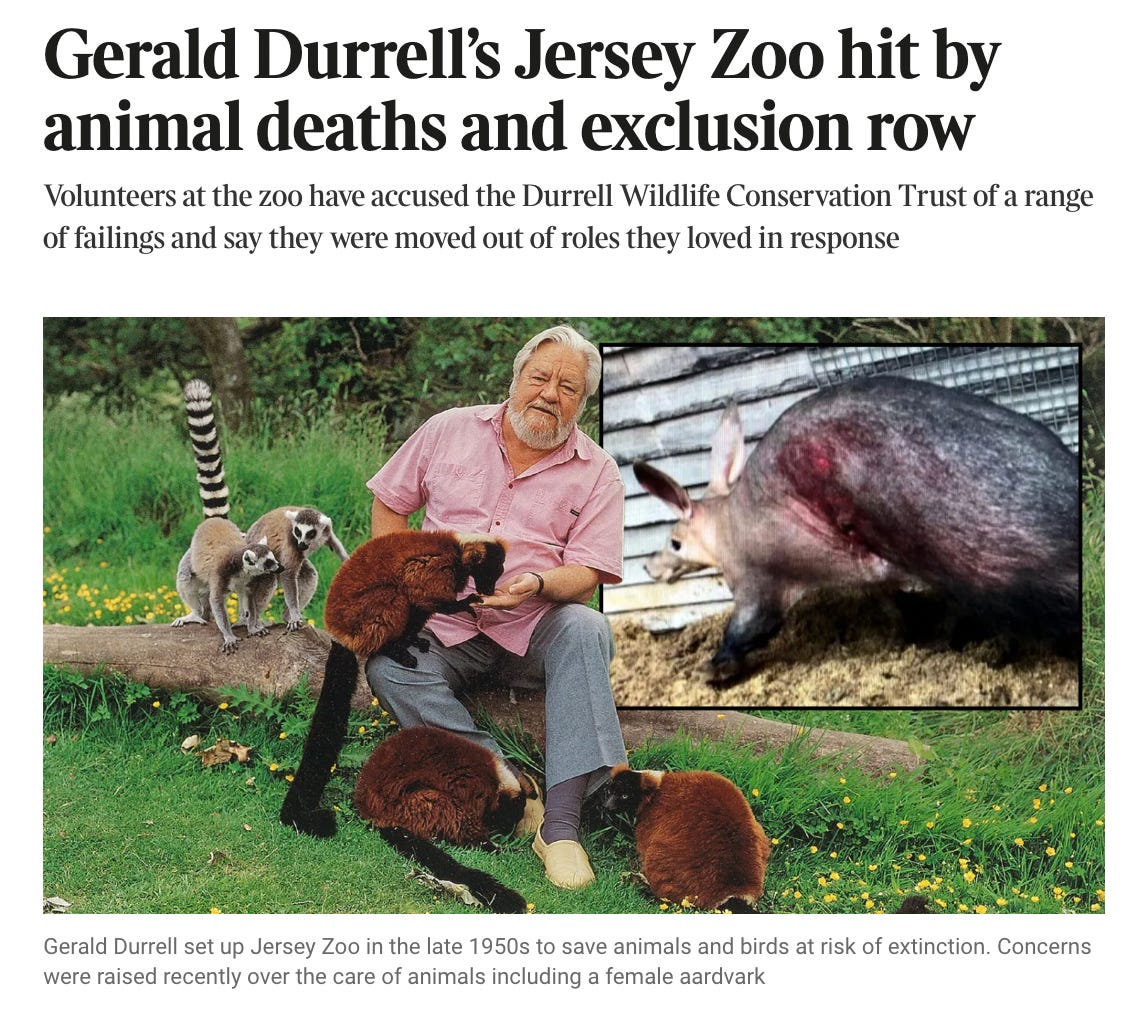
Gerald Durrell’s Jersey Zoo hit by animal deaths and exclusion row, Fiona Hamilton
Stubborn Attachments, Tyler Cowen
The Adventure of the Extraterrestrial, Mack Reynolds
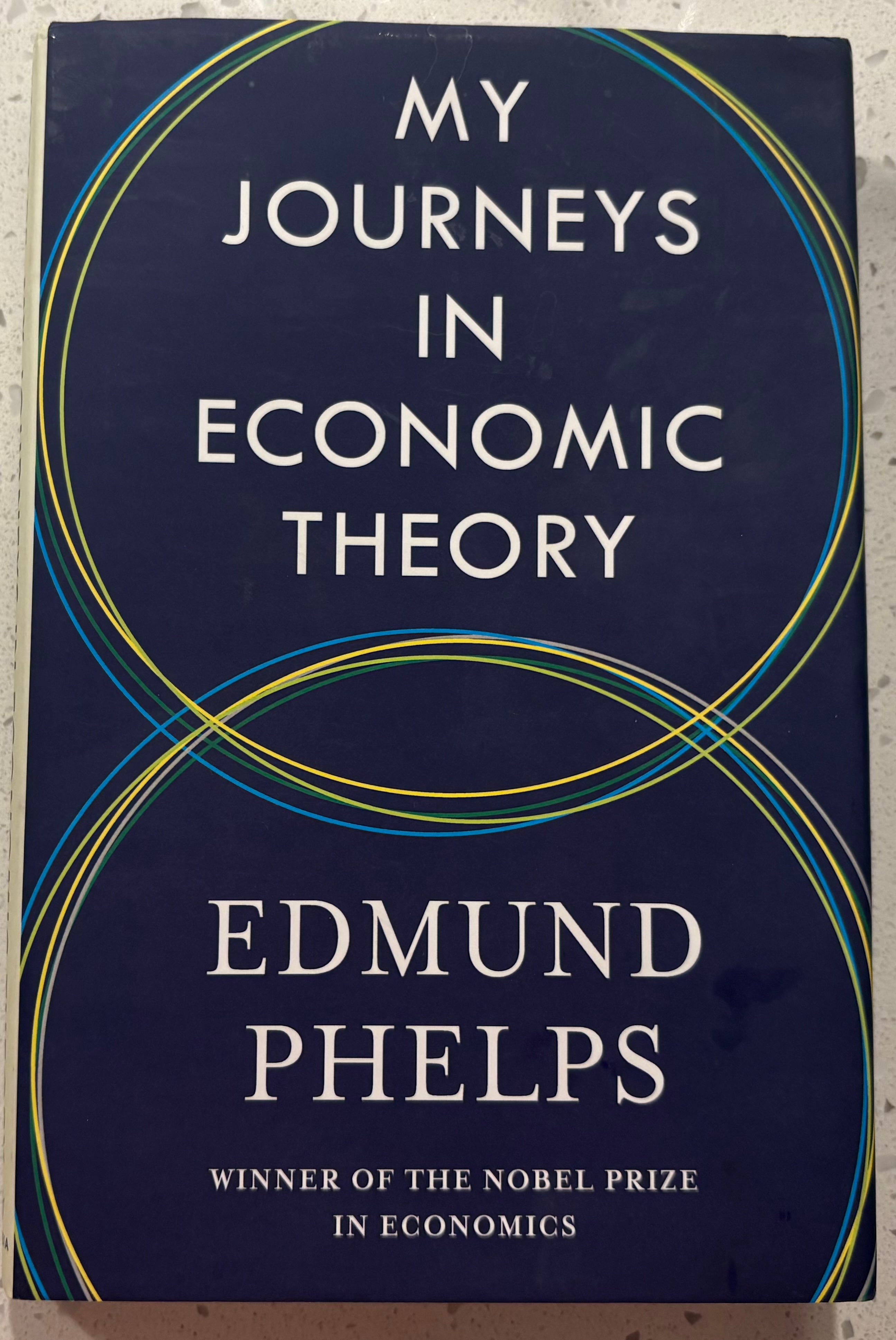
My Journeys in Economic Theory, Edmund Phelps
Der Vorname, Sönke Wortmann
This is the thirty-ninth in a weekly series. As with previous editions, I’ll move beyond things I’ve been reading, toward the end.
1) A fortnight ago, I started my weekly ‘top things’ post by discussing a recent Oliver Moody Times article, which exposed the bad behaviour of zoo keepers. On Friday, I read a follow-up exposé, this time by Times chief reporter Fiona Hamilton. So, at the risk of turning this Substack into a very specific animal-rights activism blog, here we are again.
Last time, the problem was that zoo keepers across the world had “got so good at producing and breeding” animals that they were stressing about how best to dispose of the excess. As I concluded in response, “[if] the reason you’re feeding the baby giraffe to the lions is that you’ve got too many baby giraffes for the size of your cage, then something has gone very wrong”.
This second exposé focuses on one zoo in particular: Jersey Zoo, which is best known for having been founded by the comic writer Gerald Durrell. According to Hamilton, Jersey Zoo has been suffering for a while from reduced donations and visitor numbers, and increased concerns about the treatment of its animals and whistleblowers.
Specific questions are posed in the article about the numbers of deaths of fruit bats, capybaras, pied tamarins, and howler monkeys. There’s a photo of a sloth living in a stairwell. And once again, the “we’re too good at breeding animals!” defence pops up, with a member of the zoo’s management team being described as having “said the zoo had been a victim of its own success because while the breeding programme resulted in increased numbers, the denser population meant the disease spread quickly”.
So I’ll repeat myself. If the reason your bats are dying from a nasty bacterial disease is that you’ve got too many bats for the size of your cage, then something has gone very wrong. Many ethical problems are really hard. This zoo stuff really isn’t.
2) On Friday, I released the latest episode of my new philosophy podcast, Working Definition. In each episode, I discuss a different philosophical concept with a different philosophical guest, with the aim of reaching a rough, accessible, but rigorous working definition. For this latest episode, I was joined by my friend and Mercatus colleague Tyler Cowen, to discuss freedom. You can listen to it — and read the transcript — here.
At the start of the episode, I mention that I particularly like Tyler’s book Stubborn Attachments. At its heart, this is a book about the broad value of pursuing economic growth. It’s also a book about how to address moral questions.
If you listen to our episode, you’ll see that Tyler and I have quite different ways of doing philosophy. You’ll also see that this doesn’t prevent us coming to some overlapping conclusions. One reason I like Stubborn Attachments is its upfront full-on commitment to moral realism, epistemic humility, value pluralism, and the principle “just don’t violate human rights”. These are fundamental starting points for me, too.

3) A few weeks back I wrote that I was rationing my access to the stories in Isaac Asimov’s edited collection Sherlock Holmes Through Time and Space. On Saturday, I read Mack Reynolds’ The Adventure of the Extraterrestrial. Here, an aged Holmes investigates the possibility that alien aggressors are living in London, at the behest of a young guy who shows up at Baker Street full of concern that his lord of the manor father is being conned by the ‘World Defense Society’.
While my evaluation of this short story is probably biased — I read it sitting in the sunshine next to an excellent swimming pool — I really enjoyed it. I’m yet to read a Holmes pastiche that doesn’t go too far in making fun of Doyle.1 But Mack juggles the ridiculous and the rational pretty neatly. If, like me, you think there probably is life beyond Earth, then this story makes for a better starting place than pinning your hopes on revelations about Roswell.

4) This weekend, I read some of Edmund Phelps’ autobiographical book My Journeys in Economic Theory. I particularly enjoyed the chapter about his engagement with the philosophy of John Rawls.
It’s very much an economist’s take. To Phelps, the fundamental concern of A Theory of Justice is how “working people come together to form an economy for the realization of their goals” [my italics!]. And because Phelps is so keen to discuss Rawlsian redistribution, he jumps straight into discussing the difference principle, even though Rawls is of course explicit that the difference principle only comes into consideration once his requirements around equal liberties and fair equality of opportunity have already been satisfied.
It’s a valuable and enjoyable economist’s take, all the same. Indeed, my assumption is that the many philosophers currently working on the conjunction of Rawls and economic theory or policy (and I know they’re out there because there are often talks on these things at philosophy conferences) would strongly benefit from reading Phelps’ relevant papers.
5) The other night I rewatched Der Vorname, an excellent German film about a dinner party, which I previously saw on board a plane. It’s one of those films that works like a play: there’s a very small cast, very little action, very few scene changes, and I don’t think there are any breaks in time. I won’t tell you why it’s called Der Vorname (though the English subtitles’ alternative title gives the game away, a little). But it’s all about the ‘what’s in a name?’ problem. I found it just as funny and just as philosophically annoying as the first time.

On this, check out Kingsley Amis’s short story (which the internet suggests is better known as a TV film) Doctor Watson and the Darkwater Hall Mystery. I haven’t read it in twenty years, but from memory it succeeds in making fun of Doyle and Amis in near equal amounts.