


TLDR:
Consider the Turkey, Peter Singer
‘Speaking of Objects’, W.V.O. Quine
Slaughterhouse-Five, Kurt Vonnegut
‘Last days of the lonely interstellar spacecraft’, Oliver Roeder
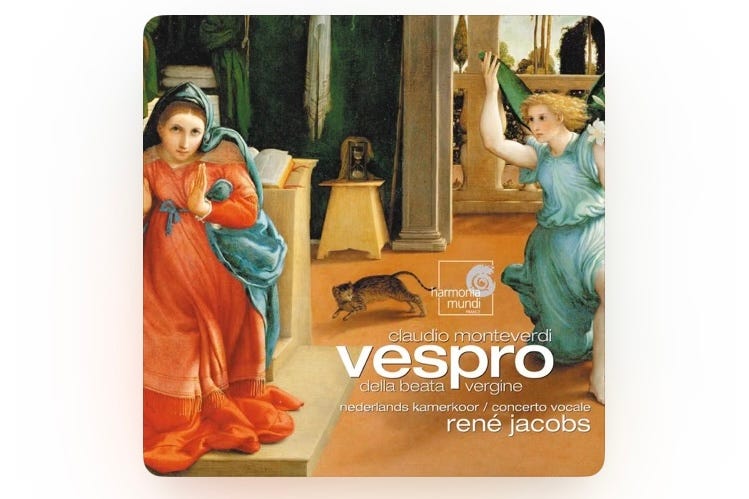
Monteverdi Vespers, René Jacobs’ 1995 recording
This is the second in a regular series. As with last week’s post, today’s includes only four things I’ve been reading, as the fifth is something I’ve been listening to. So you now have added reason to expect looseness in future, too.
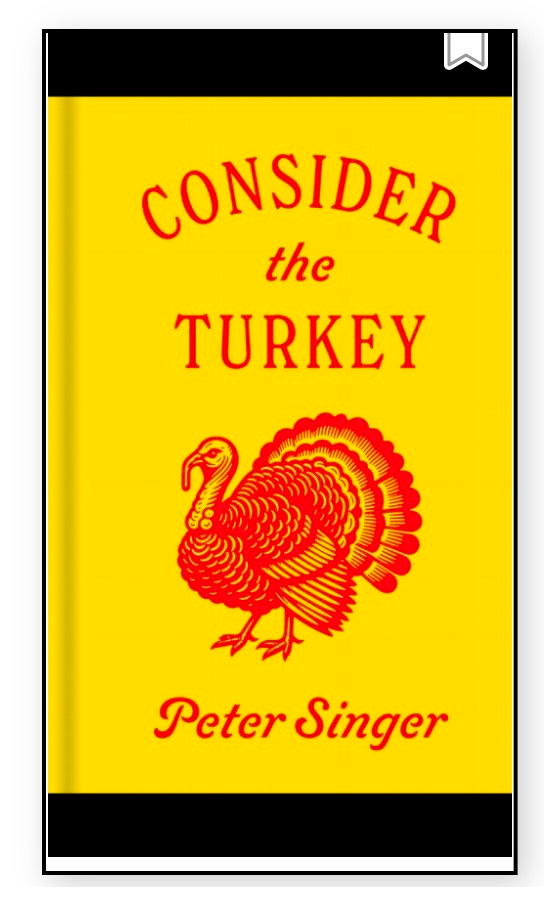
1) Consider the Turkey (2024) is Peter Singer’s latest animal rights book. If the problem with Singer’s previous animal rights books is that they inspire valuable social action at the cost of propagating bad moral theory, then Consider the Turkey is set up for success. This isn’t because this book propagates good moral theory, however. But rather, because it contains very little moral theory at all, at least explicitly. From the outset, Singer is clear he’ll focus on describing what goes on within industrial turkey farming, rather than theorising about it. That whilst he’ll finish by “sketch[ing] a simple ethical argument”, he believes his descriptions will suffice to persuade the reader. And it’s hard to imagine any reader sitting down at the thanksgiving table without a new sense of moral horror. But the same way that Singer depends on other people’s reportage of the evils of the turkey industry to make his case for its cruelty, the extremely short ‘ethical’ section — which you can find just before the more extensive ‘here are some vegetarian recipes by my friends’ section — is also largely second-hand. Singer races through a few examples of the standard moral takes, before giving us three paragraphs of lacklustre analogy between turkeys and dogs, along the lines of ‘hey you wouldn’t eat your similarly sentient family pet, would you?’. (He also seems surprisingly surprised to discover a Buddhist vegetarian.) Beyond this brief section, the little explicit moral talk in the book is jarringly anti-Singeran. Particularly, his repeated criticism of economists’ arguments for trading away the lives of individual animals, feels pretty on the beak. This isn’t to suggest there aren’t other implicit moral arguments smuggled in amongst the hard-hitting factory-farm nightmares, however, or indeed that Singer fails overall to convince. Just that it’s an odd book, on many levels.
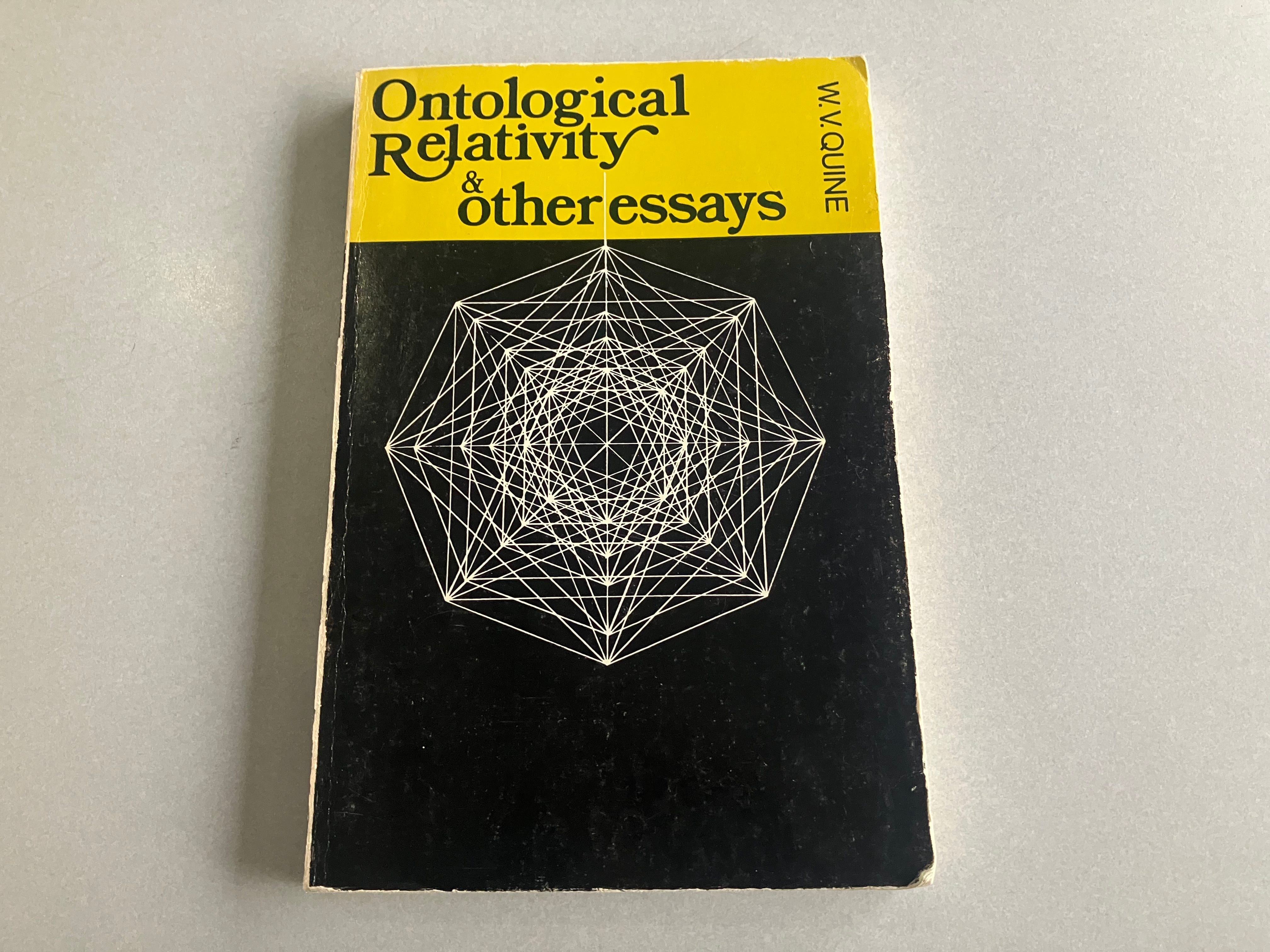
2) As part of my ongoing practice of reading classic twentieth-century philosophy papers, I returned this week to W.V.O. Quine’s 1957 ‘Speaking of Objects’ (which I’m biased towards because it’s the first essay in Ontological Relativity & Other Essays, which has, on my view, one of the best front covers of any philosophy book). It’s an article about objects. Or rather, it’s an article about talking about objects, and the extent to which we can do this with one another. Quine argues, for instance, that even if you become able to use a second language, you can’t know what a ‘native’ speaker of that language thinks exists in the world, through engagement with their seeming talk of objects: that you’re at risk of simply correlating your language with theirs, rather than entering into their ‘conceptual scheme’. And also that you shouldn’t assume that your children, through their early attempts to use your language, have the same grasp as you about what objects there are in the world, at least until they get the ‘knack’ of identity, and some other pretty sophisticated conceptual ‘devices’. And that all this has implications for our belief in objects. It’s in this paper you’ll find the famous ‘gavagai’ thought experiment.1 It’s also here Quine makes his offhand remark about how ‘Mary had a little lamb’ can be said in “either of two senses”, which is almost as hard-hitting a comment on the roast dinner as anything by Singer.
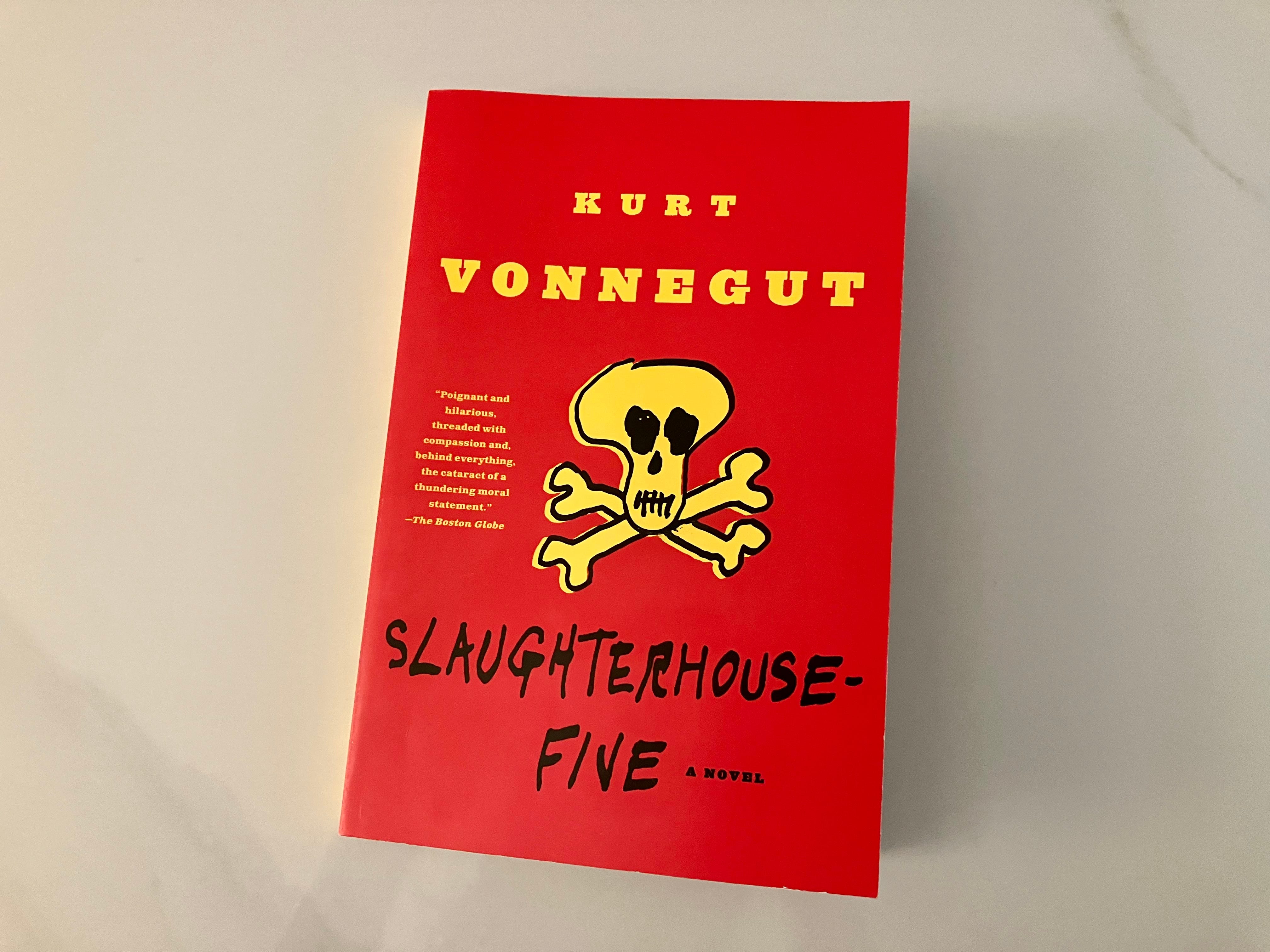
3) Kurt Vonnegut’s Slaughterhouse-Five (1969) is a short famous complex war novel, centred on the bombing of Dresden. Recently, I finally read it, after having intended to since I was a child. That said, on the understanding of its protagonist, Billy Pilgrim, my tardiness counts for little. Billy holds a strange deterministic view, on which everyone who’s ever existed always exists, always experiencing the things they were always going to experience. And Billy doesn’t just hold this view, he describes it happening: his life seemingly perpetuating in an almost perdurantist manner, uncontrollably skipping from one co-existing temporal part to another. To make things more confusing, Billy’s complex story is immured within the occasionally overlapping story of an unnamed narrator (perhaps Vonnegut, himself), and the whole thing is shot through with distracting asides (like, did you ever notice the relation between Jesus’s father’s carpentry job and Jesus’s means of death?), which you can’t help but stop and think about. As with the Singer book, I also had to skip a few of Vonnegut’s sentences, on account of their gruesomeness — particularly within a discussion of torture devices. So this book is not easy to read, in any sense. But I was an idiot to take so long to get round to doing so, and even if it didn’t exist in my mind beforehand, it’s never going away, now.
4) This week, I enjoyed Jonathan Amos’s BBC News article about the puzzle of Skynet-1A, an old UK satellite that mysteriously moved location. The best piece of space journalism I’ve read this year, however — indeed, one of the best pieces of any kind of journalism I’ve ever read — is Oliver Roeder’s ‘Last days of the lonely interstellar spacecraft’, for the FT. It’s a long account of the ever-ongoing journeys of the twin Voyager space probes, as they “now speed through the cold dark of interstellar space, beyond the influence of our Sun”. It reads like a restrained cross between William Gibson and William Blake: as with Vonnegut, every sentence counts, and somehow Roeder ties together the unworldly romance of space travel with the exactitude of an investment report. It’s fantastic.
5) The last few days, I’ve been listening to the Monteverdi Vespers a lot (mostly René Jacobs’ classic 1995 recording). I do this every so often, and each time I’m at least temporarily convinced it’s the greatest musical work ever written. This week, I came to the conclusion that I can focus this claim in on the Dixit Dominus: surely the greatest of all its great movements. The vocal soloists’ ensemble sections are some of the most memorable (try getting that ‘inimicorum’ echo out of your mind), and I love the opening textural crescendo. As with the first movement, however, perhaps the most wondrous thing is the energy and anticipation Monteverdi manages to afford to solid repeated block choral chords. Here, he doesn’t even envelop them in instrumental counterpoint and fanfares. It’s just one sung root-position chord after the same sung root-position chord, with a little bit of text-based rhythmic variation, and a lot of deep-rooted excitement.
You’ll find it in Word and Object (1960), too, and maybe some other places.
What list are you referring to for most influential philosophical papers? Would be fun to read ahead of time before reading your next take.
no list — just my own personal prefs I’m afraid! But I’ll probs include PF Strawson’s Freedom & Resentment next time :)