


Capitalism and Freedom, Milton Friedman
Autobiography, John Stuart Mill
‘The police weren’t interested’: what’s driving the rise in private prosecutions?, Hettie O’Brien
Would You Baptize an Extra-Terrestrial?, Jack Hitt
Tortas Frontera, O’Hare airport
This is the forty-seventh in a weekly series, a little later in the week than usual. As with previous editions, I’ll move beyond things I’ve been reading, toward the end. I’ll keep this edition brief as I already published something substantial here this evening.
1) My previous post this evening discussed some arguments about freedom, advanced by Milton Friedman in Capitalism and Freedom (1962). I enjoy reading Friedman, but I find his moral-theoretical approach frustratingly thin. For instance, as I wrote in that previous post:
Friedman states that the liberal’s “ultimate goal in judging societal arrangements” is “the freedom of the individual, or perhaps the family”. His use of the word “goal” here signals a focus on the value of outcomes — instead of, or above, the rights and freedoms just mentioned.
This foreshadows the opening section of the second chapter, where Friedman speaks of freely-reached “unanimity” as the democratic ideal, and where his foremost concerns about democracy are concerns about people not always getting their own way. Here, he makes the Hobbesian claim that “[f]undamental differences in basic values can seldom if ever be resolved at the ballot box; ultimately they can only be decided, though not resolved, by conflict”.
All this risks undermining the existence and value of reasoned political argument within democratic society, even about matters of basic values. It undermines the relevance of the persuasion and discussion and deliberation of free agents — of the parts of democratic politics that go far beyond the opportunity to vote once every few years. And when you think about this as Friedman’s conception of democratic possibility, then it’s not surprising he believes that politics must be centralised!
That said, it’s easy to fall into the trap of only focusing on what you see as the flaws when considering the arguments of fellow travelers. And an explicit aim of my previous piece was to raise objections to Friedman’s arguments. So I’ll end by saying that there are many things I agree with him about. Perhaps most of all, I share his unwavering belief in the good that capitalism can bring.
2) I gave a talk about John Stuart Mill on Monday, and in preparation I reread a load of the Autobiography (1873) and On Liberty (1859), and a smaller amount of the Principles of Political Economy (1848). Mill is another philosopher I enjoy reading but whose moral-theoretical approach I find frustratingly thin.
As you might have realised from the title of this Substack, and from any previous writing you’ve read here, I am quite obsessed by consequentialism, which I strongly believe to be bad and wrong. Mill, of course, did a great deal (perhaps the most of anyone, at least until Peter Singer came along?) to propagate consequentialist reasoning.
You can even see his life as instantiating its teleological quality. From the authoritarianly academic design of his childhood (how many times does Mill use the word ‘disagreeable’ in that section of the Autobiography?), to his supposed final words: “You know that I have done my work”, it’s a life directed toward the very specific goal of being a great philosopher.
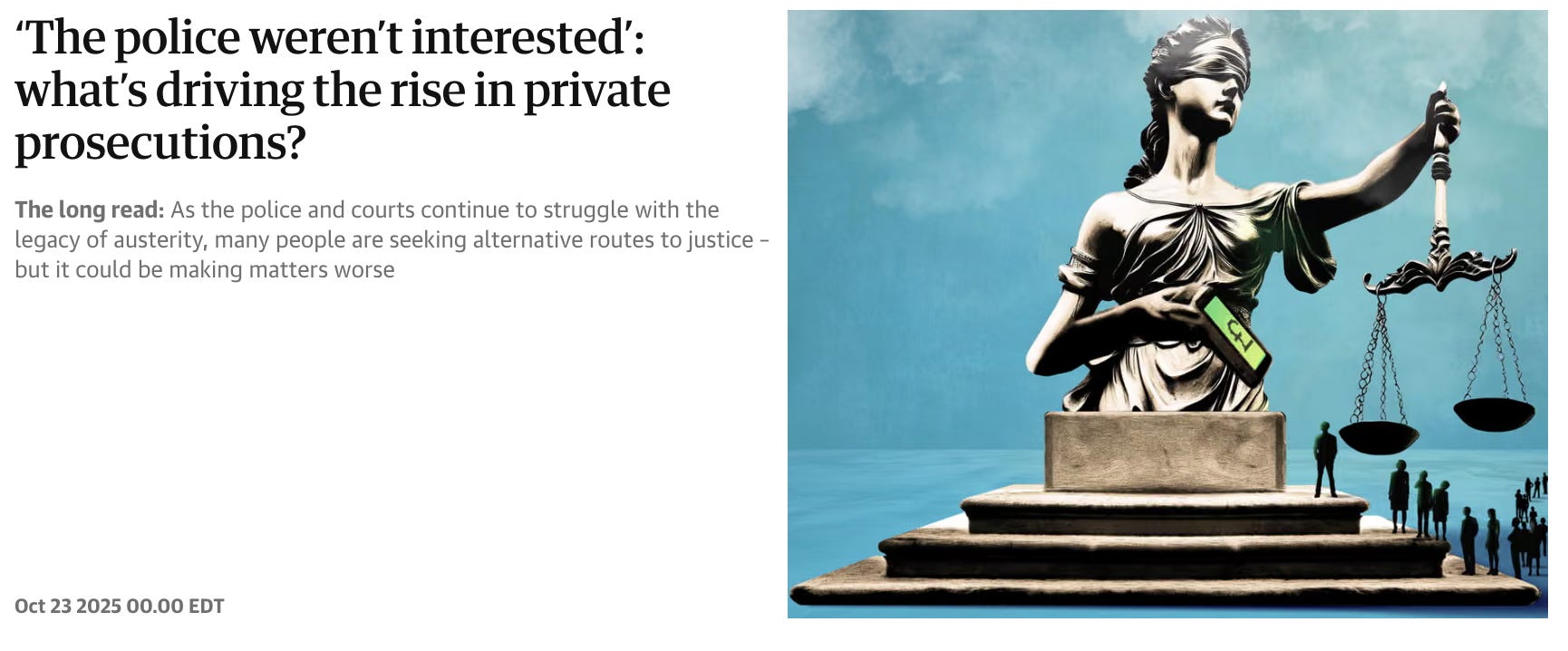
3) I didn’t agree with much of the framing of this recent Guardian piece about the rise, in the UK, of “pay for justice” private prosecutions. But it neatly brings together some big news stories of institutional failure — the courts backlog, police capitulation, the post office scandal — with the classic question of the extent to which, within political society, justice can be outsourced by the state. I’ve thought about this piece quite a few times since reading it.
4) A friend sent me this 1994 NYT Magazine piece about Jesuit astrophysicists. My favourite parts are the great Americana descriptions: Father Corbally bombing down the interstate in his 4-by-4; Father Coyne in his khakis, sweatshirt, and “square black glasses” at home in Tucson. Meanwhile, the somewhat cynical writer of the piece, Jack Hitt, tries to get slick answers to questions about the compatibility of Christianity and science. The title question, “Would you baptize an extraterrestrial?”, is one of the few yielding an assertive result.
5) The best sandwich I ate in the past week was at an airport. It wasn’t the best sandwich I’ve ever eaten, but it was perhaps the best airport food. It was a pork tortas at Tortas Frontera at O’Hare. In case you think I’m being contrarian for the sake of it, you can read this 2022 Washington Post piece by Natalie B. Compton to learn how boring my view is.

Thanks to ChatGPT for the Mill picture.
Wow, your analysis of Friedman's focus on outcomes over actualy rights really resonated. It's so important to unpack those definitions, especially when we talk about societal design. Great point!
Dang! Based on the timing, it's possible that article was an influence on the creation of a great novel, The Sparrow by Mary Doria Russell, about a Jesuit priest who visits a planet near Alpha Centauri. If you haven't read it, I recommend that you consider doing so...