


Dualism, Stanford Encyclopedia of Philosophy
The dear and detailed dream of your carved head, Iris Murdoch
Toronto’s underground labyrinth, Samuel Hughes
Should an AI copy of you help decide if you live or die?, Ashley Belanger
Dido and Aeneas, Opera Lafayette
This is the forty-sixth in a weekly series. As with previous editions, I’ll move beyond things I’ve been reading, toward the end.
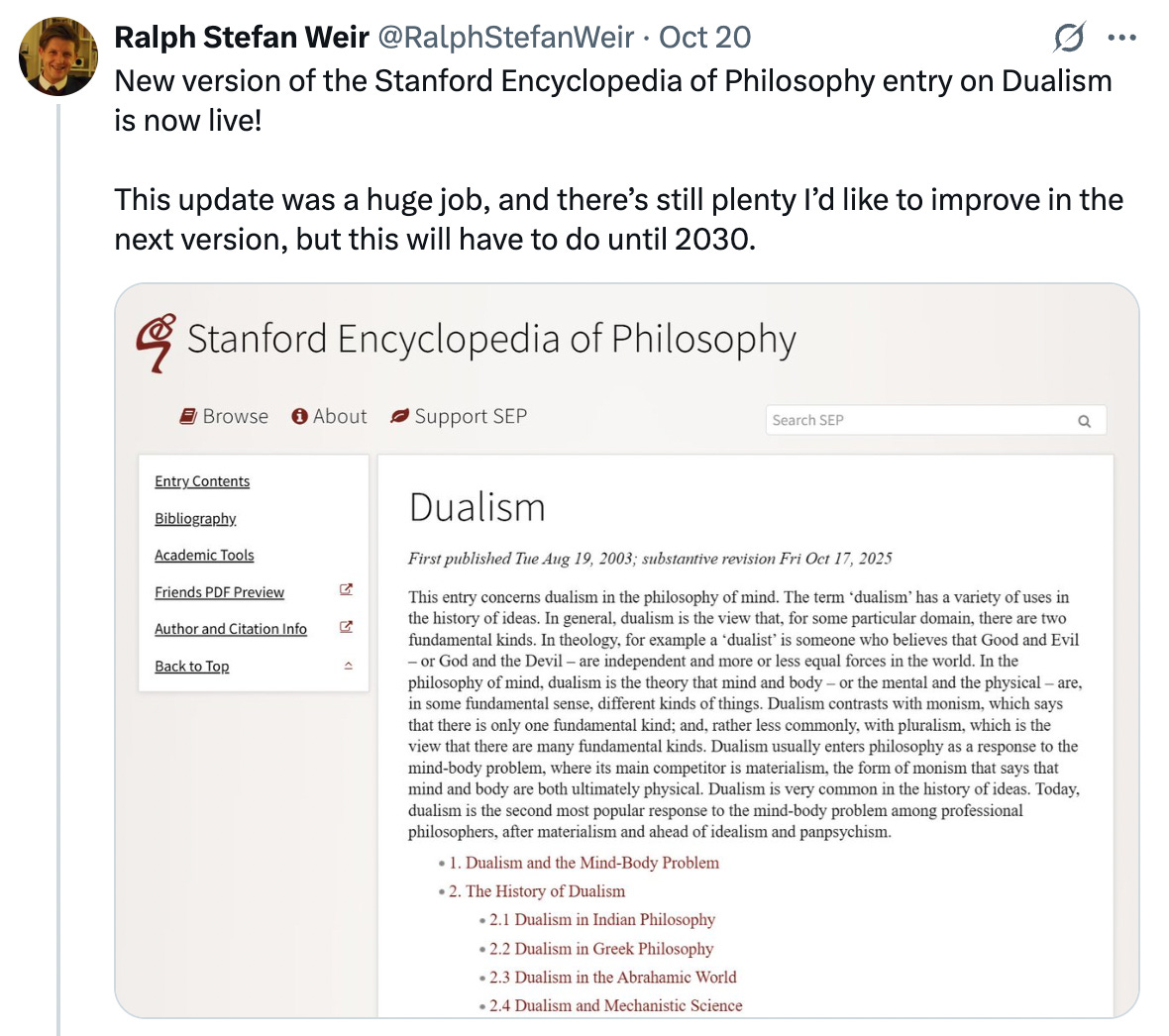
1) The thing I enjoyed reading the most over the past few days is the newly updated Stanford Encyclopedia of Philosophy entry on dualism, by Howard Robinson and Ralph Weir.1 As Robinson and Weir note, ‘dualism’ has many meanings in philosophy and more broadly. But as you might expect, their encyclopedia entry is focused on the philosophical position that “mind and body – or the mental and the physical – are, in some fundamental sense, different kinds of things”.
Robinson and Weir are extremely comprehensive in their discussion of this sense of dualism. They cover its global history, its standard “varieties”, the best-known arguments for it, and the best-known arguments against it. But along the way, they also provide neat, clear, discussions of much else. Rarely is a philosophical idea mentioned without a definition being provided; rarely is a philosophical position mentioned without an argument in its favour being outlined. This makes for a long and somewhat meandering discussion, but I enjoyed reading all of it.
Whether or not you’re interested in dualism, and whether or not you’re one of the odd people like me who not only instinctively, but also on reflection, totally buy it (Robinson and Weir relate the latest stats on this), I think you might enjoy it, too. There are different valuable ways to go about writing encyclopedia entries, and this one made me rethink some of my previous preferences.
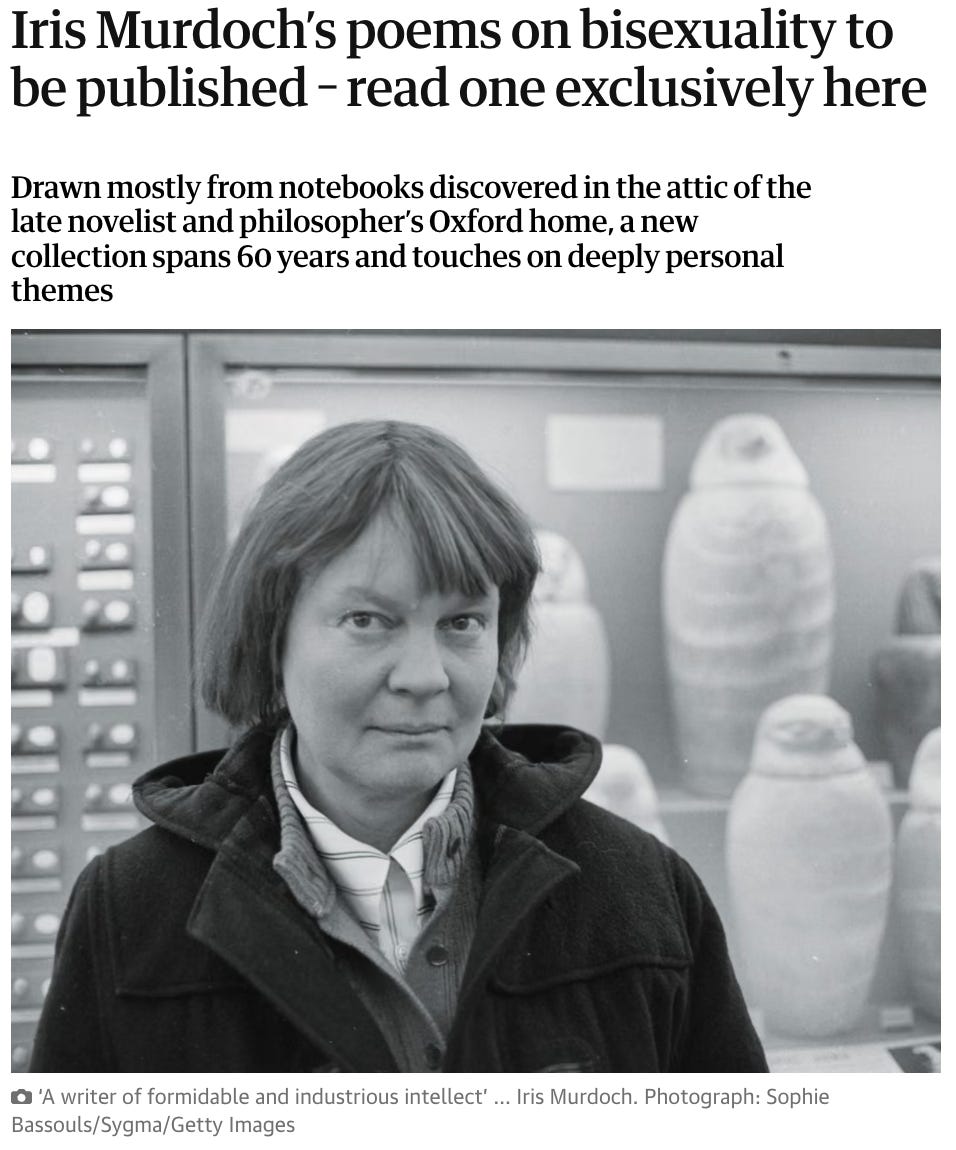
2) Just before beginning to write this Top Things edition, I read The dear and detailed dream of your carved head — a recently discovered Iris Murdoch poem, published in The Guardian this evening, and apparently written for Elizabeth Anscombe. It looks like a sonnet, but the way its first line trips you up — even if, as seems natural, you think of ‘carved’ as ‘carv-ed’ — signals something else.
I don’t like some of the phrasing of this poem, and most of its sentiments, but I think it’s good. I love a few of Murdoch’s novels: The Sea, The Sea is easily one of the ten best I’ve ever read. But I’ve never got anywhere with her philosophy (and I find the explicitly philosophical parts of her novels the worst parts). I’d put this poem right in between.
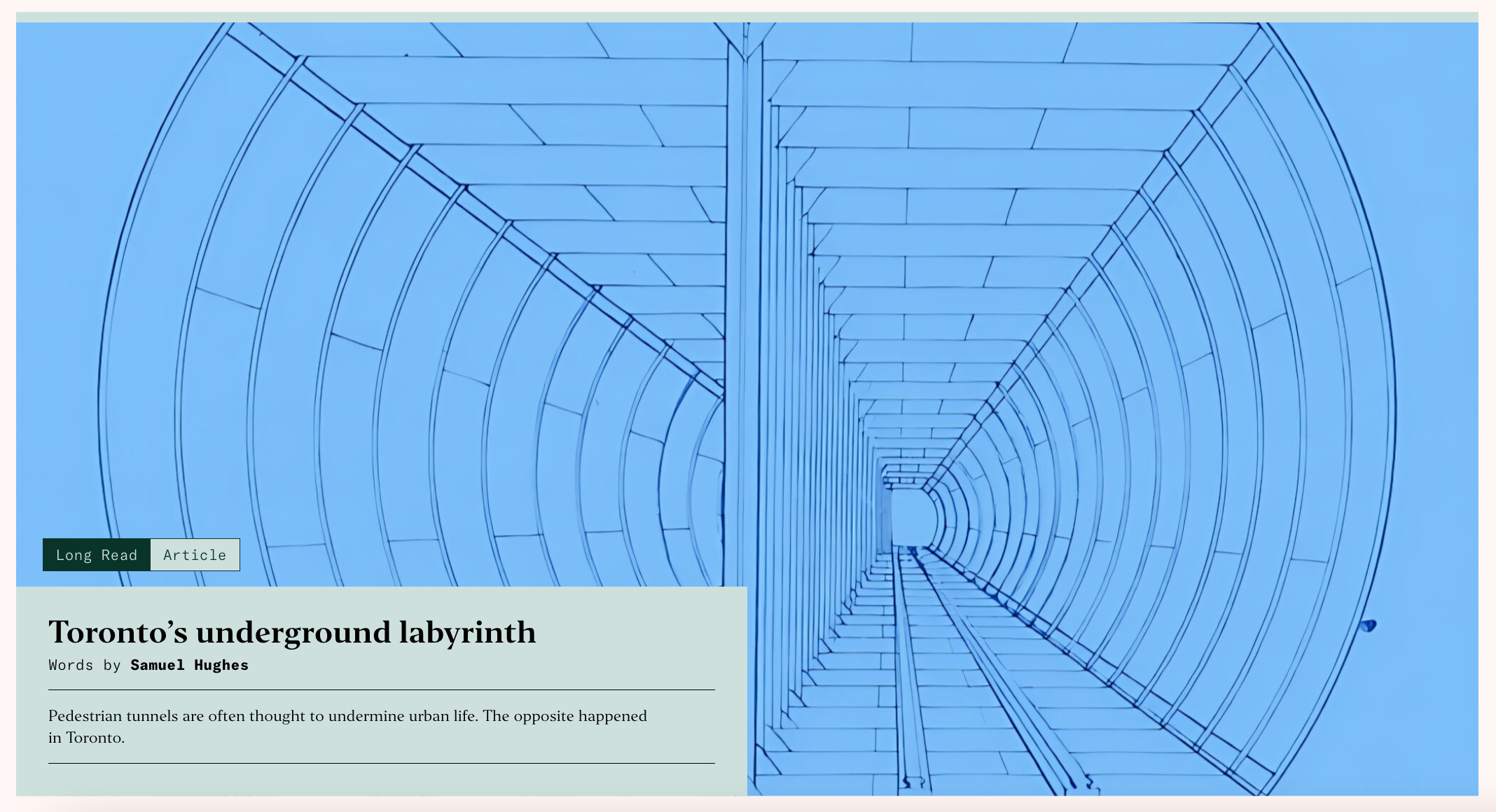
3) Toronto’s underground labyrinth is a recent Works in Progress piece by Samuel Hughes, about The Path — a set of pedestrian tunnels snaking under Toronto. I particularly liked the following hypothetical railway analogy:
“The Path is also interesting for what it tells us about transport economics. It is exceptionally unusual in forming an integrated network without having been developed by a single body. The equivalent would be a railway that was created piecemeal by uncoordinated landowners, with each adding small chunks until it stretched from one city terminus to another – a thing which, to my knowledge, has never happened.”
I enjoyed thinking about the implications of this feature of The Path for standard arguments about the state provision of Samuelson-type public goods — and reading Hughes’ discussion about reasons for, and the extent of, The Path’s distinctiveness.
4) All I’m going to say in response to this new Ars Technica piece is QTWTAIN.

5) I went to an impressive Opera Lafayette production of Dido and Aeneas last week, at the Sixth and I synagogue in DC. The singing was mostly excellent (particularly Belinda), the staging effective (particularly the death scene), and the playing extremely tight.

If you’re not a regular reader of the SEP, then you’re missing out. Most of the entries (of the many I’ve read over the years) are really strong. It’s one of the great internet resources.
The tunnel story does not have a comment section, so I will try to answer the question about Boston not having pedestrian tunnels. Boston is walkable above ground. The reason for the tunnels is due to weather. In winter time, it can be cold to walk outside in Boston, but you can dress for that. It is unusual that snow makes sidewalks impassible.
Note that Minneapolis has bridges between building that serve the same purpose, not having to walk outdoors through the snow.