


Decoding Without Pictures, Hollis Robbins
Nature, Ralph Waldo Emerson
Emergence explains nothing and is bad science, John Heil
The Adventure of the Global Traveler, Anne Lear
The ‘Scandal Room’, Watergate Hotel
This is the forty-fifth in a weekly series. As with previous editions, I’ll move beyond things I’ve been reading, toward the end.
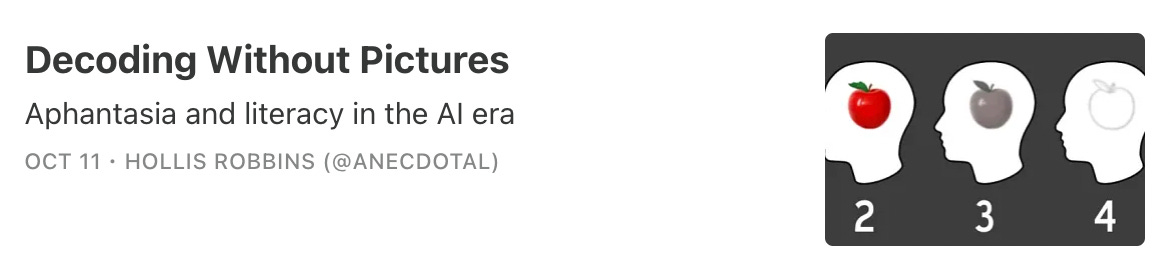
1) I learned from Decoding Without Pictures, a recent Substack piece by Hollis Robbins, that a standard method for teaching children to read involves telling them to picture things in their mind — things that the words on a page refer to. I have a particular interest in this because, like Robbins, I don’t have the capacity to picture things in my mind.
If I try really hard — uncomfortably hard — I can sometimes get what I think is a flash of something. But the more I think about my efforts to this end, the more I conclude that even these flashes might just be me thinking about what it would be like to experience them. I mean, sometimes, I think I can get a momentary glimpse of the red door to my childhood home, or of a close friend’s face as depicted in a photo I’ve looked at many times. But the idea of holding such things steady in my mind is unfathomable to me.
And when I try to test my ‘glimpsing’ out — over and over, which feels increasingly bad — I become less convinced I can even get a glimpse. Or perhaps it’s that I’m limited to a single glimpse every so often, or when I’m not really trying... I genuinely don’t know! I mean, I sit here trying so hard to see the cherry red of my Nats baseball cap, and I can’t. Even if I look at the cap immediately before shutting my eyes, I fail. Rather, I get something more like the feelings of colours, or ideas about them.
Relatedly, I can access none of the details of a painting that I haven’t explicitly thought about while looking at it, no matter how many times I’ve seen the painting, or how well I feel I know it. So I can tell you some things about the floor in Holbein’s Ambassadors, even though I can’t picture the Ambassadors floor. But I can’t tell you what either of the two guys’ ears look like — or even if their ears are showing under their pointy hats. Sad!
All of this is to agree with the emphasis of Robbins’ piece, which is that the ‘picturing things’ approach no doubt has disastrous effects. I feel extremely sorry for aphantasic children who are being ‘taught’ to read this way. It won’t only be a non-starter for such children, they likely won’t realise why this is the case. I mean, even though awareness of aphantasia is growing, I presume partly owing to its common co-occurrence with autism, I didn’t know such a thing existed until a few years ago, when I read a philosophy piece about it. And by saying that I didn’t know it existed, I don’t just mean I didn’t know the term for it — I simply didn’t know that most other people could truly picture things in their minds.
I’ve been able to read since before I can remember. But for kids with aphantasia who haven’t grown up in a house full of books, who didn’t have the chance to learn to read before arriving at school, I can only assume that being told authoritatively by teachers to do the impossible could be a quick route into dissatisfaction with reading. Perhaps forever. And as Robbins powerfully argues, these children “will remain invisible because the harm is diffuse and the practice is ubiquitous. No one is systematically tracking which students fail because they’re being taught to do something their brains don’t do”.
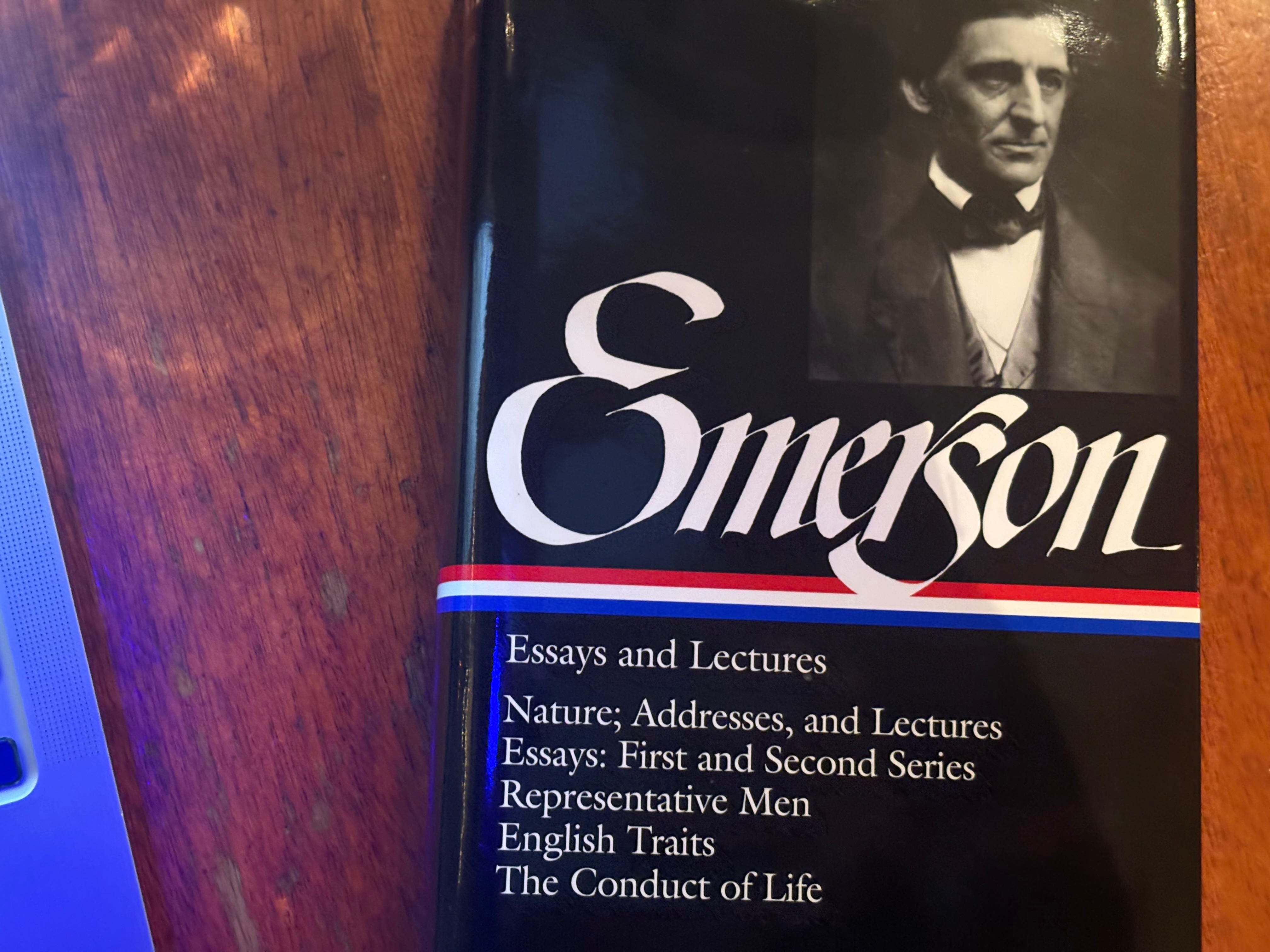
2) I read some Emerson essays over the weekend, but the only one I really liked was Nature (1836).1 Love (1841), in particular, I found pedestrian, in both style and vision. I’d say it’s cliched, but Emerson probably got there first on at least some of its content!
Nature is good, however. There’s a central focus on the stars, as an exemplar of nature as an everyday representation of the sublime. Emerson wants us to believe that nature retains the capacity to exhilarate, comfort, and inspire even those people who’ve seemingly lost their sense of wonder. In the woods, we can “cast off [our] years”, he tells us. “In the woods, we return to reason and faith.”
I like that Emerson doesn’t present these moments of woodland “wisdom” as a substitute for lost wonder — in the depressing way he presents “cheerful disengagement” as a substitute for lost passion, in Love. Rather, both are present within us, he suggests. And nature “reflects” this, mirroring our moods both good and bad.
3) The philosophy essay I enjoyed reading the most this weekend, however, was this new IAI piece by my friend John Heil. I’ve written before about how much, in particular, I like John’s book The Universe As We Find It (2012). This new piece overlaps with that book in various ways, including a focus on the relation between parts and wholes. Here, parts and wholes are discussed with a view to helping expose flaws in philosophical dependence on the concept of ‘emergence’.
Emergence is best-known today for its role in the consciousness debate. That is, an increasingly popular answer to the ‘hard problem’ — which asks how we flesh and blood creatures can experience phenomenological interiority — involves the move that somehow our bodies are more than the sum of their parts, and that consciousness is the happy emergent extra bit.
John explicitly sidesteps the consciousness debate in this piece, however, to address the “mechanics” of emergence, more broadly. He argues first that “competing accounts [of emergence] appear to be accounts of entirely different phenomena”. This makes emergence different, he points out, from causation, for instance, because while the “nature of causation” is of course the subject of competing philosophical accounts, causation is at least generally taken by philosophers to happen. Second, he argues that the most supposedly promising accounts of the explanatory value of emergence are confused in themselves.
The whole piece is clear and compelling. But I particularly like the point John makes, toward the end, that wholes are sometimes taken to be more than the sum of their parts by people who have mistakenly conceived of these wholes as bland “aggregates of atoms or molecules”, instead of acknowledging the complex ways in which their “dynamic” parts interact and change. Over-aggregation comes with costs in domains beyond moral theory, this should remind us!
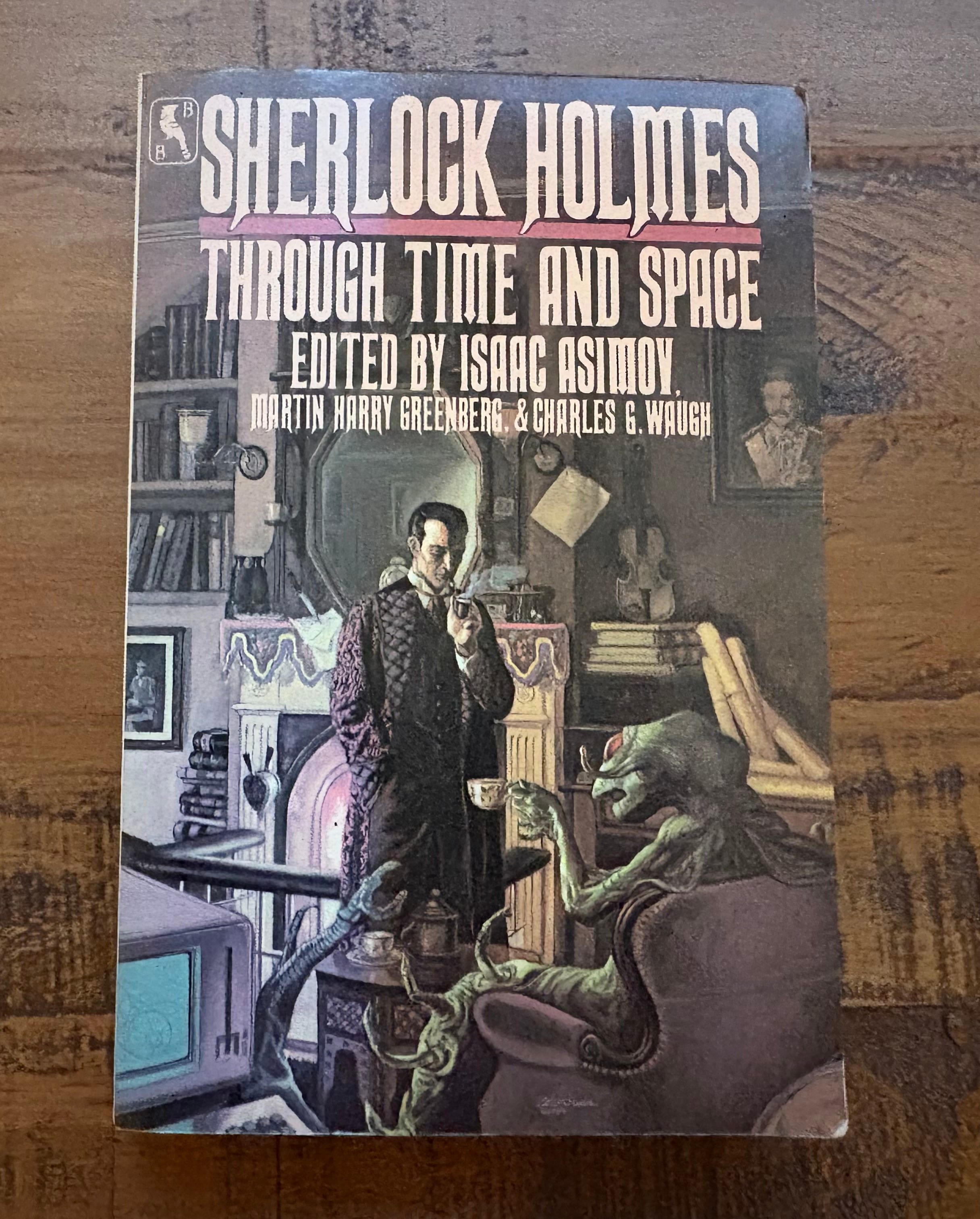
4) In August, I wrote that I was rationing my access to the stories in Isaac Asimov’s edited collection Sherlock Holmes Through Time and Space (1984). More recently, I returned to the collection, and wrote about Mack Reynolds’ The Adventure of the Extraterrestrial, in which, as I put it, “an aged Holmes investigates the possibility that alien aggressors are living in London”.
Yesterday, I read Anne Lear’s The Adventure of the Global Traveler, in which none of the Holmes characters appear, except for one exciting one, in secret epistolary form. I don’t want to wreck the many-layered surprise of this story. But I particularly enjoyed the line, “My work led me eventually to construct a machine which would permit me to travel into the past and future”. In the middle of an overwritten adventure story, this provides a moment of calm understatement — and the key to a clever conclusion.
5) I was going to write here about the American Art Museum’s current Experience America exhibition, and its focus on the New Deal-era Public Works of Art Project. But then, yesterday evening, I saw the room at the Watergate Hotel where the Nixon-downfall burglary was coordinated. It’s aesthetically pretty cool. I particularly enjoyed its (useful) view over the main road toward the river, and the little bridge that (usefully) connects its balcony to the building next door.


I mean the opening chapter of Emerson’s 1836 lengthy work Nature, which takes the form of a short essay also entitled Nature. Not the longer essay, also called Nature, from 1844. I haven’t read the 1844 one yet, but I hope I’ll like it, too.
That’s a good essay on emergence! I’ve been ruminating on some early Buddhist (Madhyamaka) and Hindu (Vaisheshika) literature on the relationships between parts and wholes recently. What a time to be alive when these very old questions have real, practical, everyday consequences in the planet’s economy. Thank you for the recommendation.