


Are disadvantaged workers who take hazardous jobs forced to take hazardous jobs?, G.A. Cohen
Weather Forecasting Satellites: Past, Present, & Future, Etai Nardi et al
Ender’s Game, Orson Scott Card
Infinite Worlds, Michael Soluri
Devil’s Playground, Lucy Walker
This is the fifty-seventh in a weekly series. As with previous editions, I’ll move beyond things I’ve been reading, toward the end.
1) Today, I reread the great G.A. Cohen article Are disadvantaged workers who take hazardous jobs forced to take hazardous jobs?.1 Every time I read this article, I get more from it. It is perhaps my favourite thing that Cohen wrote, even though he clearly should’ve saved the disjointed end section for another day. And even though I can think of good objections to many of the arguments about freedom he makes in this article, I’m convinced that they are arguments that all philosophers interested in freedom should engage with.
The big argument at the heart of the article runs like this:
“If you are forced to do A, you do A. But, if you do A, you are free to do A: you cannot do what you are not free to do. So, if you are forced to do A, you are free to do A.”
Cohen attempts to refine this argument in various ways, some of which don’t help. For instance, I think his conception of choice becomes whittled away. But there’s a lot to be taken from his claim that this argument — or something quite like it — brings together the “leftists” who are keen to focus on how disadvantaged workers are ‘forced’ to take on hazardous jobs, and the “rightists” who are keen to focus on how such workers are ‘exercising their freedom’ to take on such jobs. It is wrong to assume, as most people do, that these positions are contradictory, Cohen tells us — just read the big argument, and see!
There are so many other things to take from this paper, however. Today, I particularly enjoyed the opening section, in which Cohen sticks up for the value of ordinary language philosophy. The value of this kind of philosophy imbues the article. It’s why its arguments are so clear and beautiful to me, even when I think their substance is wrong. Even when I think their substance is crazy!
Cohen’s substance got less crazy, over his lifetime. Particularly significant to this were his early gradual turn away from core Marxist commitments and his later acceptance of the practical limitations of socialism. Think about how, in Self-Ownership, Freedom, and Equality (1995), he says Marxists should think hard about why they’ve been ignoring the importance of equality. Think about how, in Why Not Socialism? (2009), he can’t bring himself to dismiss standard feasibility objections.
At his best, Cohen is the paradigmatic analytic political philosopher — committed, above all, to applying methodological rigour to the search for the truth, no matter the costs to his long-held beliefs.
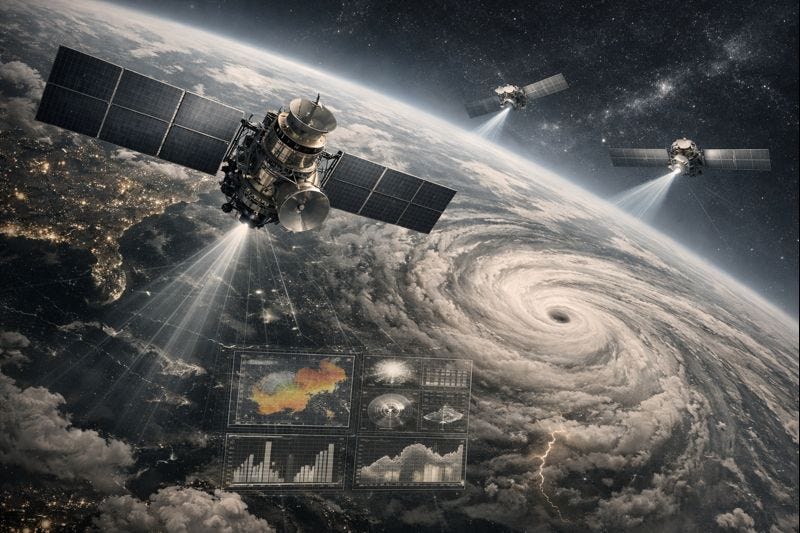
2) As someone living through a snowmageddon who’s interested in space, I’ve been enjoying reading about the role satellites play in weather forecasting. Weather Forecasting Satellites — Past, Present, & Future (2025) provides a useful overview of the development of the field since the 1960s. Etai Nardi and his co-authors afford great emphasis to the importance of building weather observation systems that can collect, analyse, and report ‘near real time’ information.
The success of such systems remains limited, we learn, by ‘satellite revisit rates’ — i.e., how often a satellite can monitor a specific location. Yet thankfully, it seems that technological development (including AI, which is given less prominence in this paper than you might expect), in combination with the bulked capacities of new multi-national collaborations, make improvements likely soon.
“Ultimately”, the paper concludes, “the driving force behind these technological achievements remains clear: to safeguard human life by improving our ability to predict, monitor, and respond to increasingly complex weather and climate phenomena”. This is even though its authors have just told us about the ongoing role of military incentives!
I’ve written before about the significance of the role military spending plays in space progress:
“the Space Foundation (2024) has calculated that, in 2023, global military space budgets grew 18 per cent on the previous year, totalling $57 billion, and comprising almost half of total government space expenditure. And Euroconsult, which published similar figures, claims that 2023 was the first year in which more was spent on these military budgets (which it calculates at $58 billion, and describes as “defence expenditures”) than on civil programmes (Euroconsult, 2023).”
3) On topic, other things I’ve been enjoying reading this week include Orson Scott Card’s American sci-fi classic, Ender’s Game (1985). It’s the story of Ender, a young boy sent up into space to train to be a war hero. I might write about this novel in more detail some other time. But one question that keeps arising is whether Ender is being trained to provide defence against the Earth’s potential aggressors, or to win power against his nation’s supposed Earthly allies…

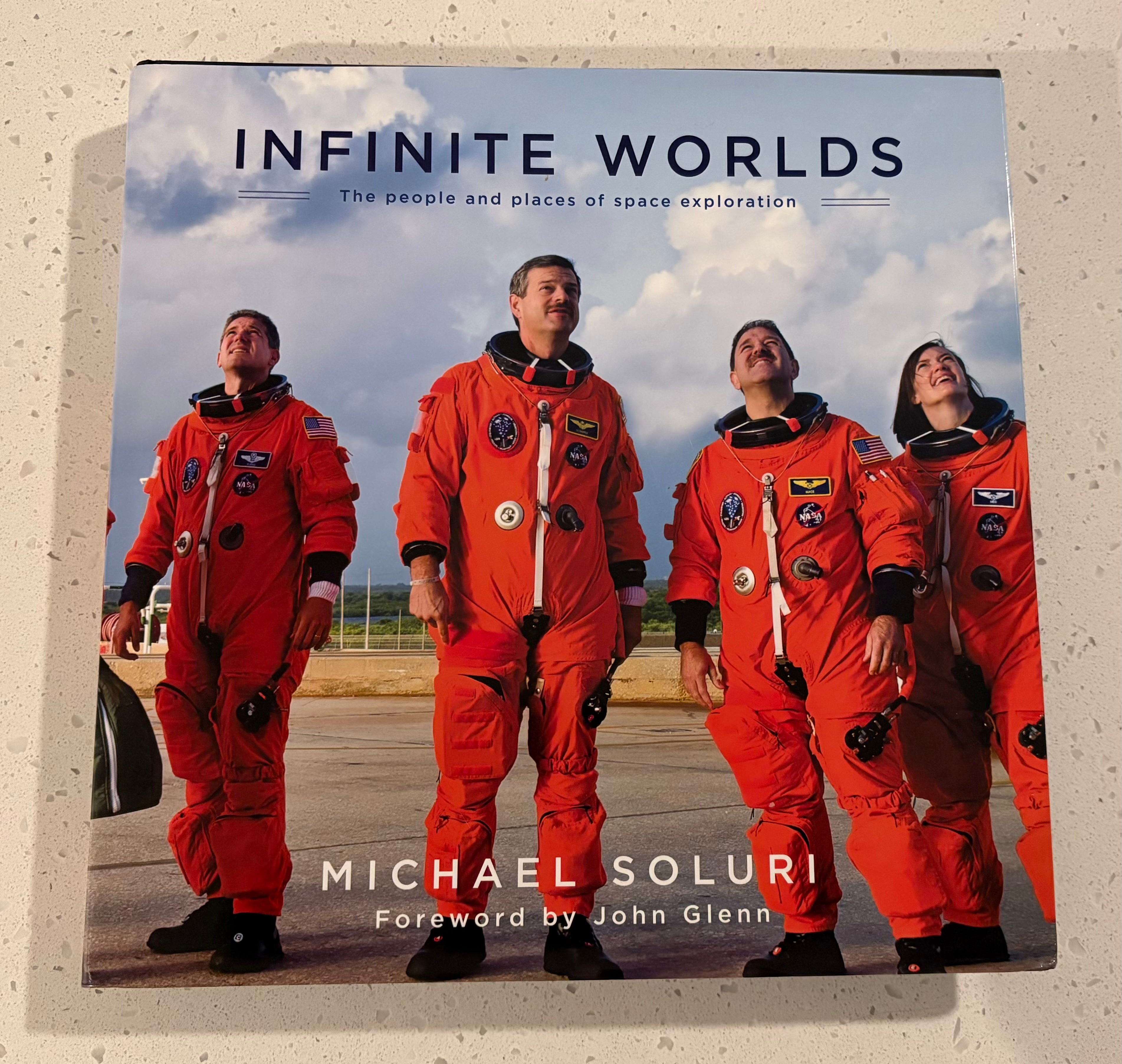
4) My current favourite space photography book is Infinite Worlds by my friend Michael Soluri. It’s full of astonishing behind the scenes NASA shots, ranging from astronauts practising under water, to rockets ready to blast into the sky. I think my favourites, however, are the close-up portraits of tools on white backgrounds: the bright blue of the high torque connector that’s been used inside the Hubble telescope; the delicacy of the metallic mini power drill employed on EVAs. Everything here is art.
5) At the weekend, I watched Devil’s Playground (2002), a documentary about rumspringa. Rumspringa is a period of time in a young Amish person’s life, starting around age sixteen, when they try out other ways of living, to help them decide whether or not to commit to the Amish church for the rest of their life.
If we take the documentary at face value, then these ‘other ways of living’ entirely cohere around cigarettes, alcohol, drugs, sex, and — seemingly just for the boys — cars and ‘English’ clothes. ‘English’ is the term the teenagers in the film use for non-Amish people, but it seems particularly to track the everyday trends of the modern West.
Now, perhaps some Amish teenagers try out other ways of living aside from partying hard — perhaps they experiment with options like returning to school (having generally left around age 14), working for non-Amish employers, and experimenting with other religions. But the partying option is clearly attractive both to the teenagers, and to the wider Amish community, as a ‘getting it out of their system’ experience.
For some of the documentary’s subjects, this proves really hard. Faron, a compelling central figure, struggles with meth addiction. He also can’t seem to move beyond his dependency on the Amish network, no matter what he’s doing or where he goes.
Velda, however, finally manages to go it alone. She’d also partied hard during her rumspringa years — largely, she tells us, to try to overcome depression and suicidal thoughts. Valuable support was available to her as an in-patient at a psychiatric hospital, but her parents made her come home. By the end of the documentary, however, Velda has built a life for herself, working as a receptionist and planning for her future: “When I was a young Amish girl, I never dreamt that I would have a career”.
The best moment of the film is when we witness her delighted amazement at gaining a place at college.

Thanks to GPT for the satellites picture.
The version in History, Labour, and Freedom (1988).