


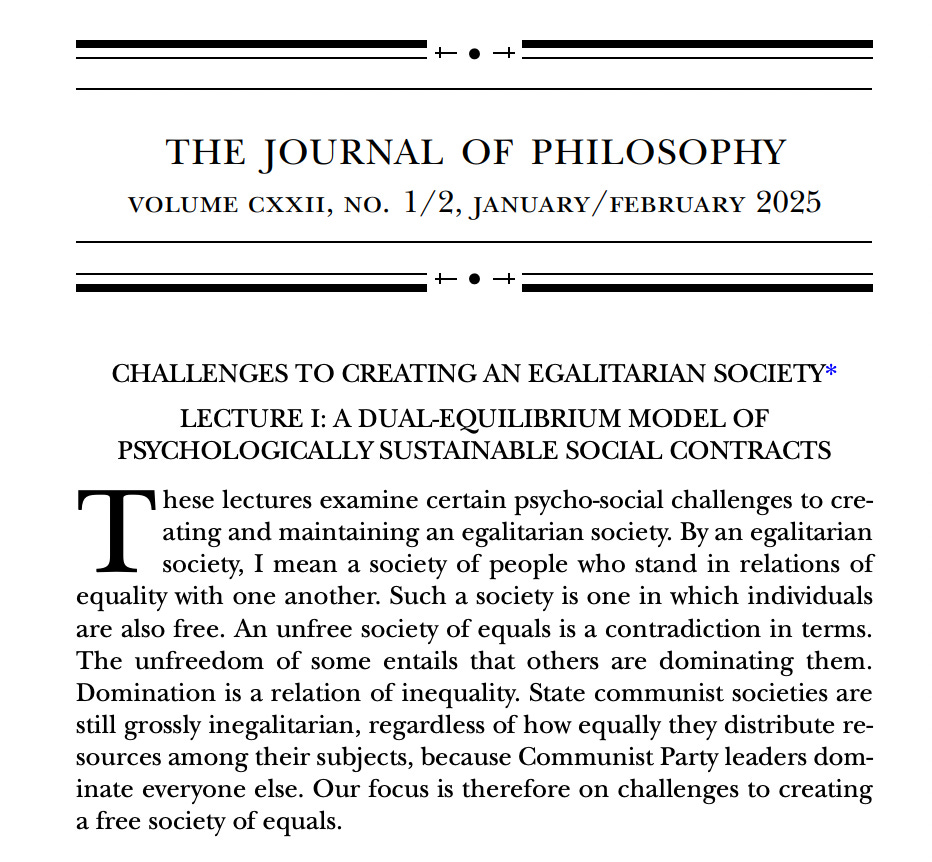
A Dual-Equilibrium Model of Psychologically Sustainable Social Contract, Elizabeth Anderson
Human Rights, Rationality, and Sentimentality, Richard Rorty
The Quiet American, Graham Greene
Wes Streeting announces investigation into ‘failing’ NHS maternity services, Guardian
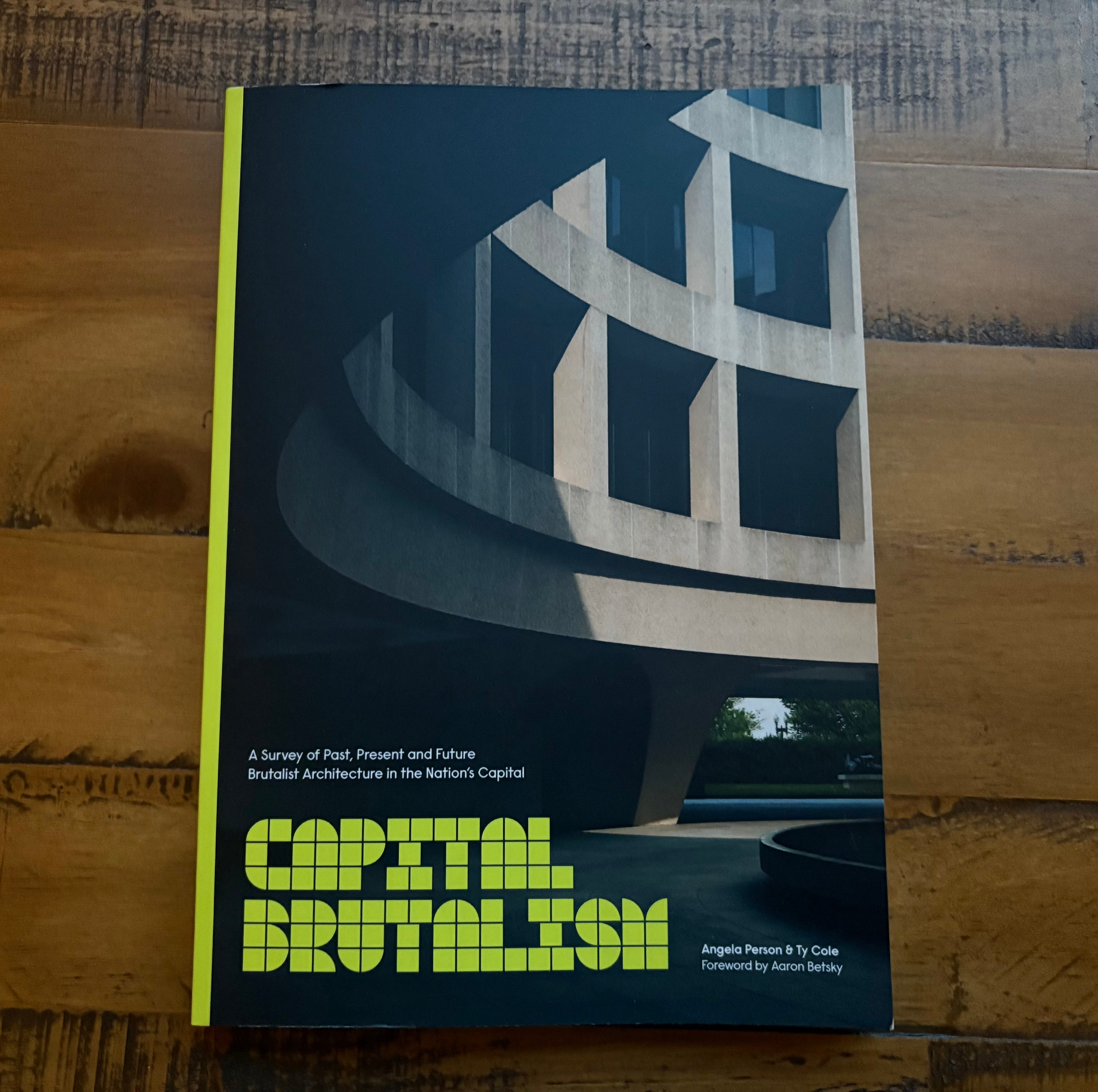
Capital Brutalism, National Building Museum, DC
This is the thirtieth (!) in a weekly series. As with previous editions, I’ll move beyond things I’ve been reading, toward the end.
1) Elizabeth Anderson is known for her writing about equality. Often, the focus of her attention here isn’t the receipt of goods, or access to opportunity, but standing — in the sense of a person’s status as an object of other people’s concern. Of course, the actual standing that any person is held in may well depend on the goods they’ve acquired or the opportunities they’ve experienced. But Anderson’s attention is on something deeper: the truth that we are each other’s equal, and that this holds both at the fundamental level of our shared humanity, and at the contingent level of our mutually-held valuable societal memberships.
At the societal level, Anderson and others often refer to this kind of egalitarianism as relational. In her best-known paper, What is the Point of Equality? (1999), Anderson goes as far as claiming that the “proper positive aim of egalitarian justice is not to ensure that everyone gets what they morally deserve, but to create a community in which people stand in relations of equality to others”.
Anderson is by no means a classical liberal, but you can see the idea of equal moral status ranging across classical-liberal (and classical-liberal-adjacent) thought, from John Locke to contemporary democratic theorists like Josh Ober. I like this idea a lot.
Indeed, it frustrates me when supposed individualists fail to acknowledge that the basic moral rights we each hold as individuals derive from our shared moral status as human beings: that my basic moral rights derive from my humanness, not my Rebeccaness! And that there are further political and social moral rights that we each hold equally as members of particular political societies: the right to a fair trial, for instance, means little if you’re not living in a society bound by positive law. And also that the overbearing state isn’t the only threat to individual freedom: you don’t have to accept Anderson’s hardcore critiques of capitalism to agree with her that many workers are oppressed by their bosses. A failure to recognise these things can drive you into the hands of authoritarianism.
Anyway, Anderson has some new writing out on equality. It comes in the form of three papers, originally given as Dewey Lectures at Columbia, and published earlier this year by The Journal of Philosophy. On Sunday, I read the first of these papers: A Dual-Equilibrium Model of Psychologically Sustainable Social Contract.
The focus of this paper is on the psychological barriers that stand in the way of realising and maintaining relationally-egalitarian societies. That is, Anderson explicitly sets aside institutional limitation concerns here, such as the practical and epistemic barriers that central planners always come up against when they try to allocate resources in line with their chosen ideals of outcome. Instead, she focuses on answering the question “why is it so hard to dismantle social hierarchy and prevent its resurgence?” through a psychological lens.
Some useful context here is that Anderson sees social hierarchies as the nemesis of the relational egalitarian. Social hierarchies, to Anderson, are to be fought. Now, I’ll set aside my automatic objection that some kinds of social hierarchy are surely valuable — the hierarchy on which we have certain expectations of the top surgeon that we don’t have of the junior doctor, for instance.1 After all, Anderson’s focus here is on bad hierarchies, such as “racism, slavery, aristocracy, and patriarchy”, and how to “create a free society of equals” to replace the oppressive societies within which these bad hierarchies obtain. I’ll also set aside my objection that ‘create’ sounds overly interventionist, and accept that Anderson is aiming at modelling rather than enforcing.
Through engagement with a rolling cast of anthropologists, Anderson concludes that hierarchical and egalitarian societies, alike, are “social contract societies”, and that both of these types of society depend for their establishment and sustenance on the similarly substantive motivating moral concerns of their members. That is, Anderson argues that: 1) the social contract, seen as a “social-theoretical” explainer, rather than a hypothetical or actual consent mechanism from which to derive legitimacy or justification, can help us to understand two very different kinds of norm-based social order. She also argues that: 2) at the heart of both the “domination contract” and the “egalitarian contract” is a deep Rousseauvian desire for “recognition from others”.
Cashed out more fully, Anderson’s view is that hierarchical societies are societies based on domination contracts — contracts that appeal to the human desire to dominate, as driven by our greed to acquire superiority of esteem over others. Whereas, the societies we should be aiming for are those based on egalitarian contracts — contracts that appeal to the human desire to protect the equal esteem we are owed from each other. Then, the final piece of the puzzle is that Anderson believes that both of these societies are maintained by a kind of esteem-driven equilibrium:
“Thus, we arrive at a dual-equilibrium model of social possibilities that broadly supports Boehm’s view. [Boehm is an anthropologist, whose idea that humans are “despotic”, in their ape-like nature and their tendency for dominant and submissive behaviour, Anderson effectively accepts from the start of the paper.] Humans are capable of forming both egalitarian and domination contracts. Each type of contract mobilizes certain common motivations and dispositions in its own way. The desire for esteem and standing motivates dominance behavior: in domination contracts, often as the very substance of superior esteem and standing; in egalitarian contracts, in self-defense against others who try to dominate. Fear motivates submissive behavior: in domination contracts, of all subordinates; in egalitarian contracts, of those who violate the rules of the egalitarian order. The desire for autonomy drives resentment of real or imagined submission. Resentment motivates resistance to actual domination contracts. However, it can also be activated by deceptive ideologies, advanced by members of advantaged groups, to motivate resistance to egalitarian social movements by representing them as movements to subordinate, insult, or disfavor them. These motives and dispositions are present in all societies and can be activated for egalitarian or hierarchical ends. Though social contracts establish institutions and practices to stabilize and reproduce themselves, the availability of these motives for opposing ends always poses a potential threat to the status quo.”
I quoted the whole of that section to try to give you an idea of why I found this paper both appealing and annoying. Anderson’s writing is mostly extremely clear. And as ever, she obviously cares deeply about freedom, equality, and their interrelation.
But what often isn’t super-clear within this paper is: 1) the distinction between what’s Anderson’s own view, and what’s her reportage of other people’s views; and 2) the distinction between what’s Anderson’s own view about how things should be, and what’s her view about how things are. Moreover, her reliance on what a cynic might call cherry-picked anthropological arguments does her little good. I mean, minimally, presumably these arguments are contested within anthropology? Who knows? I’m just a philosopher.
All that said, if at heart, what Anderson is arguing is simply that, as autonomous creatures, we humans have reasons to push for our own interests and also to protect ourselves against the extremes of other people doing the same, and that this often comes out in the form of relational-egalitarian-relevant domination and anti-domination, then sure. Of course this ties us together in midst of pushing us apart: it’s the manifestation of the unbreakable bond of human equality underpinning the expansive flexibility of human freedom! And of course it’s present in societies that are more and less free. John Locke said this stuff centuries ago.
2) As part of my ongoing project of reading classic twentieth-century philosophy papers, this week I returned to Richard Rorty’s Human Rights, Rationality, and Sentimentality (1993). The first time I read this paper, it frustrated and even disturbed me. At the practical level — and it’s very much a practically orientated piece — it’s a paper about intergroup conflict. Specifically, it’s about how to get the members of one group to recognise the interests of the members of another group, at least to the extent of refraining from violating their human rights.
Rorty opens by citing David’s Rieff’s discussion of some extremely graphic examples of human rights violations carried out by Serbs during the Bosnian War. For Rorty, Rieff’s comments exemplify a standard response to such atrocities, on which it’s assumed that human rights violators have failed to recognise the humanity of their victims. The Serbian human rights violators did not “think of themselves as violating human rights”, Rorty takes Rieff to conclude, because they did not see their Muslim victims as humans. Rorty then goes on to emphasise that the standard response to this, too, takes a similar form. In other words, that “we in the safe, rich, democracies” typically conceive of these overseas human rights violators as animals, themselves — or at least “as more like animals than us”.
Rorty spends the rest of the paper trying to work out how to prevent human rights violations. He begins by criticising the way in which philosophers have standardly seen the solution as lying in increased recognition of the exceptionalism of our shared humanity. That philosophers from Plato to Kant, and beyond, have said something like, ‘Hey, if only we could get Group A to see that what they share with Group B is that they are both groups of human beings, and that human beings are really special, then all would be ok!’. Rorty sees this answer as falling within a tradition of “human rights foundationalism”. And he takes as central to this tradition certain claims about the objective truths of human nature — claims that coalesce around the idea of human beings as rational bearers of inalienable rights.
Rorty makes two overlapping arguments in response. First, he argues that human rights foundationalism is “outmoded”. That is, he accepts that the “human rights culture” that has arisen over the past century is morally superior to other cultures. But to Rorty, this doesn’t “count in favor of the existence of a universal human nature”. We needn’t conclude, he tell us, that “respect for human dignity […] must presuppose the existence of any such attribute”.
Second, Rorty argues that a reliance on human rights foundationalism can be surpassed by a new focus on “sentimental education”, as a means for deflating violent intergroup conflict. Rorty means by this that we should capitalise on the way in which humans are “moved to action by sad and sentimental stories”. On our capacity, that is, not for knowledge or for reason, but for sympathy. He refers here to “the sort [of reaction] that white Americans had more of after reading Uncle Tom’s Cabin than before”, and “the sort [of reaction] that we have more of after watching TV programs about the genocide in Bosnia”. Rorty believes that these reactions can motivate us to treat each other in less violent ways: that there is great power in realisations like “her mother would grieve for her”. This kind of education, he thinks, can bring us closer even to the “smirking racist”, because it enables us to move beyond “why should I be moral?”, and towards “why should I care about a stranger, a person who is no kin to me, a person whose habits I find disgusting?”.
There is surely space for such a project. But ultimately, this is a defeatist paper. That is, it’s not only that Rorty gives up on the value of persuading the world about the shared moral status of all human beings — he gives up on a load of other fronts, too. He doesn’t properly get on to the deep problem of epistemic fallibility because his pragmatist “doubts about the effectiveness of appeals to moral knowledge are doubts about causal efficacy not about epistemological status”. And he jettisons the idea of obligation. Rather, his biggest commitment is to the thin value of effectiveness. He’s betting away morality on his assumption that the sentimental route will bring about better outcomes!
Aside from any empirical counters to this conclusion, the classic problem therefore arises that, if we stop furthering the idea that equal moral status obtains as a matter of objective truth, then why should we — or anyone else — really care about stuff like group conflict? I mean, ok, it seems clear that Rorty does want an end to human rights violations. But if he isn’t willing to argue that it’s true that we’re moral equals, then why that goal over competing ones? As with the last time I read this paper, I came away convinced that Rorty does care about the bigger unspoken goal at the heart of this paper: the goal of bringing about the objective human good. But that he just doesn’t think that members of other groups ever will. Sad!
3) My favourite Graham Greene novel is Our Man in Havana (1958). The Graham Greene novel I’ve enjoyed reading the most is The End of the Affair (1951), because I read it on my first-ever night-train journey, from Milan to Paris, a long time ago. (Indeed, that may rival the Boxing Day I once spent in front of my grandparents’ log fire reading Middlemarch as my top novel-reading experience.) On Saturday, I read The Quiet American (1955), which on various counts was published pretty much bang in the middle of Greene’s career as a novelist.
It’s a story about three people: Fowler, a reserved English war journalist; Phuong, a beautiful Vietnamese woman; and Pyle, the enthusiastic yet ‘quiet’ young American who is Fowler’s competitor for Phuong’s affections. Phuong doesn’t get much of a look in on the direction of anything, to be honest. There’s this telling moment when Fowler, holed up in a storeroom on an army base, and about to be burst in upon by an apologetic Pyle, thinks, “I wondered, but oddly without jealousy, whether Phuong was at the flat. The possession of a body seemed a very small thing — perhaps that day I had seen too many bodies which belonged to no one, not even to themselves. We were all expendable.” Speak for yourself!
Thin romance aside, The Quiet American is an important comment on the legitimacy of intervention. A topic that doesn’t go away.
4) As this Guardian article reports, a “national investigation” was finally launched last week into the UK’s catastrophic maternity-service failures. As I wrote a few months ago:
“A recent Oxford report tells us that the rate of UK women dying whilst pregnant, giving birth, or soon after, recently rose to the highest level in almost 20 years. And that UK women from socio-economically deprived and some ethnic-minority groups face a higher risk, by multiples, than their white and less socio-economically deprived comparators. Meanwhile, a House of Lords Library paper emphasises that “in November 2023, around two-thirds (67 per cent) of England’s maternity units received a CQC rating of ‘requires improvement’ or ‘inadequate’ on safety”. And in 2022, the Guardian reported that the UK’s maternal mortality rate was higher than many other European countries including France and Italy, and three times higher than Norway.”
Last week’s Guardian article highlights further failings. It quotes the Health Secretary, Wes Streeting, referring to the way in which bereaved families “describe being ignored, gaslit, lied to, manipulated and damaged further by the inability for a trust to simply be honest with them that something has gone wrong”. It also quotes Streeting stating that, “Probably the most shocking statistic in this area is that we are paying out more in clinical negligence for maternity failures than we are spending on maternity services.”
It’s hard to know how you’d begin to determine which statistic is the most shocking in a case like this.

5) On Saturday, I went to the National Building Museum’s exhibition on DC brutalism. I enjoyed the architectural sketches and other related artefacts on display, but the Ty Cole photos at the centre of the exhibition deserved a show of their own.
In some of her other writing, I think it’s fair to conclude that Anderson accepts this kind of distinction. But in this paper, it often feels as if she is opposed to all social hierarchies. For example, very early on she states: “Egalitarian social movements have historically defined themselves in opposition to particular forms of social hierarchy, such as racism, slavery, aristocracy, and patriarchy. Egalitarians are astute critics of social hierarchies along every ethical dimension: hierarchies are unjust and oppressive; they are bad for individuals, communities, and the environment; and they promote vice and corruption. Yet egalitarians cannot simply abolish hierarchy, as one might eradicate an infectious disease. Hierarchical institutions coordinate individuals’ conduct for socially necessary functions such as material production, child-rearing, and collective self-defense. Hence, egalitarians must envision replacements for these institutions that can serve these functions while up- holding individuals’ equality and freedom.” I think it’s really hard not to interpret this as oppositional to all social hierarchies!