


Sense and Sensibilia, J.L. Austin
On the Calculation of Volume 3, Solvej Balle
What We Talk to When We Talk to Language Models, David Chalmers
Living in artificial gravity, Angadh Nanjangud
Sure on This Shining Night, Samuel Barber
This is the fiftieth (!) in a weekly series. As with previous editions, I’ll move beyond things I’ve been reading, toward the end.
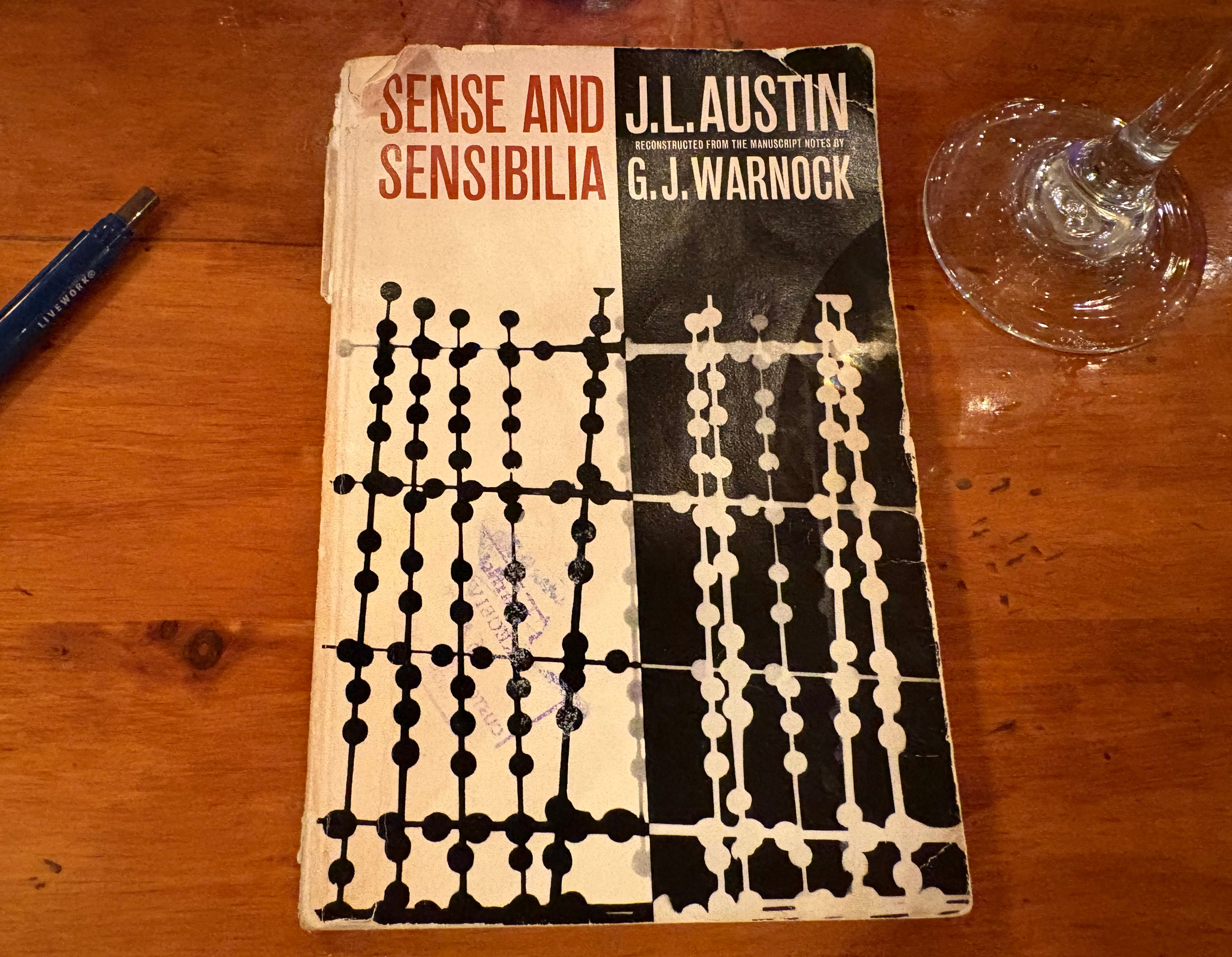
1) This is my fifth post about J.L. Austin’s Sense and Sensibilia. My last update was back in August, when I was in Ghana, and Austin was still on about the ‘argument from illusion’. Yesterday, I decided it was finally time for Chapter Seven.
This is the chapter in which Austin gives his full attention to ‘real’ — a word he’s been making jokes about since page 15, when he used it as an example of a “snake in the linguistic grass”. It’s a great chapter. I’ll restrain myself to discussing two of the many things I like about it.
First, I like the distinction Austin draws at the beginning of the chapter between: 1) “normal” words, like ‘real’, which have become “firmly established” in ordinary language through widespread everyday usage; and 2) words that “only philosophers use”, like ‘material thing’. You can have fun thinking up your favourite one-word example of the latter..
Drawing this distinction helps Austin to argue that there are some words philosophers shouldn’t “fool around with ad lib”. So, according to him, it’s ok for us philosophers to do what we want with specialist philosophical terms, “within reason”. Whereas, he tells us that normal everyday words (“most words”) come with all kinds of factual padding around their usage, which should be taken into account before meddling. Thankfully, he caveats that this doesn't mean we can’t try to “revise the map” of these normal words a bit. But he warns that doing so is rarely easy, and that it often seems necessary only because such words have been “misrepresented”.
There’s much more to be said on this topic. But if you believe — as I think most people do — that the central purpose of uttering words is to communicate,1 then you should take Austin’s warning quite seriously. Of course, as you might have guessed from the snake comment above, Austin then goes on to argue that the word ‘real’ is “not a normal word at all”! Nonetheless, his distinction can stand the loss of that example, and you can have fun thinking up another..
A second thing I like about this chapter is Austin’s list of four “salient features” of the usage of ‘real’:
a) Austin tells us that ‘real’ is “substantive-hungry”. By this, he means it’s a qualifier that you can’t use without knowing what it’s qualifying. Here, think about how the ‘real’ in “Hey, Pinocchio, you’re a real boy now!” means something quite different from the ‘real’ in “Is this the real life, is this just fantasy?”. Austin is pointing out that we can never know which kind of ‘real’ is being referred to, unless this is clarified through its attachment to a word like ‘boy’ or ‘life’.
b) Austin tells us that ‘real’ is a “trouser-word”. By this, he means it’s a word that you come to understand from its “negative use”, in the sense that “it is the negative use that wears the trousers”. Here, he gives the example of how ‘a real duck’ differs from ‘a duck’, in that ‘a real duck’ is used “to exclude various ways of being not a real duck”. In other words, when ‘real’ is appended to ‘duck’, it’s the implication of a ‘non-real duck’ that helps us to understand what work the word ‘real’ is doing.
This is a nice point. But I think what Austin might really (ha) mean here is that ‘real’ is a negative trouser-word, rather than just being a trouser-word. This is because it seems to be the negativity, rather than the trousers, that’s wearing the trousers in Austin’s point. I mean, aside from anything else, doesn’t his phrasing “it is the negative use that wears the trousers” imply that there are non-negative trousers words, too?
c) Austin tells us that ‘real’ is a “dimension word”. By this, he means it’s a word that is the most “general and comprehensive” example in a group of terms that “fulfil the same function”. Here, he wants us to accept that words such as ‘fake’, ‘genuine’, ‘authentic’, ‘dummy’, ‘live’, ‘hallucination’, and so on, are less fundamental variants of ‘real’ or ‘non-real’. So the idea he’s getting at is that words like ‘real’ can act as general terms grounding a set of particularised offshoots.
d) Austin tells us that ‘real’ is an “adjuster word”. By this, he means it’s a word that allows us to expand our use of other extant words when we come across something we don’t have a word for. Here, he uses the example of seeing an unknown animal that looks like a pig. ‘Like’, he tells us, is an adjuster word, because it enables us to discuss the unknown animal without having to come up with a new word for it. Although he then confuses things by trying to convince us that ‘quasi’ and ‘ish’ don’t count as adjusters..
Anyway, that’s the four!
You might be wondering, however, what all this does for Austin’s overall argument in Sense and Sensibilia. I mean, if you’d read my previous four instalments about this book, then you’ve probably been wading through all this waiting for an update on whether you really (!) saw the chicken salad sandwich you ate for lunch, or whether it was just an impression your brain created.
We’ll come to that next time, when in Chapter Eight, Austin will use some of his conclusions about the word ‘real’ to bolster his ongoing attack on A.J. Ayer’s account of perception.
For now, I just want to say that there are few things I’ve enjoyed reading more this year than this chapter about ‘real’. And that I’m happy to leave my discussion of the “four salient features” of its usage at this largely exegetical level — even though I have more to say about each of them — because I’m writing about some of this stuff in a paper I’m currently working on, for an upcoming conference organised by the excellent Victor Kumar. Maybe I’ll post my paper here, as a follow-up..
2) The third instalment of Solvej Balle’s On the Calculation of Volume series was published on Tuesday, and I read it that evening. It was just as good as I hoped! But I’m intending to write something here soon about how Balle uses these novels to engage with the container theory of time — because I think that’s philosophically worthy of a post of its own. And tomorrow I’m recording a podcast about the latest volume with Henry Oliver. So I’ll leave Balle here for now!
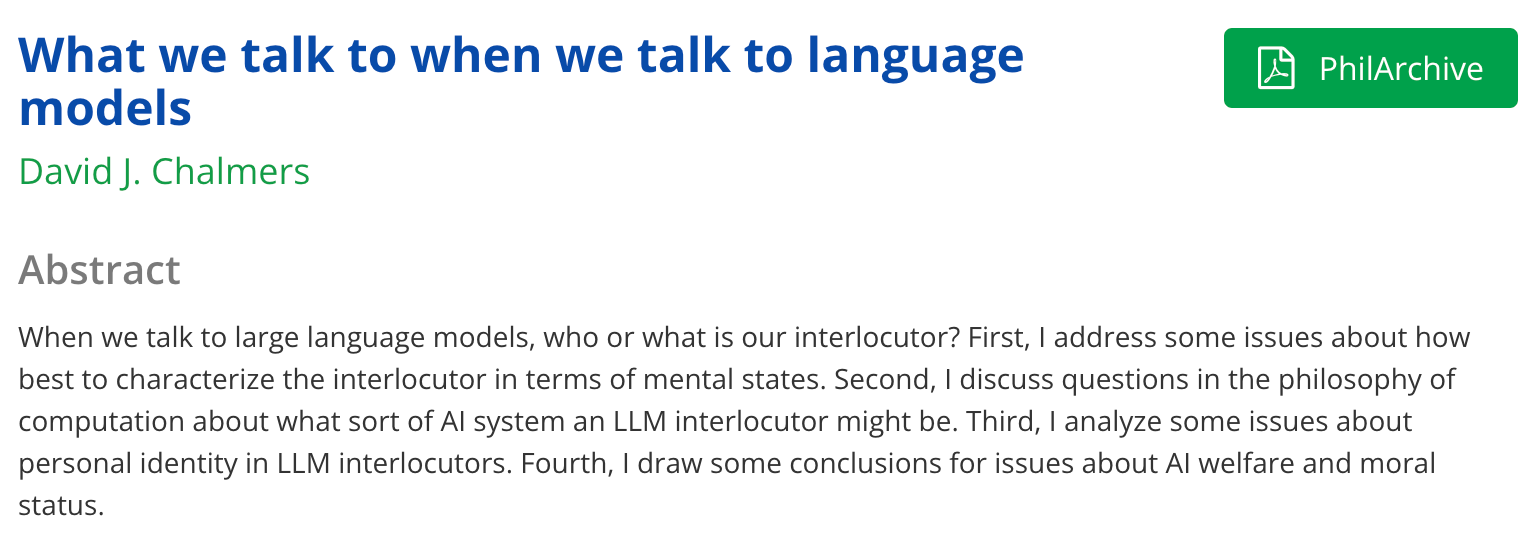
3) Last night, I read this new paper by David Chalmers, called What We Talk to When We Talk to Language Models. It’s an extremely readable paper. Indeed, I’ve rarely read anything serious about AI that does anywhere near as good a job as this paper at discussing relevant technical matters simply yet thoroughly. I have three quick thoughts on its substance, though.
First, Chalmers begins by arguing for the value of focusing on LLMs as “interpretable as having beliefs and desires”. He does this with the aim of finding a more ‘neutral’ starting point than focusing on LLMs simply as “having beliefs and desires”. I understand this move. But focusing the rest of the piece on what counts as “interpretable” about LLMs risks shifting everything away from metaphysics and into epistemology.
That’d be okay, but Chalmers’ ultimate goal here is to address questions about the identity of LLMs! So the risk is that, through this dependence of “interpretable”, his investigation becomes about us rather than them. Beyond that, but relatedly, Chalmers’ application of the ‘neutrality’ condition he sets himself comes across as arbitrary — or, at best, somewhat biased towards the status quo.
Second, I really like the clarity of structure in this paper. In particular, Chalmers’ list of five features “required” by LLMs to count as interlocutors (being interactive, persistent, coherent, faithful, and unified), and his three options for what could count here as an interlocutor (LLM models, instances, and conversations), give the paper both meat and structural bones.
Finally, I made an argument here a few months ago about AI’s lack of particularity. In the context of continuing to think about these matters, I was glad to read Chalmers’ detailed discussion of the relevance of LLM memory functions to the question of LLM identity. One point, however, which I think is implicit in Chalmers’ discussion, but I find worth emphasising explicitly, is that an appeal to memory strengthens arguments in favour of persistence only in the case of conscious subjects.
As I wrote in my piece:
“The most obvious objection to the idea that AI isn’t the kind of individuated thing that persists across time relates to the introduction of the AI ‘memory’ function. That is, you might see as decisive here the way in which, nowadays, when you hold a conversation with certain AI models — o3, for instance — the responses you receive bear reference to previous things you’ve discussed together. This is because the content of your conversations is now stored in a database, which the model has the functionality to access, “via an external retrieval step”.1
What makes this ‘memory’ objection seem particularly strong, I think, is that memory is often appealed to in arguments for human personal identity. That is, Lockean-type personal identity theorists, for instance, argue that a thick conception of memory (simply put, my awareness of my previous self-awareness) can be used to conclude that my personhood persists across time. And that even if I don’t remember what it was like to be two-year-old Rebecca, I can still remember what it was like to be thirty-year-old Rebecca, when I remembered what it was like to be twenty-year-old Rebecca, and so on, in a neat little backwards chain.
Of course, this is an over-simplification of the details and developments of Lockean-type personal identity arguments. But it can help to show how the ‘memory’ objection to my particularity argument isn’t as strong as it might seem. This is because the Lockean-type personal identity arguments depend on a conception of memory that goes far beyond o3’s capacity to access the externally-stored content of conversations. Indeed, this Lockean-type conception of memory has self-awareness baked into it! So, while the ‘backward chain of human memories’ idea might seem helpful for dealing with the fact that o3 doesn’t hold all of ‘its’ memories at the same time, the problem remains that these ‘memories’ are not ‘its memories’, in the sense that they aren’t (and never were) the reflections of a self-aware thing. In other words, sure, if you can persuade me that o3’s memory function is proof of its consciousness, then you win the overall argument. But until you can do that, you don’t defeat the sub-argument I’m making, which is that AI doesn’t have particularity.”
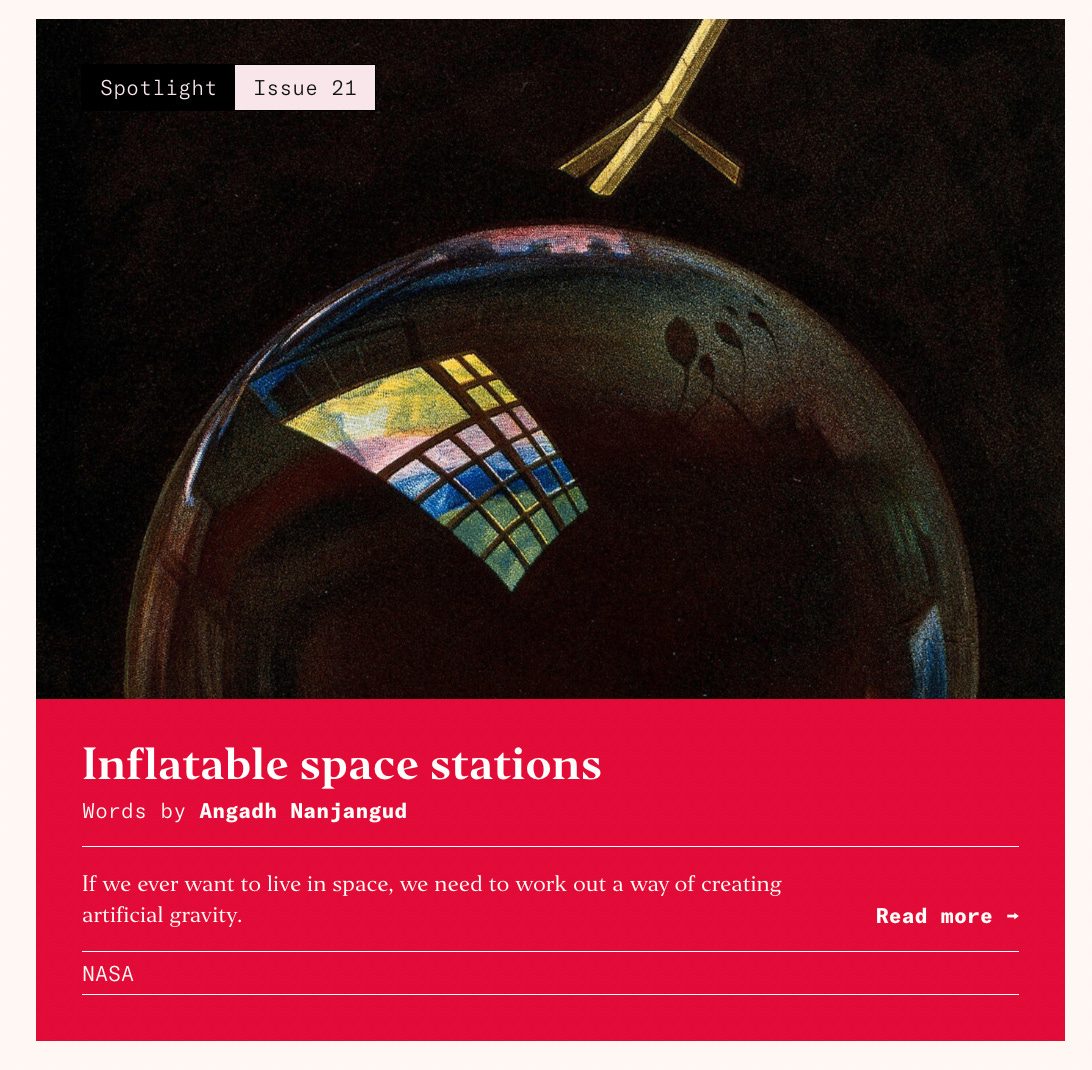
4) I really enjoyed this recent Works in Progress piece by Angadh Nanjangud, about the need to think more innovatively about building space stations. This is my favourite sentence from it:
“Such in-space assembly involves spacecraft either gently crashing into each other at specific connection points (a maneuver called rendezvous and docking) or astronauts using space cranes to catch and attach spacecraft to the ISS (known as berthing).”
“Gently crashing into each other”! But you’ll be missing out if you don’t read the whole thing.
5) One reason I love living in America relates to my love of American cultural and intellectual goods. Regular readers will know, for instance, how much I enjoy reading twentieth-century American analytic philosophy. I also love twentieth-century American literary fiction. I’d even be happy to make the (increasingly) unpopular argument that the set of American writers including Franzen, Roth, and DeLillo, might be the greatest of all time.
I find American classical music, however, much more limited. I love Copland. And Glass is great. But I think the only truly top-rate piece of American classical music — the only piece that could contend to be the greatest in its category — might be Barber’s Sure on This Shining Night. Annoyingly, I can’t find a good version on YouTube to link to, so here’s a little video of Renee Fleming talking about it, and you can find her recording of it elsewhere.

Thanks to GPT for this attempt at making Barber the model for the Statue of Liberty.
This point about communication is my point, not Austin’s. So I’m not making a claim here about his position on the value or purpose of language.
Congrats on 50!
What do you think about Charles Ives? I’m new to his stuff but a fan.
50 of these excellent posts -- congratulations and thank you!!