


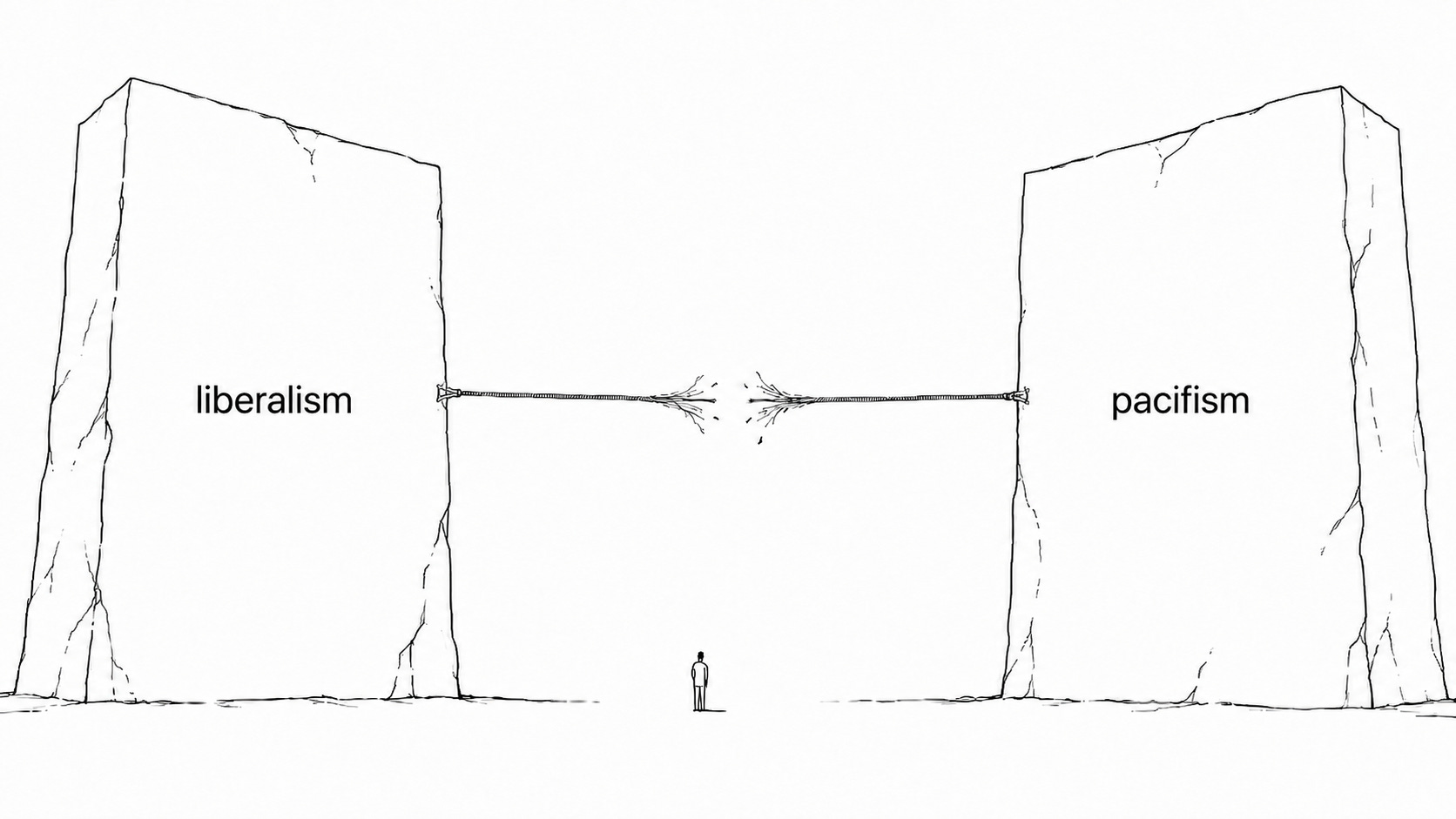
I want to share with you a quick argument I made during a recent episode of The Street Porter and The Philosopher. It’s a classic argument about the tension between liberalism and pacifism, though I think it’s under-represented outside of Philosophy World. It’s also an argument that bothers me a lot. I am a liberal! I want to be a pacifist, too! But can I?
“There is this classic objection to pacifism if you’re a liberal — or at least there is this pretty strong argument that suggests that pacifism and liberalism are deeply in conflict. That it might even be incoherent to be a pacifist if you’re a liberal.
[…] there are various arguments [to this end]. There are some weak points around things like free-riding objections, not holding your part in the bargain.
I think the strongest argument, though, that being a liberal pacifist is incoherent, says something like, look, if you’re a liberal, then you buy at least into some kind of justification for the limited state. You think that it’s not just that, within the state, you have the right to defend yourself, but also that you have some rights and obligations around collective protection. To the extent that if somebody comes and attacks you in the street, you can expect that other people should come and help you. You’ve got some kind of right to push back against that person. You might even expect that they’d be punished. There are laws about this stuff, and these laws are enforced.
But then, all of a sudden, as soon as a whole load of people from some other nation come and attack you, well, you’re not allowed to respond, and you’re not allowed to preemptively push them away. This seems like, in terms of the liberal’s commitment to these collective rights and obligations around protection, that pacifism — if pacifism, in its absolute form at least, is that no wars are justified, that even we have problems with enforcement, we have problems with any kind of aggression — this just seems like, well, if you’re an anarchist, fine.
But for the liberal? Can a liberal be a pacifist?”
Here it is in video form..
Thanks to GPT for the picture.
It also seems to me that to take individual rights seriously means some sort of protection mechanism for said rights, including infringement on those rights from powers abroad.
One of the most underrated (in Tyler's parlance) aspects of the Second Amendment is that it frames defense as both a right and a responsibility. On the individual level, there is the right to bear arms. On the civic level, there is the idea of the militia–distinct from an army– This is a reminder that the Founders, or at least those who framed the amendment, were wary of standing armies and professional soldiering.
That concern did not originate with the American Founders. It runs through the broader liberal tradition. The English Bill of Rights restricted the Crown's ability to maintain a standing army without Parliament's consent, reflecting fears that a permanent military could become an instrument of domestic tyranny. And in Roman history, where Caesar's crossing of the Rubicon stood as the archetypal example of a military commander turning an army inward against the republic itself.
A militia assumes that the burden of collective defense belongs to citizens themselves rather than to a separate warrior class. In that sense, the amendment may offer a different path through the liberalism-versus-pacifism dilemma. A society that looks at armed citizens as the default by right can deter invasion and resist tyranny without requiring a large permanent military establishment.
This seems ironic today, but it is not entirely foreign to pacifist traditions. Even the Quakers, often associated with nonviolence, have a history that includes arms manufacturing. The point is not that pacifism requires violence, but that a well-armed citizenry was historically understood as a means of preventing war and domination rather than encouraging it.