


T.S. Eliot on literary criticism
Philip Goff on William James on drunkenness
Robert Skidelsky on Ronald Coase on economists
Sunil Iyengar on the importance of reading
The Enola Gay
This is the sixty-sixth in a weekly series. As with previous editions, I’ll move beyond things I’ve been reading, toward the end.
1) I spent last weekend in one of my favourite American cities, St Louis. Among other excellent experiences including a ball game, I attended a philosophical half-day conference on T.S. Eliot, run by my friend Sebastian Garren. In preparation, I read a load of Eliot poems, and a few of his works of literary criticism.
I particularly enjoyed the poem Marina, which I don’t think I’d read before, though I recognised this wonderful line: “The awakened, lips parted, the hope, the new ships”. I love it when Eliot describes boats and the sea. And I love his use of language, more generally. I often find the poems frustrating on a deeper level, however. Too complex! Too layered! Too much! And I really didn’t like The Frontiers of Criticism (1956).
In this somehow classic essay, Eliot discusses what literary criticism is, who does it, how it changes over time, and why it matters. He makes some clever points, including a nice claim about how the reading of literary criticism affects the writing of literary criticism. But his supposedly big conclusions about the relation between the concepts of ‘enjoying’ and ‘understanding’ fall flat. “To understand a poem comes to the same thing as to enjoy it for the right reasons”, he tells us, in a moment of full-on clarity — before going right back to talking about these concepts as totally separate.
There’s also a lack of clarity, throughout this essay, about the relevance Eliot thinks we should afford to the intentions of a poem’s author when attempting to determine truths about the meaning of its content. (Hardly an under-discussed topic in aesthetics!) Sometimes, he seems to dismiss this as irrelevant. Then suddenly, he’s making fun of people for trying to tell him what his poems are about! Yet various of his arguments here, as much as they count as arguments, unsurprisingly hinge on this unclarified central matter.
Of course, perhaps you want to tell me that the real problem is that I am expecting the standards of the analytic philosopher, when I am reading the work of a poet. That would be unfair to poets! But also, don’t forget that Eliot wrote a philosophy PhD thesis at Harvard, even though he didn’t take the exam required to attain the degree.
I tried last weekend to find and read Eliot’s PhD thesis, but constrained by time, the best I could do was skim-read a 1967 article about it. If the author of the article, George Whiteside, is correct — and it’s an exegetical article, featuring lots of quotations from the thesis — then Eliot’s focus was on appearance and reality. He was interested in what there is, and how we can know about it. He was inspired by F.H. Bradley’s monism and idealism.
I found myself wishing that Eliot could have read J.L. Austin’s Sense and Sensibilia (1962) before addressing all this. I found myself, while reading Eliot’s attempts to define ‘objects’ and ‘ideas’, thinking of the looseness of his literary criticism. But the conference was excellent. We saw the house where the teenaged Eliot sort-of lived; we read Eliot poems until late.
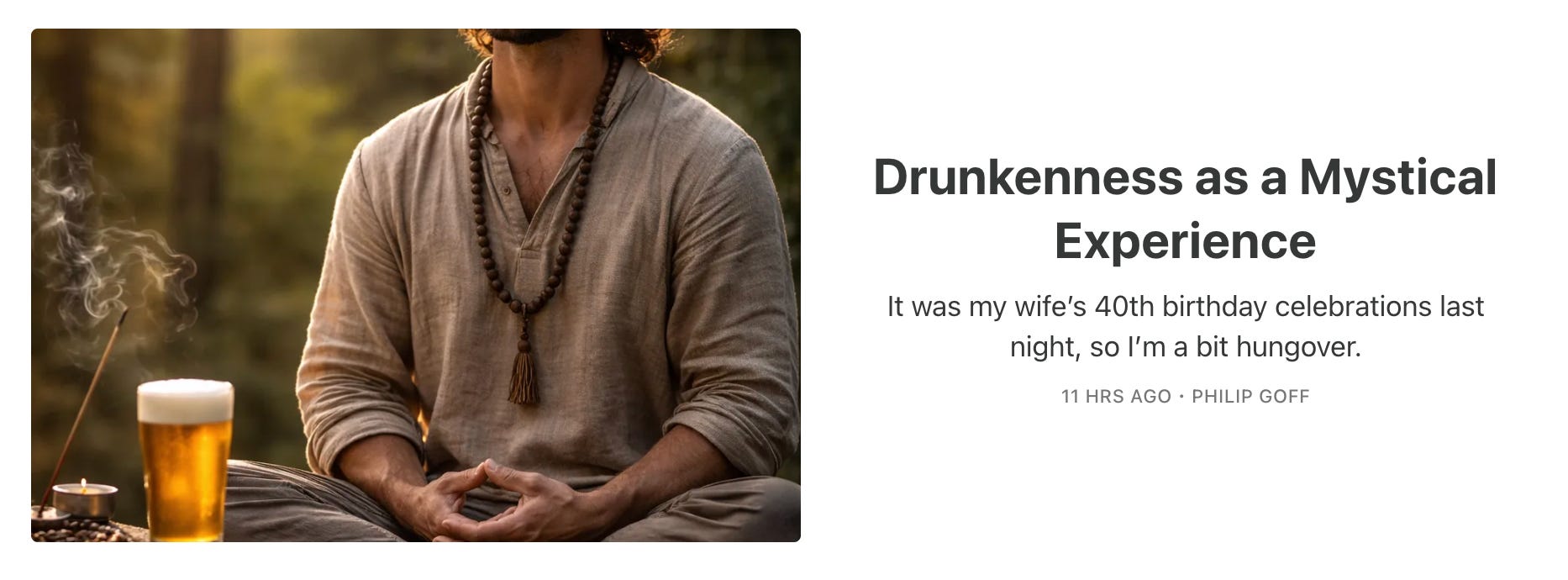
2) Today, I enjoyed this short post by my friend Philip Goff about William James on “drunkenness as a mystical experience”. Under the excuse of post-drunkenness, Philip’s post consists mostly in a quotation from The Varieties of Religious Experience (1902). The quotation itself features drunken-type writing: over the top, overly confident, slightly veering, fun but untrustworthy. This part will stick with me, however:
Not through mere perversity do men run after [drunkenness]. To the poor and the unlettered it stands in the place of symphony concerts and of literature; and it is part of the deeper mystery and tragedy of life that whiffs and gleams of something that we immediately recognise as excellent should be vouchsafed to so many of us only in the fleeting phases of what in its totality is so degrading a poisoning.
Now, I don’t buy the preceding claim James makes about accessing truth through drunkenness — though this is owing, in large part, to the general problems I have with his pragmatist account of truth. And I’ll put aside his talk of mysticism and tragedy, too. But I like the idea of limited drunkenness as an option for experiencing excellence, at least when tied to the value of certain kinds of alcoholic drinks.
Choosing to drink good wine, for instance, in part for its delicious taste and in part for its enjoyable effects, seems to me not only rational, but one of the many valuable options on offer for spending some time. Alongside concerts and literature, as James says. (Good old pluralism!) Sure, you have to be clear about the personal point past which drinking degrades your capacity for making good choices. But some drunkenness can come sooner than that.
3) I was sorry to hear of the death of Robert Skidelsky. Here’s an excellent anecdote from his Money and Government (2018):

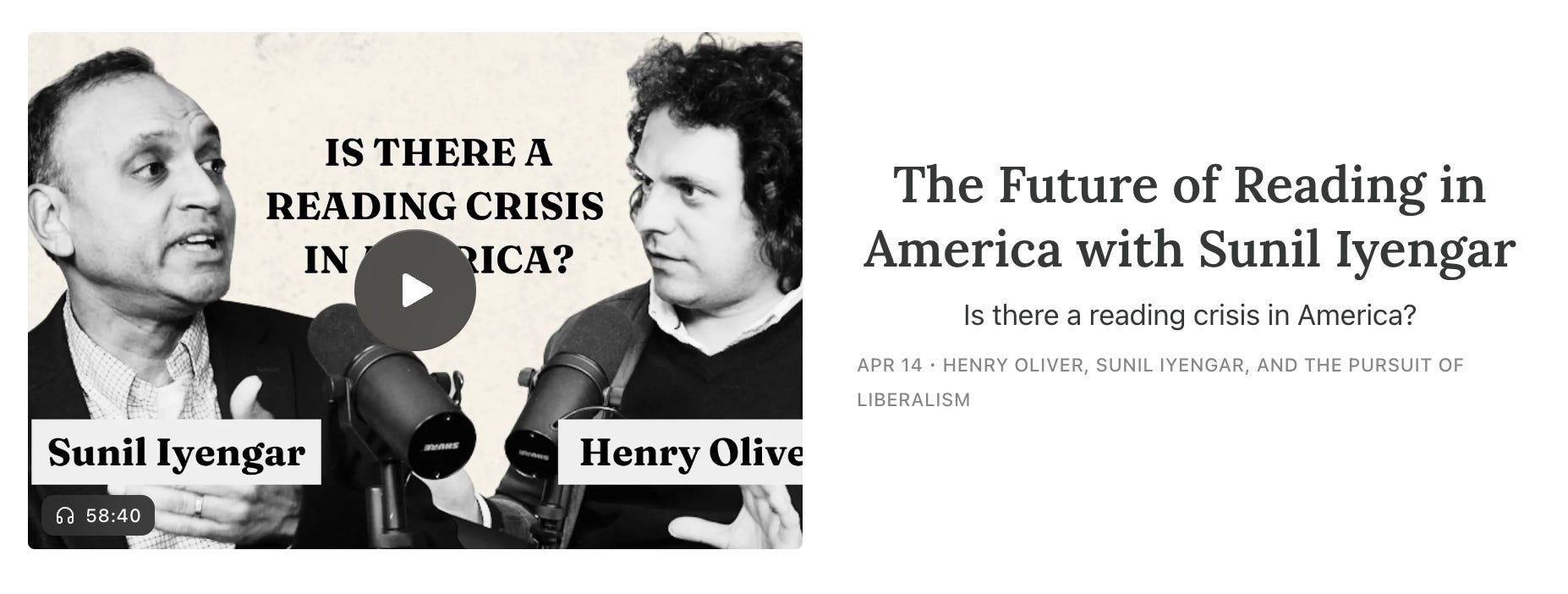
4) A few days ago, Henry Oliver and I launched our new podcast, The Street Porter and the Philosopher, with a season of episodes on the arts and liberalism. This podcast is part of our The Pursuit of Liberalism project, which is dedicated to refocusing classical liberalism on the arts and philosophy alongside economics.
In the first episode, Henry talks with the excellent Sunil Iyengar about the value of reading. Is there a reading crisis in America? What’s the relation between reading rates and liberal culture? Watch, listen, or read, to find out!
Here’s a little extract:
OLIVER: I wanted to get to this because there are a lot of surveys being pushed in the media about the decline of reading, whether they’re your data, other people are doing surveys. There’s so much of this. There are so many graphs showing, “Oh my goodness, it’s going down.” One thing I’m getting from you in this conversation is that we don’t know everything we would need to know, and that we can make some tentative conclusions, but we should be open to the idea that the real picture might not be quite what it looks like.
IYENGAR: I think you’re right. The only thing I would caution about is we’ve been asking the question, in some ways, the same way for years and years and years.
OLIVER: That, do you read a book?
IYENGAR: Yes. Do you read a book of any type? It could have been any kind, et cetera. Now, of course, the ways people read have expanded enormously since 40 years ago or 30 years ago or 20 years ago. I think there is something to the trend line. There is a marked decline in the general population. Again, the thing to remind people is, it’s the general population.
People often say, “People are still reading. I’m seeing people on the metro reading Middlemarch.” I’m like, “That’s great. Where do you live. What’s your zip code?” I think you have to talk about the entire country, and it’s a pretty large country. If you see the rates eroding over a period of many years and somewhat—there was a blip here and there, but it’s pretty much a particular direction—I think it’s worth maybe sitting up a little more, then say, a poll, which is a snapshot survey, and it says that things seem to be fine because 80 percent of people are reading.
I do think there’s a lot of nuance, though, that we have to unpack. There’s a lot more we’d like to know as researchers, and I think there’s a lot the policymakers could know. I would say there’s a preponderant amount of these data showing that fewer and fewer people are reading works of literature, as we broadly define it, and also books in general.
It’s a great discussion, and we have much more to come. Watch out for a new episode every other Tuesday, for next few months..
5) Yesterday, I finally went to the Udvar-Hazy Center. I’ve been putting this off for various reasons — one of which being that I both wanted and didn’t want to see the Enola Gay. It hangs there all shiny yet ordinary, its movie poster name at a jaunty angle. I think I wish I hadn’t seen it. The only comparable experience I’ve had is visiting Auschwitz. Here’s a link to something I wrote here a while back about the importance of talking openly about the horrors of nuclear war.

Interested in hearing you say more about pragmatism. I’m rather a fan.