


Americans Have Never Been All That Excited About Going to the Moon, Kenneth Chang
Hayekian Behavioral Economics, Cass Sunstein
Mercy, John Tasioulas
Luck Swallows Everything, Galen Strawson
Monteverdi Vespers, Washington Bach Consort conducted by Dana Marsh
This is the sixty-fourth in a weekly series. As with previous editions, I’ll move beyond things I’ve been reading, toward the end.
1) If you’re anything like me, you’ll be extremely excited about NASA’s upcoming trip around the moon. Artemis II is the first crewed moon mission in over 50 years, and its goals include kickstarting the American plan to maintain human presence up there. What’s more, the launch is tonight!
If, like me, you’re extremely excited about all this, then according to the NYT, you’re out of kilter with the average American. In Americans Have Never Been All That Excited About Going to the Moon, science reporter Kenneth Chang tells us that the American on the street doesn’t prioritise moon missions within NASA activities, and didn’t think the Apollo program was “worth the cost”. Okay, except during the month of Neil Armstrong’s one small step — but even then only just! In July 1969, Chang reports, a mere 53 per cent of Americans agreed with the spend.
Now, all this polling data is very interesting, but hey people are often wrong! Regular readers of this Substack will know my concerns about depending on consensus to answer important questions. And clearly, the new NASA moon mission is objectively extremely exciting! You can find details about watching the launch here. Tonight!

2) Last week, Cass Sunstein gave a great lecture at Mercatus, where I’m fortunate to work as Philosophy Senior Research Fellow and Director of Emerging Scholars. The lecture was organised by the six members of the first cohort of our Emerging Scholars Program. This is a program aimed at supporting brilliant classical-liberal thinkers to become compelling public intellectuals — so you can see why they invited Cass to speak!
If you weren’t able to attend the lecture, which was entitled Hayekian Behavioral Economics, then you might be happy to learn that yesterday Henry Oliver and I shared a transcript and video recording of it, on our joint Substack The Pursuit of Liberalism. Henry and I are planning each to write a short response to the lecture in the coming weeks, so I’ll save my thoughts for then. But I’ll probably focus on what I think is lost by conceptually reducing the act of choosing to ‘what you would choose in epistemically favourable conditions’…
In the meantime, do check out the lecture. There’s so much in it to enjoy!

3) While we’re on the topic of transcripts and recordings, this week I released the latest episode of my philosophy podcast, Working Definition. This episode is on the topic of forgiveness, and it stars my excellent friend Ben. Ben is a pastor at Emmanuel Baptist Church in Alexandria, so I like to think of this episode as ‘a philosopher and a pastor debate forgiveness’.
My central goal with Working Definition is to show people what it’s like to ‘do philosophy’, and I think this episode succeeds particularly well in this. Here’s an extract, to give you some sense of its back-and-forth deliberative nature:
REBECCA: […] So I just want to test out this idea of the other person’s involvement and ask you a few questions.
Let’s imagine that we go back to the lamp example. I like this one. We want to work out what role the lamp-breaker has to play in forgiveness taking place, right? So let’s imagine that the lamp-breaker didn’t know that they broke the lamp. They go away on their holiday to Australia. They’ve lost their phone. Can you forgive them before they know that they broke the lamp?
BEN: Yeah.
REBECCA: You think they can?
BEN: I think so.
REBECCA: So they don’t need to have even that level of awareness. What about if they died? What if they died on the ship to Australia? It wasn’t just that they didn’t know, but —
BEN: There’s nothing they can do.
REBECCA: They’re never going to know.
BEN: Yeah, I think forgiveness is still possible. And this happens all the time. Scripture talks about overlooking an offence. We bear with one another.
REBECCA: So repentance can’t be a condition, then?
BEN: No. I think for internal forgiveness, no.
REBECCA: The change of heart.
BEN: In fact, we do this, you do this all the time. [laughter] There are people that do annoying things to you or wrong things to you and you go, “Ah, whatever, I’ll let it go.” We forbear.
REBECCA: We do. We do forbear. Forbearance, I think, may be different from forgiveness, though.
BEN: Fair enough.
REBECCA: I’d probably — I haven’t thought about forbearance, maybe ever as a concept! [laughter] I mean, I know the word, obviously. But just my gut instinct is I would be happier to say some of this stuff about the other person not needing to be involved, about forbearance. Forbearance implies to me, me standing strong in the face of some bad thing. Whereas forgiveness seems to me very other-directed. I’m not sure I can just forgive — I think I have to forgive the person.
BEN: It depends on how you’re thinking about forbearance. But if forbearance means I’m enduring the wrong thing and I release all bad feeling, all punishment, all — then I think you’ve both forbeared and forgiven.
REBECCA: Interesting. So let’s just try a few more of these out.
We also briefly discussed an excellent article on the nearby concept of mercy:
BEN: So to go back to mercy —
REBECCA: Do you think then that mercy is an element of justice? Because I would be more tempted to put it on the charity side. I don’t think you’re obligated, in the rights-correlative sense, to. Actually, a piece that people, listeners, should read, I don’t know if you’ve read this, Ben. My ex-boyfriend, John Tasioulas, he’s a very good Australian legal philosopher, he wrote a great article just called ‘Mercy’. It’s a very good piece. He, I think, says something like mercy is an element of charity, and it’s about — it’s a form of charity that justifies punishing somebody less severely.
BEN: I think that’s right. I’m not inclined to disagree.
REBECCA: Less severely than — I think I even wrote this down — less severely than they deserve according to justice.
BEN: Yes.
REBECCA: So this comes back to our post-wrong thing. So we’ve recognised that the person’s done the wrong thing. They’re blameworthy, it’s a matter of justice, we can go as far as to say. But then the judge, or whoever it is who’s going to afford mercy in this instance, takes some charitable approach on which mercy justifies them from punishing less severely than justice actually requires.
BEN: I think that’s right. I think he’s right.
REBECCA: I think it also does help us with this distinction between justice and charity. And I think similarly, I want to — I think you and I might differ on this — but I feel I want to keep forgiveness in this charity bucket. That’s because I don’t think you’re obligated to forgive. I think it’s certainly not you’re justice-obligated to forgive, whereas I think you do think that. But I think that’s because of the role that you’re putting God in here.
BEN: I specifically think Christians are required to forgive. As for non-Christians, I think they probably are too. But it does not surprise me that it’s hard to mandate forgiveness without a Christian worldview.

4) Last night, I returned to Galen Strawson’s Things That Bother Me: Death, Freedom, the Self, Etc (2018). I found the chapter on luck too frustrating to finish, mainly because I’ve rarely read a more confusing explanation of compatibilism. For a much clearer attempt, see the free will chapter in Thomas Nagel’s What Does It All Mean? (1987). As I’ve written here before:
“The Nagel chapter is rare in providing a good simple explainer of the complexities of the free-will debate. It even manages to make compatibilism seem reasonable! This is important because while on the surface compatibilism seems crazy (what do you mean that acting of your own volition can be compatible with all your actions having been predetermined?!), nonetheless a load of contemporary philosophers subscribe to it.”
I persisted with the Strawson book, nonetheless, and was glad I did. In the first few sections of the chapter entitled The Silliest Claim, he does a nice job of arguing that this accolade should be afforded to the very silly claim that there’s no such thing as conscious experience. (If you’re sitting there ruminating about why this very silly claim might be true, then you’ve almost got it!)
Strawson also does a nice job of explaining the rise of support, over the twentieth century, for this very silly claim. Don’t blame the psychologists, he warns us! After all, they weren’t in denial about the existence of conscious experience; rather, they just needed something more tangible to do “proper science” with. It was the philosophers who wrecked things, by bringing in metaphysics...

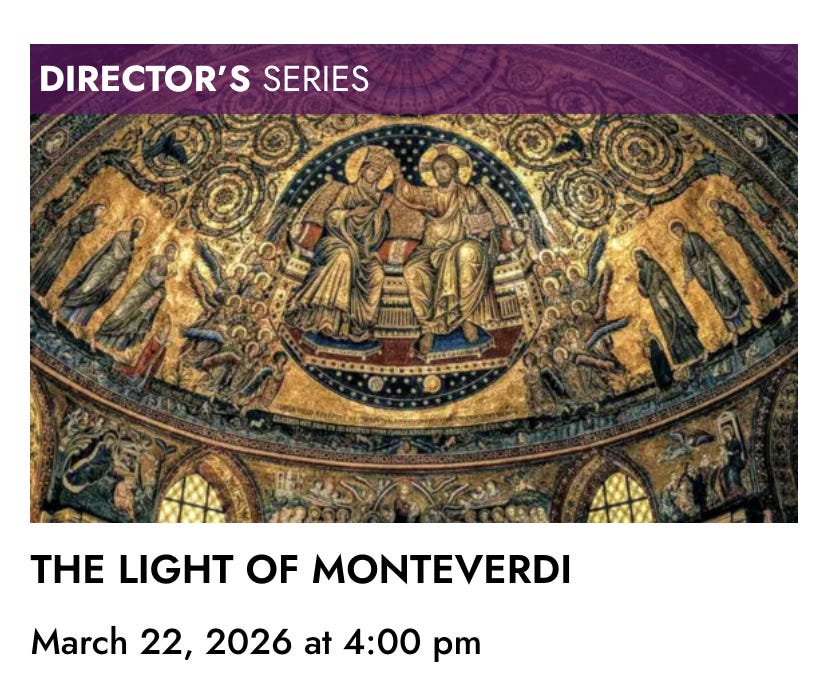
5) I firmly believe that the Monteverdi Vespers is one of the great human achievements. I’ve written here previously about my love of the Dixit Dominus movement. But it’s hard to think of a more arresting start to any choral work than the opening tenor proclamation: “DE-US IN ADJUTO-O-RI-UM ME-UM IN-TE-EN-DE”! This is immediately followed by a massive block choral and orchestral entry, which feels like The Renaissance in a single chord. Then, over the following couple of hours, Monteverdi doesn’t ever really let up.
Sadly, its large scale, technical vocal demands, and (now) niche instrumentation make the Vespers difficult to perform well. I sang in a good performance over twenty years ago, and still remember so many of the complicating factors faced by my friend conducting it.
I was thankful as well as happy, therefore, when the Washington Bach Consort’s recent attempt turned out to be one of the best performances of any choral work I’ve ever attended in America. My only real criticism was that a couple of the solo singers felt a little underpowered at times. The consort’s director, Dana Marsh, did a fantastic job.
Just wanted to drop in to say how much I enjoy these posts + discussions. Much of the content is wildly outside my field, but it sparks so many thoughts that it's almost dangerous! Also: totally agree about Monteverdi's Vespers: so vibrant in performance, and, really, one for the tenors.