Factory farming polling, Our World in Data
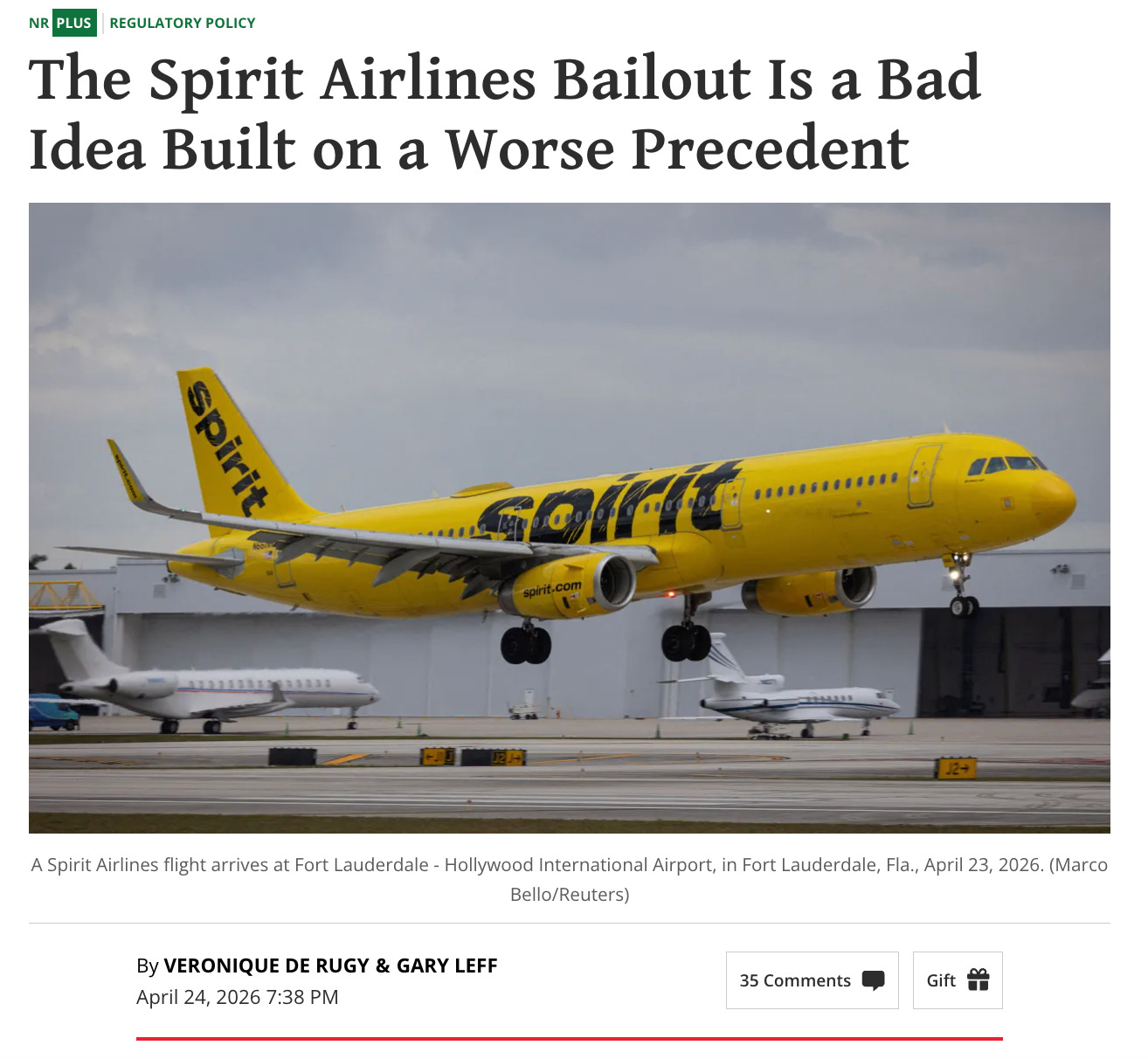
The Spirit Airlines Bailout Is a Bad Idea Built on a Worse Precedent, Vero de Rugy and Gary Leff
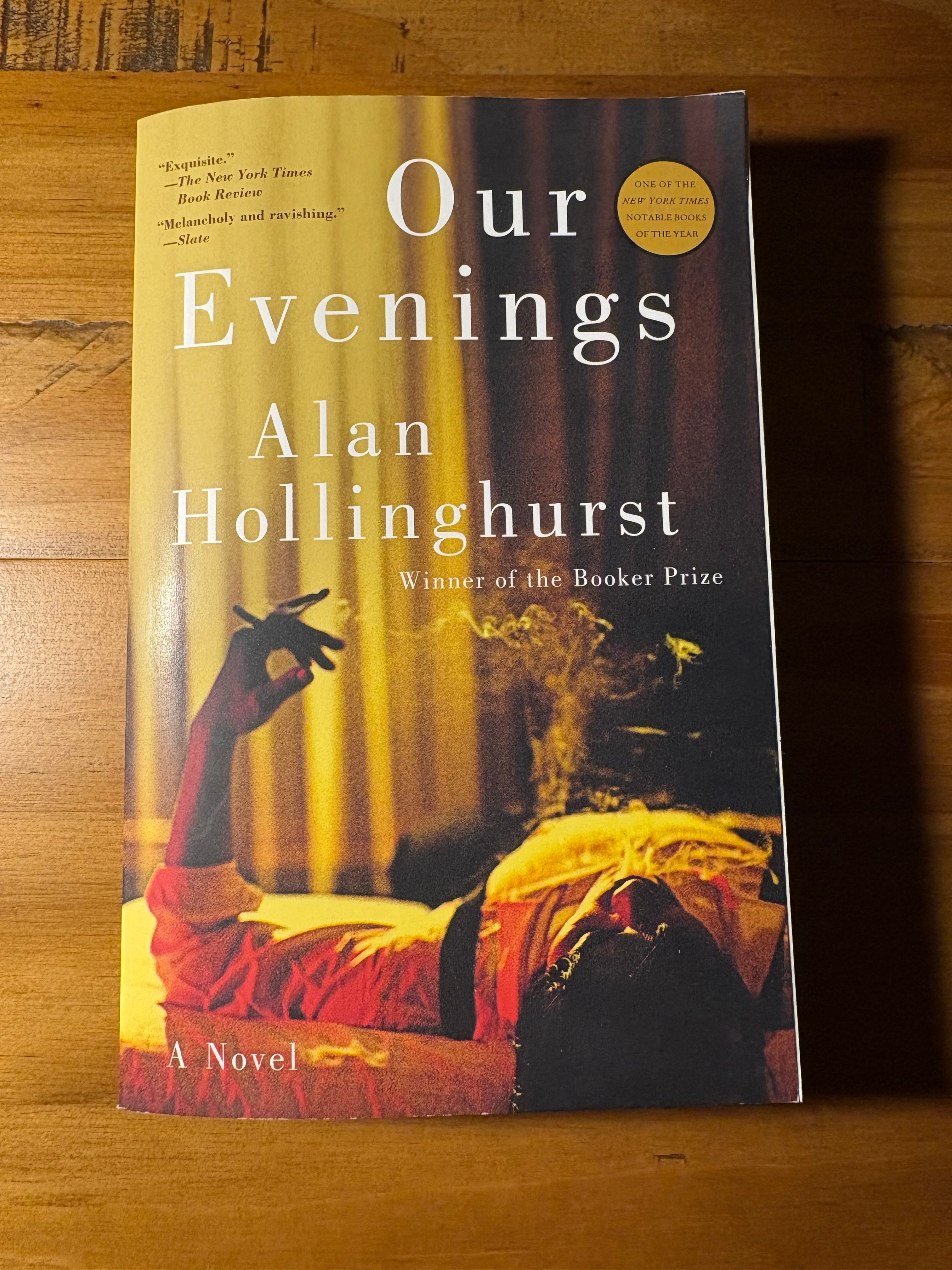
Our Evenings, Alan Hollinghurst
Jonas Kaufmann on Peter Grimes
American paintings at the Virginia Museum of Fine Arts
This is the sixty-eighth in a weekly series. As with previous editions, I’ll move beyond things I’ve been reading, toward the end.
1) A few days ago, I read some polling reports on attitudes to factory farming, thanks to discussion on Substack about this recent Our World in Data piece. As the writer of the piece, Charlie Giattino, argues, it seems “[t]here is a clear gap between what people want — meat produced without suffering — and what the food system delivers”.
Except, it’s not so clear. Yes, the chart in the piece shows that a large majority of UK adults claim to find certain “common farming practices” to be “not acceptable”. But it’s also the case, as Giattino emphasises, that “[a]t a global level, meat consumption is not only high but also increasing.”
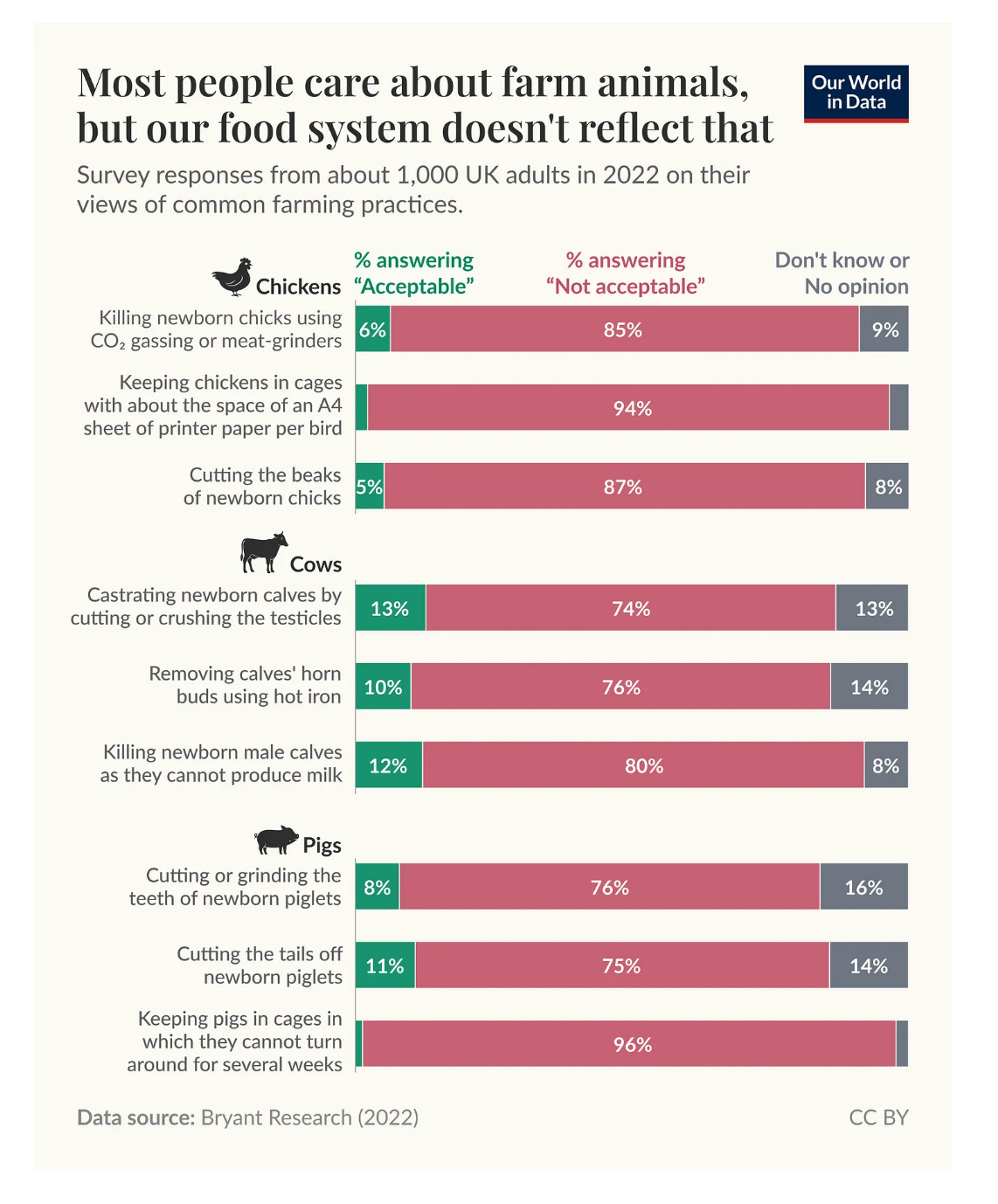
Okay, we can assume that not everyone who claims to find the system’s practices unacceptable also eats the system’s products. And maybe it’s just that the UK’s an odd place? Nope. A subheading in the OWID piece clarifies that: “Surveys worldwide show that most people find common animal farming practices unacceptable, even where meat consumption is high”.
To go back to the ‘there’s a gap’ claim, therefore, the people do indeed suggest they want “meat produced without suffering”. But the people also continue to eat “what the food system delivers” — more and more of it!
Sure, we could conclude that the people have a loose understanding of “unacceptable”. Or we could conclude that they’d prefer a system that wasn’t so vile. But whichever way we cut it, we’re going to have to face the fact that expressed concerns about animal welfare simply aren’t enough to prevent many, many people from eating meat. That the gap is a dream!
It would be nice if we could conclude otherwise. But it would be cheating. Just like eating the meat, when you think you shouldn’t. Like I do.
As I’ve written before, I think it’d be wrong to eat the dead bodies of animals even if they’d lived the best possible lives and had the best possible deaths. And as I said during my recent The Pursuit of Liberalism podcast episode with Cass Sunstein, I continue to eat meat, even though “I think the welfare thing is […] a sufficient problem in itself. It’s a reason in itself not to eat pretty much any bit of meat you get served.”
I did quit meat for a few months, a while back, but all it took was one fantastic steak, and I was back off the animal wagon full-time. Sure, I choose the ‘highest welfare’ products on offer, and happily — how horrible to say ‘happily’! how horrible to say ‘products’! — pay the higher prices for them. And as of this week, I’m trying to quit chicken and pork. But, of course, I know this is nowhere near enough.
There’s a horrible truth to be accepted here. A truth that often makes me wonder what other bad things we would do to meet our basest desires.
2) A few days ago, I wrote about three podcasts I’d enjoyed appearing on. But the most fun I’ve recently had on a podcast was when Henry Oliver and I appeared on our friend Veronique de Rugy’s Qualified Opinions. There was a lot of laughing. Here’s a link to the episode, and here’s the summary on the site:
“Vero is joined by colleagues Rebecca Lowe, a political philosopher, and Henry Oliver, a literary critic, to discuss their new project, The Pursuit of Liberalism. While the liberal order—built on free markets, free speech, and the rule of law—has delivered more for human flourishing than any other system, many feel it is currently “losing the argument”. The trio explores whether this is because the defense of liberalism has been narrowed down to economics and legal theory, neglecting the deeper questions of meaning, dignity, and the human soul.”
Vero is one of my very favourite people, and everything she writes is worth reading. Last week, I really liked the National Review column she co-authored with Gary Leff on the then-possibility of a state bailout for Spirit Airlines. I would summarise their arguments for you, but the piece is so clear and well-structured that they do this themselves, near the start:
“This is a bad idea that deserves to be called what it is: Washington nationalizing a problem it partially created with a misguided application of antitrust, for a company that consumers don’t want, at the expense of its competitors, and handing taxpayers the bill.”
The piece powers on. Unlike Spirit Airlines.
3) A few days ago, I finally finished reading Alan Hollinghurst’s most recent novel, Our Evenings (2024). It’s nowhere near as good as The Swimming Pool Library (1988). It’s not even anywhere near as good as The Sparsholt Affair (2018) or The Stranger’s Child (2011).
Hollinghurst is one of those previously, if inconsistently, excellent British novelists, who’ve gone off the boil over the past twenty years. This is a trend exemplified by Ian McEwan, whose novels can be divided in two at the Chesil Beach (2007) point. One common argument runs that these novelists have been driven crazy by British politics. The treatment of the Brexit debate in Our Evenings provides strong support for this argument. I hate the word ‘cringy’, but there’s no alternative here.
That said, I pressed on with Our Evenings, because somewhere — amid the silly political commentary, and even at the silly political commentary’s height amid the ‘old age’ section which, more generally, required some serious editing — there’s something there. It’s not the something I assume Hollinghurst would want us to take from this novel. That’d be something deep about race and community. Instead, it’s probably just the well-developed skill of basic readability.
4) Last week, I read a load of things about Benjamin Britten in preparation for recording an episode of The Street Porter and the Philosopher. In particular, I enjoyed thinking about the claim, made in this short translated extract from an interview with Jonas Kaufmann, that Peter Grimes is autistic.
“I feel so sorry for him. I don’t think he’s a real killer. Today you would say: autistic or Asperger’s or whatever. Modern expressions for the fact that in this place where he is arrested, he is simply being crushed by the many, many intrigues that are being spun. And of course it’s tragic that the first boy dies of thirst in a storm because they somehow drift too far and can’t find their way home.
But we also have to put this in the context of how it was, so to speak, back then: Children from the orphanage were kept as cheap slaves for centuries. That is an unfortunate fact. Whether they worked in the mines because they were nice and small and could dig their holes there – and that was no different here in Bavaria – or whether they lived on the coast and then helped the fishermen. And Grimes says himself: I can’t afford it. I can’t afford a second fisherman, an adult, to take with me, that’s impossible. It can only be a child who has to work 24 hours a day for board and lodging, so to speak, and is available. That is very tragic and of course reprehensible from today’s perspective. But you can’t really blame Grimes for that….”
As you might have guessed, I don’t like Kaufmann’s relativism. But I think his claim about autism is worth considering. Minimally, it makes an interesting change from the common, but surely incorrect, take on which Grimes’s ‘otherness’ is a sign that he’s gay.
5) On Sunday, I saw fantastic paintings by (mostly North-Eastern) Americans, including Andrew Wyeth, John Henry Twachtman, George Luks, William Merritt Chase, Charles Alston, William Glackens, Stuart Davis, Beauford Delaney, Robert Henri, Everett Shinn, and Georgia O’Keeffe, at the Virginia Museum of Fine Arts. Best of all was this catfish piece by Jacob Lawrence: