The Radical Development of an Entirely New Painkiller, Rivka Galchen
Extreme-American-weather Twitter
This is the twenty-eighth in a weekly series. As with previous editions, I’ll move beyond things I’ve been reading, toward the end.
Thanks for reading the ends don't justify the means! Subscribe for free to receive new posts and support my work.
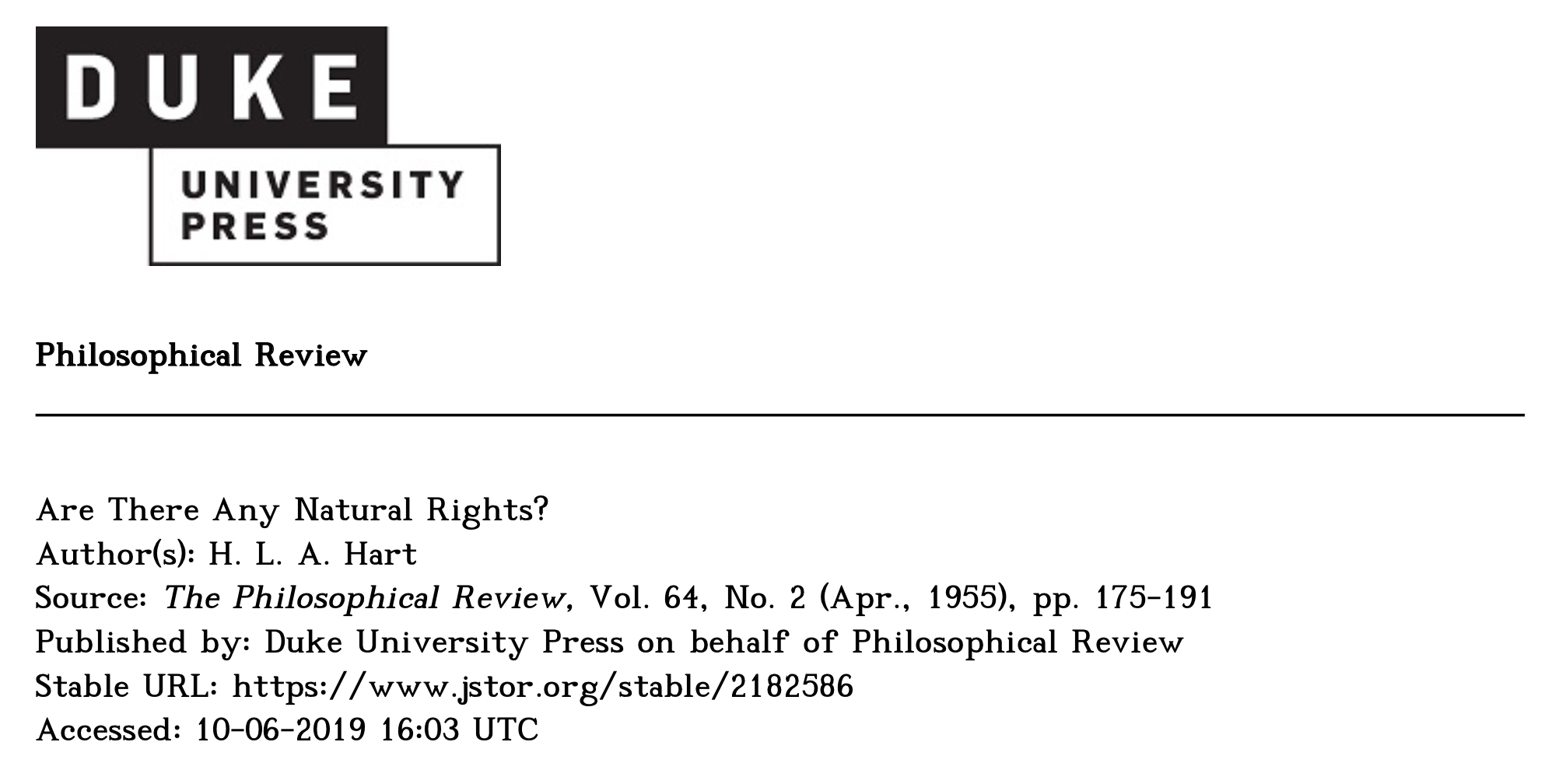
1) As part of my ongoing practice of reading classic twentieth-century philosophy papers, I returned this week to Are There Any Natural Rights? (1955), by H.L.A. Hart. Hart is one of my favourite twentieth-century philosophers, mainly because I usually end up thinking really hard when I read his work, and I quite enjoy the consequent mental feeling of satisfied exhaustion. I get that feeling every time I read this paper. It’s about the role rights play within morality, and particularly, about who holds which kinds of rights and why.
Having set aside legal rights, Hart argues that most moral rights are specifically-held, in the sense that each of these rights is held by a specific individual, as the result of a transaction they entered into, or a relation they stand in, with another specific individual who holds the correlative obligation. These are what Hart terms ‘special rights’, and if ‘special’ effectively means ‘specific’, then they are special in many ways! Whereas, the conception of ‘natural rights’ that Hart is referring to in the paper’s title is one on which these are moral rights that are held by all men — by which he means all adult humans who are “capable of choice”. For Hart, therefore, natural rights are not ‘special rights’, but ‘general rights’. These are rights that arise not from a specific transaction or relation, but from shared humanity, and as such aren’t just the business of specific limited parties, but hold between everyone.
Hart’s general/special distinction remains important within rights discourse, particularly within philosophical discussion of property rights. But before I get carried away on that topic, I’d better release you from your state of anticipation, and reveal that Hart’s answer to the title question is yes! Well, sort of. As we’re warned at the beginning of the paper, he only goes as far as arguing that if there are any moral rights, then there’s at least one natural right. In other words, he’s accepting that there may in fact be no natural rights, and also that there may be infinite of them!
Hart seems pretty sure however, by the end, that there is at least one natural right. Indeed, I think it’s not unfair to claim that he stacks the deck somewhat in favour of this outcome. The natural right in question is the ‘equal right of all men to be free’. As Hart sees it, this is the right not to be coerced or restrained (from doing something, anything), unless it’s to prevent you from coercing or restraining someone else (from doing something, anything). In other words, this right is all about interference. To this end, the reason I think Hart stacks the deck a little is that he seems convinced that there are indeed such things as moral rights, and also that they are tied together with interference. It’s a “very important feature of a moral right,” he tells us, that:
“the possessor of it is conceived as having a moral justification for limiting the freedom of another and that he has this justification not because the action he is entitled to require of another has some moral quality but simply because in the circumstances a certain distribution of human freedom will be maintained if he by his choice is allowed to determine how that other shall act.”
But rather than considering whether Hart starts out from the belief that moral rights are a certain way, or that unjustified interference is foundationally wrong, I want to note the strain he puts on history in this paper.
Consider the Hartian special rights that arise from transactions. These transactions often take the form of promises or consent-giving, and for Hart, what these transactions generate is extremely hardcore. “If I consent to your taking precautions for my health or happiness or authorize you to look after my interests,” he states, “then you have a right which others have not, and I cannot complain of your interference if it is within the sphere of your authority”. Indeed, he even clarifies that “this is what is meant by a person surrendering his rights to another”!
As it happens, I’ve written a paper arguing against this non-conditional ‘authorising’ conception of consent-giving. Instead, I propose that we should see consent-giving as one conditional part of a wider consent-giving-and-receiving interaction, within which it takes the form of something like: “Yes, I give you my particular permission to Φ!”. This paper will appear in the book I’m currently writing about freedom, but maybe I’ll publish it here first sometime. I should probably end this item, however, by noting that Hart went on to reject some of what he wrote in Are There Any Natural Rights?. Perhaps I’m unusual infinding this change of heart (sorry!) pretty much irrelevant to the paper’s philosophical value. I certainly don’t think it provides strong reason to avoid engaging with it.
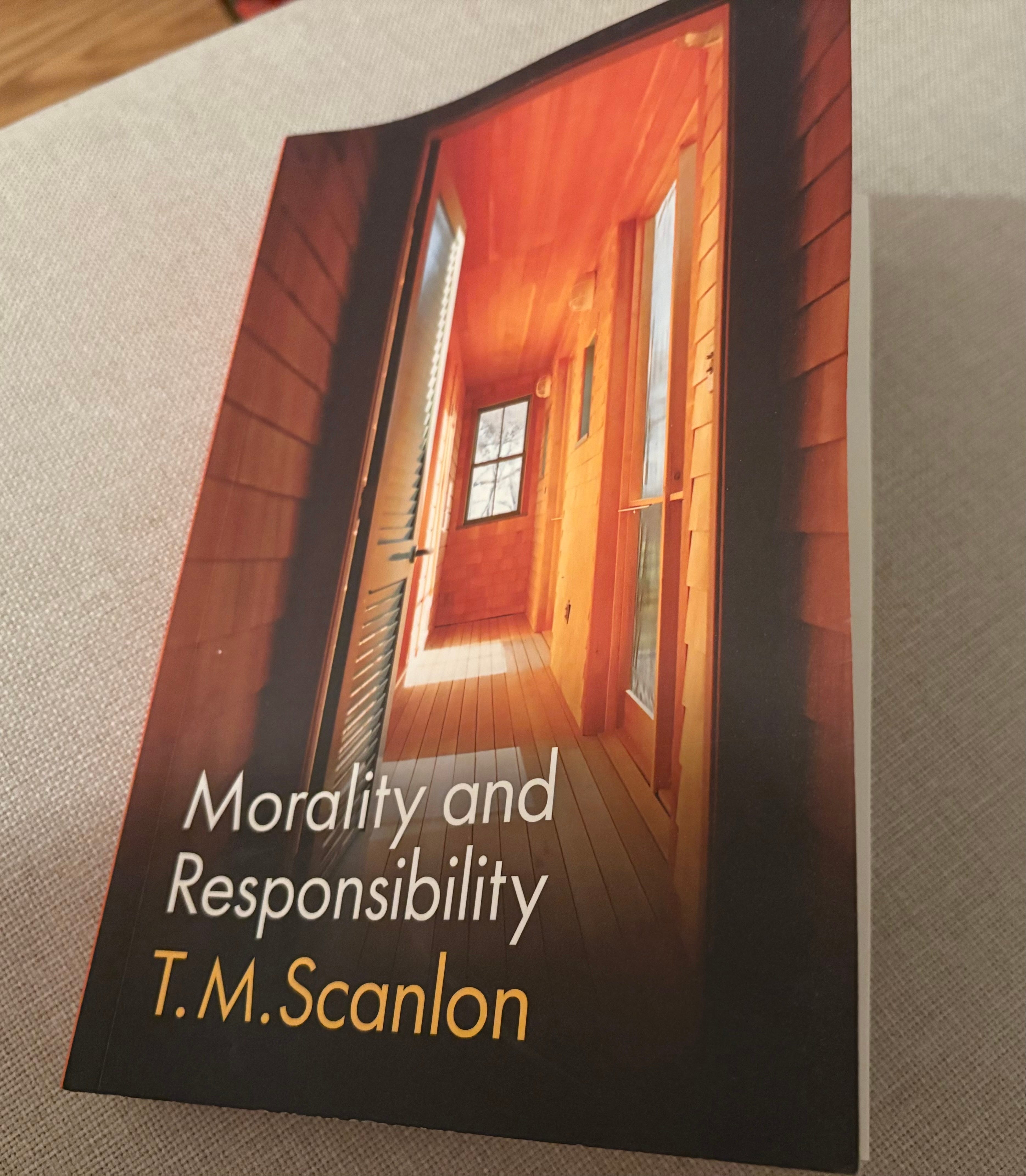
2) Talking of strong reasons, I just started reading Tim Scanlon’s new essay collection, Morality and Responsibility. It features his usual readable style and clarity of argument. Most of the chapters of this book have appeared as papers elsewhere, but as Scanlon explains in the introduction, the opening chapter, What is Morality?, is the summary of a course he gave at Harvard.
In a way reminiscent of Hart, Scanlon grapples in this chapter, to varying degrees of success, with questions about the concerns and constituent parts of morality. It’s not made clear, for instance, the distinction he draws between morality and justice. His general focus here, however, is on right and wrong. He asks: what makes actions and principles right or wrong? And why are we motivated to do right rather than wrong? The answers he offers are most useful as an explainer of his particular type of contractualism, which you’ll know about if you’ve read his most famous book, What We Owe to Each Other.
A refrain throughout the chapter is that what makes your action count as wrong is not that the “principle permitting it” is rejected as wrong by other people — to whom we owe moral justification — but that it would be “reasonably rejected” by them. Socrates, Scanlon emphasises, believed that philosophical enquiry about moral matters was “not settled by taking a vote”. And Scanlon believes that what’s required is evaluating “the relative strength of the reasons on both sides” — for and against.
As he admits, however, this leaves us pushing the problem downstream, in terms of knowing how to act. How do we work out which reasons are strong? Well, he ends the chapter by telling us to evaluate the claims he’s been making about morality by reflecting on the reasons he’s offered — which is surely a good start.
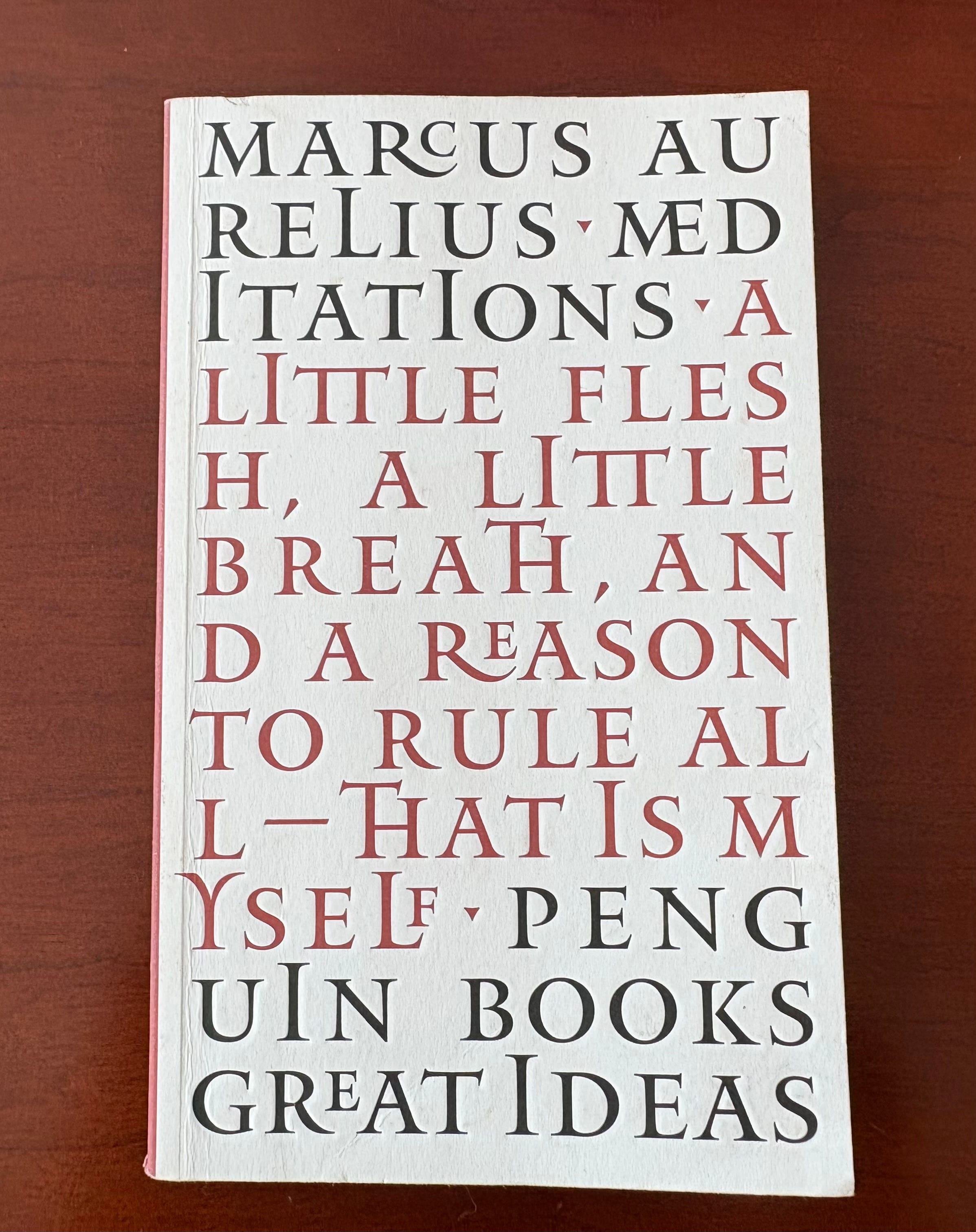
3) I’ve enjoyed reading Marcus Aurelius’s Meditations (c.170s AD) since I was a teenager. I return to it every so often, and particularly value Book Two. Here, Marcus sets out his views on the goodness of nature, the briefness of life (‘hey, all you have is the present, so short lives are equal to long ones!’), the temptations of pleasure, the pitifulness of not being able to tell good from evil, and the interrelation of all these things.
He tells us to spend our limited time focused — consciously focused — on doing good. And that philosophy will help us to cope with whatever happens along the way. I disagree with a lot of what he says. And I’m not usually one for passing around quotes, but I love this bit:
“Think of your many years of procrastination; how the gods have repeatedly granted you further periods of grace, of which you have taken no advantage. It is time now to realize the nature of the universe to which you belong, and of that controlling power whose offspring you are; and to understand that your time has a limit set to it. Use it, then, to advance your enlightenment; or it will be gone, and never in your power again.”
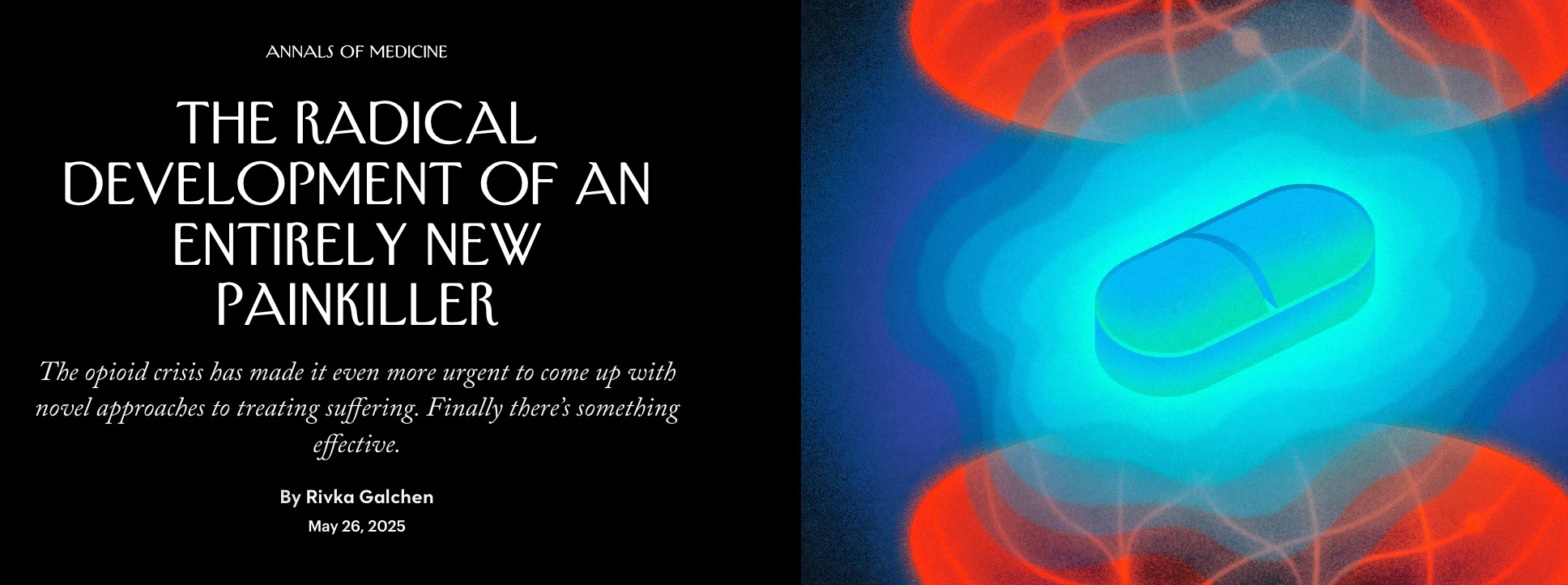
4) I really enjoyed this recent New Yorker piece, by Rivka Galchen, about the development of a new pain-relief drug. The drug, suzetrigine, works by “interrupting pain signalling before it [reaches] the brain”. It provides an alternative to opioids, therefore, which instead “target the parts of the brain that receive pain signals”. Such a development is obviously extremely exciting.
I enjoyed the piece most, however, for its wide-ranging discussion of pain: its nature, its scope, how to track it. We’re told that the creator of the McGill Pain Questionnaire (which is used to help people to describe the qualities of the pains they’re suffering) saw pain as “one of the most fascinating problems in psychology”. And, as I discussed here a few months ago, philosophical questions about pain are extremely complex. I argued back then that awareness of this complexity — particularly in relation to the difficulties involved in parsing and perceiving the distinction between physical pain and mental pain — should be playing a much larger role in ongoing debate about the permissibility of assisted dying.
What exactly, for instance, is that “mental feeling” I referred to above of “satisfied exhaustion”?
5) My new favourite thing is the section of Twitter that’s dedicated to charting extreme American weather. I wrote recently about the softball-cantaloupe scale for cataloguing the size of hailstones, but since then I’ve learned there’s a gorilla category! I’ve also learned about earth-eating supercells, red polygons, epic shelf clouds and multivortex gustnadoes. I’ve even lived through a Twitter-informed (nearby) flash flood.
Thanks for reading the ends don't justify the means! Subscribe for free to receive new posts and support my work.