


“I miss the goodness of Sarah”, Susan Everard
Discussion Arcs for Topics and Philosophers, Eric Schwitzgebel
The Report of the Iraq Inquiry, John Chilcot et al
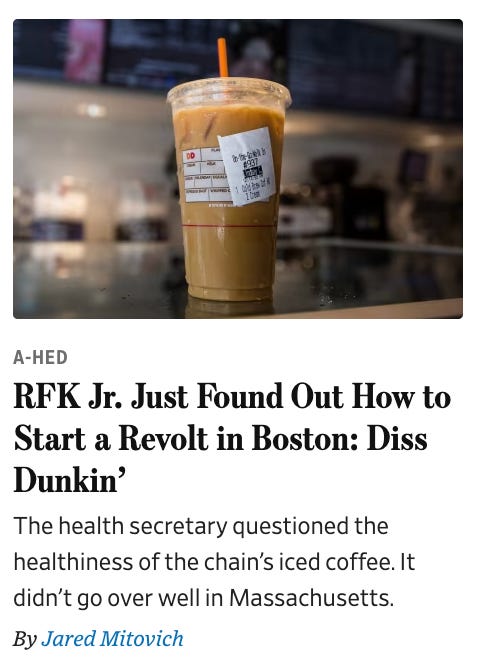
RFK Jr. Just Found Out How to Start a Revolt in Boston: Diss Dunkin’, Jared Mitovich
Texas food
This is the sixty-first in a weekly series. As with previous editions, I’ll move beyond things I’ve been reading, toward the end. And because this edition is a little overdue, you can expect another sooner than usual.
1) A couple of days ago, I read this short Vogue piece by Susan Everard, about her daughter Sarah. If you were to read this piece without knowing what happened to Sarah Everard, you would surely realise that she is dead. But it is such a gentle, close kind of a piece that you would likely not suspect what kind of death she suffered.
That feature of this piece seems to me a beautiful achievement. There is also something majestic about the writing — it has a simple poise that I’m not sure I’ve seen before. It is open and straightforward, but it is also careful. “I miss the goodness of Sarah”, Susan Everard tells us. “I like to think of her dancing”, she says.

2) I wrote a while back about Eric Schwitzgebel’s investigation into the most cited works in the Stanford Encyclopedia of Philosophy.1 In particular, I was glad to note “the way the authorship of its top 10 (Rawls, Kripke, Parfit, Nozick, Wittgenstein, Lewis, Quine, Scanlon, Kuhn, Rawls) goes some way to propping up my view that there’s no better place for an analytic philosopher to live than America.”
I was delighted to see this week, therefore, that Schwitzgebel has undertaken some further philosophy stats analysis! This time, Schwitzgebel’s focus is the ‘discussion arc’ — something he defines as “a curve displaying how frequently a term appears in philosophical journal abstracts, titles, and keywords”.
As with last time, I enjoyed thinking about Schwitzgebel’s methodological choices. He argues, for instance, that searching in these places enabled him to capture something more substantive — a stronger likelihood of discussion — than by searching citations:
“A philosopher who is cited in passing might have very little influence on the shape of an article. In contrast, if a philosopher's name is explicitly mentioned in the title, abstract, or keywords, that philosopher's work is among the chief topics of the article. Discussion rates and citation rates thus capture different phenomena and will sometimes diverge.”
Now, surely having “influence on the shape of an article” isn’t necessary to counting as a topic of discussion. And I wish the titles of philosophy articles were better signals of their content! But I’m nitpicking, here. Schwitzgebel’s piece is full of interesting claims, many of which ring true, not least:
“Wittgenstein peaks in the late 1960s, Frege in the early 1980s, and Nietzsche in the early 2000s. Heidegger's influence is moderately steady from the late 1960s to the early 2000s, declining modestly in the past couple of decades.”
I was a bit surprised by the supposed relative death of ‘ordinary language’, however!


3) A few days ago, I read some of the 2.6 million words of the Chilcot Report. This is the 2016 document that records the findings of the Chilcot Inquiry into the UK’s involvement in the Iraq War. You can read my thoughts about the report, and about the UK’s involvement in the Iraq War, in my new piece about liberal interventionism, which I published earlier today on the The Pursuit of Liberalism.

4) Regular readers may remember my love for the original and best RFK. Handsome, stylish, oratorically gifted, self-affirmed saviour of the Cuban Missile Crisis, only wrong on about 50 per cent of other matters, etc etc. Well, yesterday I learned from this WSJ piece by Jared Mitovich that the original RFK’s current namesake has been busy undercutting the dynastic privilege he usually spends his time trading upon.2
“Massachusetts may have a unique bond with the Kennedys,” Mitovich explains, “but it has a particularly rabid connection to its hometown coffee brand” — Dunkin’ Donuts! Now, it’s only recently I learned that Dunkin’ Donuts is not the precisely descriptively-named store that I assumed it was. It is a coffee place, first and foremost! At least, reputationally. And it’s only from Mitovich’s piece that I learned that it is technically now named just Dunkin’, even though I walk past one every day.3
Anyway, RFK has taken to criticising Dunkin’s sugary drinks. This went down well in Austin, Mitovich reports:
““We’re gonna ask Dunkin’ Donuts and Starbucks, ‘Show us the safety data that show that it’s OK for a teenage girl to drink an iced coffee with 115 grams of sugar in it,’” Kennedy said to laughter and applause. “I don’t think they’re gonna be able to do it.””
But this did not go down so well in MA. Mitovich reports that “locals snapped”! Some of them, anyway. One Bostonian told him, “It just made me remember that I hadn’t gotten one yet”. It wouldn’t be the first time a Kennedy had tried to sneakily intervene in the economy..
5) Last weekend, I was in Austin (not with RFK Jr.) for an excellent conference held by the Cosmos Institute. My favourite part was hanging out and talking philosophy with Hollis Robbins and Zena Hitz. I also ate all the Texas food!

The SEP is one of the world’s greatest resources.
Thanks to my excellent friend Eileen Norcross for alerting me to this important news story!
As soon I press ‘publish’ on this Top 5, I shall go and try Dunkin’s donuts and coffee for the first time..