


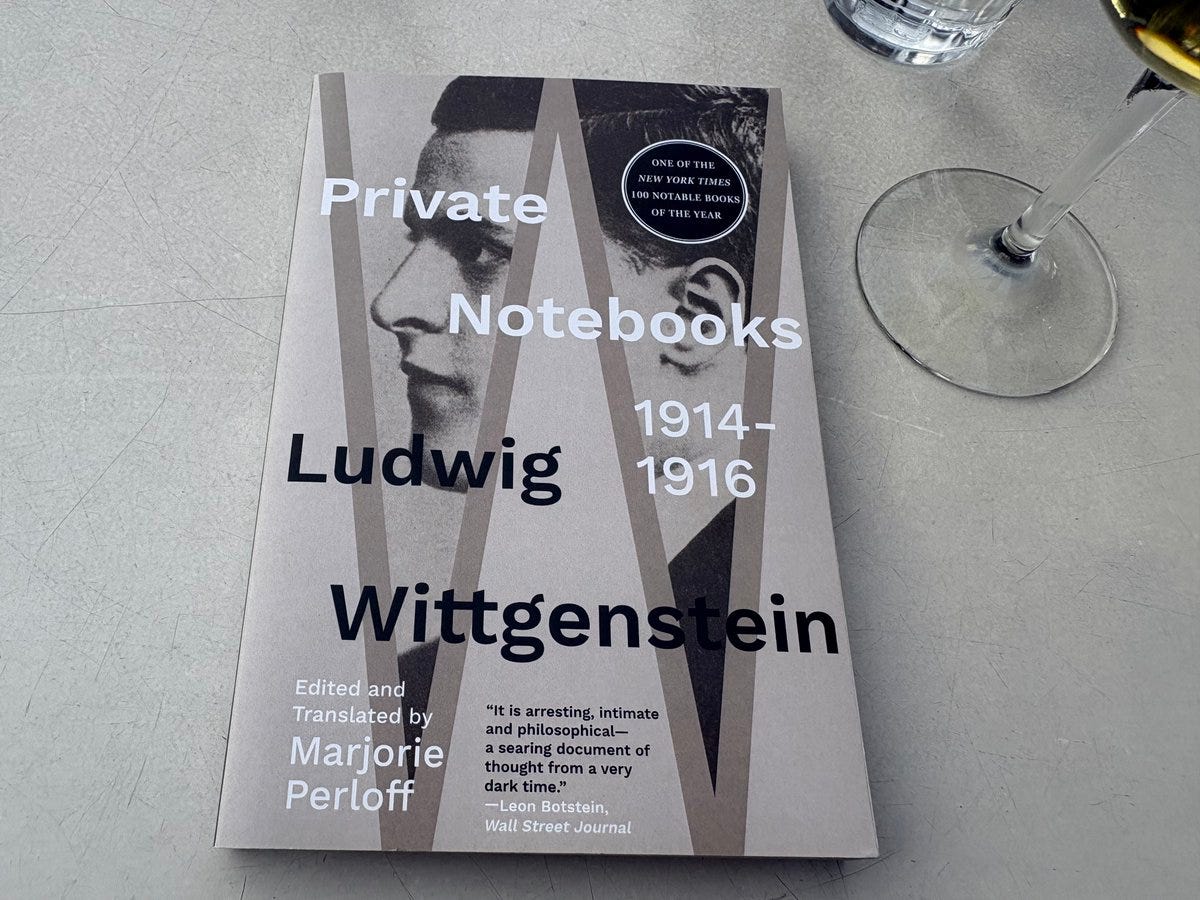
Private Notebooks 1914-1916, Ludwig Wittgenstein
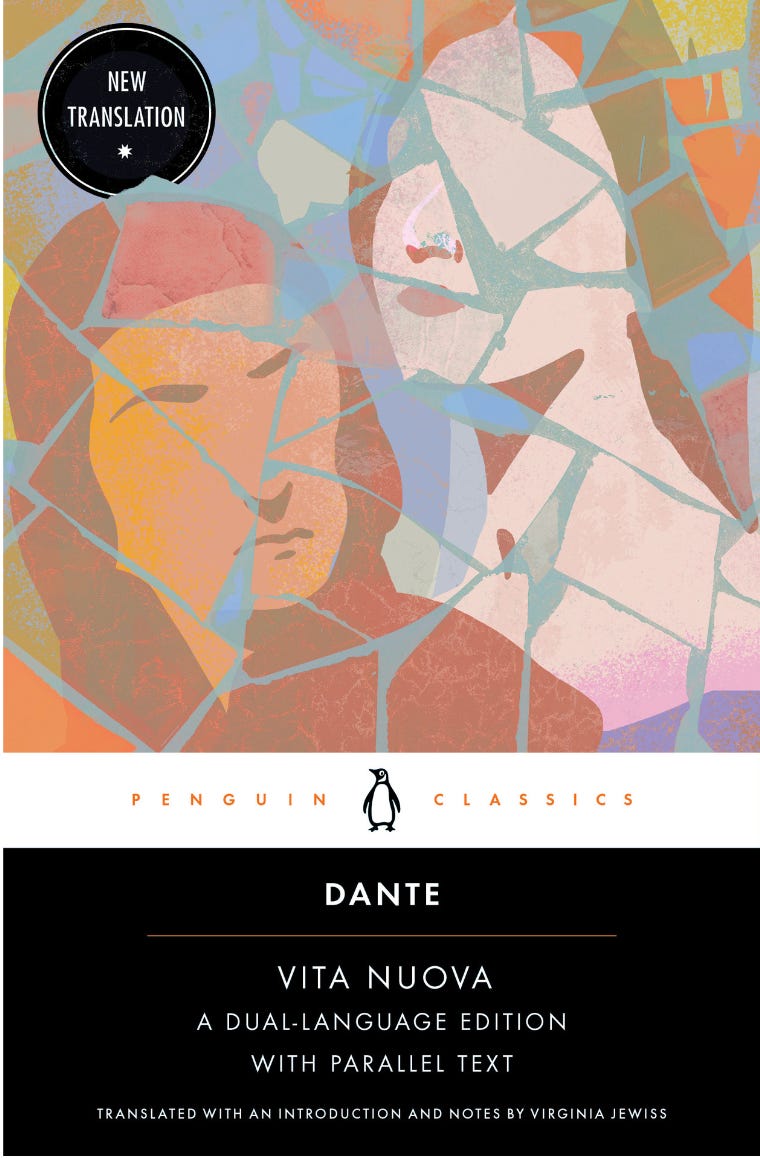
Vita Nuova, Dante
According to the Law, Solvej Balle
On Beckett, Bill Irwin
Mostly English keyboard music, Mishka Rushdie Momen
This is the sixty-second in a weekly series. As with previous editions, I’ll move beyond things I’ve been reading, toward the end.
1) The only time I’ve ever found Wittgenstein properly philosophically satisfying was immediately after visiting the house in Vienna he designed for his sister. It’s one of the top five buildings I’ve seen. That evening, I found myself getting more from On Certainty than I had from any of his works before. Sadly, when I arrived back in the UK the next day, I returned to my previous philistine state! But I keep on trying.
This week, I reread the 2022 Liveright edition of his Private Notebooks 1914-1916, edited and translated by the poetry expert Marjorie Perloff. I have to admit that I don’t really like Perloff’s introduction to the volume. Somewhat appropriately, I find it philosophically unsatisfying. But we philosophers owe Perloff much gratitude, because her bilingual edition fills a gap for both English speakers and German speakers (presumably the Wittgenstein notebooks aren’t available in any other language!).
Moreover, even though my German is pretty bad, I enjoy reading the ‘parallel texts’ that Perloff presents here — on each double-page spread, you get the German on the left, and the English on the right. This luxury comes with some cost, however. As Perloff explains, the notebooks themselves contain both ‘personal’ sections and ‘philosophical’ sections:
“For the entries of any single day in each notebook, his personal remarks, written in a code he had learned and used with his siblings when he was young, are placed on the left-hand page (the verso). On the right-hand page (the recto), he composed in normal script, the logical treatise that was to be the penultimate draft of the Tractatus Logico-Philosophicus.”
Whereas in the Perloff edition, we’re only given the ‘personal’ sections — since, as above, the verso/recto layout is reserved for presenting the German alongside the English. Except towards the end, that is, when Perloff thinks we should get some philosophy!
For the majority of the book, this means reading endless statements like “did no work” or “worked a little” — or even more frustratingly, “I am on the way to a great discovery” — without much idea of what Wittgenstein is referring to. And then suddenly, in the final section, you’re thrown the occasional lump of philosophy. For me at least, this doesn’t work well.
On the upside, however, it does mean you’re free to focus on the everyday. That is, even though the experiences Wittgenstein is writing about here are physically tough, wartime experiences, much of the time he comes across as pretty ordinary. (Not least for his use of multiple exclamation marks!!!!) He struggles to cope with a lack of letters from the man he loves. He struggles to cope with uncertainty over what his English friends are thinking about his choice to join the Austrian army. He finds joy in reading, frustration when his ideals fall, and temptations he hates himself for.
This is the second time I’ve read this book, which is probably two times more than if Perloff had left in all the philosophy.
2) A few days ago, I read the Vita Nuova — Dante’s celebration of his love for Beatrice — translated for Penguin Classics by Virginia Jewiss. I speak only very basic Italian, but as with the Perloff, I enjoyed being able to read the Jewiss translation alongside the original Dante.1
The thing I like most about the Vita Nuova (mostly written in the 1290s) is its form. There’s debate about how to present and even describe this, however. So I’ll just say that the chapters of the Vita Nuova generally fall into one of two types: 1) a short essay; or 2) a short essay, followed by a poem, followed by a short analysis of the poem.
Now, it’s tempting to respond to the inclusion of these analyses with surprise. How clever! How self-reflexive, as the literature people say! But surely it just shows us that modernity doesn’t get a monopoly on artistic experimentation. The all-too-common idea that the Medieval people were intellectually barren is silly, as you’ll know if you’ve ever listened to Machaut.
This doesn’t mean that the analysis parts of the Vita Nuova aren’t special, however, or that they aren’t the precursors of much later achievements. They’re certainly my favourite parts. They’re so earnest, and I like how they remind me of contemporary philosophical exegesis. Take this one, for example, which I chose pretty much at random:

Man, those last couple of sentences, in particular, could’ve been written by R.M. Hare.
3) Yesterday, I finished According to the Law, by Solvej Balle. If you’ve read my recent long piece about Balle’s three most recent books — the first three of her ongoing On the Calculation of Volume series, and the best three novels I read last year — then you’ll know that I finished each one the day I got hold of it. Whereas, According to the Law took me a couple of weeks, a few pages at a time, often feeling unsure about whether I’d continue. Sometimes this is a sign I really like a book! Not in this case.
It’s okay, I guess. Some of the better bits even remind me of Paul Auster’s New York Trilogy — a book I rate very highly. Like the Auster, According to the Law is a set of short stories, which seem separate until you realise they aren’t. The best is perhaps the first, in which a scientist called Nicholas S. cuts up a young woman’s brain in the hope of proving a thesis about how humans stay upright. Sorry… describing it this way reminds me how annoying it was!
The simplicity of style, and mastery of structure, that I love about the On Calculation books is almost entirely missing from According to the Law. If I’m being blunt, it’s try-hard juvenilia: of interest to Balle obsessives, but likely few others.

4) Last weekend, I went to Bill Irwin’s one-man show about Samuel Beckett. I didn’t know who Bill Irwin was beforehand, but I learned quickly that he’s an extremely good clown. I’ve never been much into Beckett, and Irwin’s first reading — the show takes the form of Irwin alternating readings and analysis — left me thinking that I wasn’t much into Irwin’s interpretation of him either. All too over-the-top surreal, for me.
Something changed during Irwin’s performance (‘reading’ definitely isn’t the right word, on reflection) of part of Beckett’s Watt, however. And by the end of the show, I was completely bought in. Not only to Irwin’s take, which is clever, and at times extremely funny (tonight’s the last night, so go go see it, if you’re free!). But also to the idea that I’ve been seriously underrating Beckett. I thought he was a bad non-realist version of Pinter. I think I was wrong.

5) Yesterday, I went to hear English pianist Mishka Rushdie Momen play (mostly) English music at the Hopkins Bloomberg Theater. This theater is hard to find — hidden away in a complicated wood and metal multi-story-carpark of a modern corporate building, full of grey locker rooms down wrong turns. The lady sitting next to me missed the first half of the concert because she got lost, and I bet she wasn’t the only one.
Rushdie Momen’s playing was lovely, though. Not world-class, but maybe one day. Her Byrd and Bull were light and neat. And there was some excellent Haydn — really technically great. The best part, however, was the final movement of the late Beethoven E major sonata: the glorious variations on the slow chordal theme. Wonderful. You go to a concert of English music; you’re forced to think about where it stands.

Okay okay, a recent Italian edition of the original Dante!
Last year I attended an Irish themed engagement party, and the mother of the bride gave out a quiz about Ireland. Despite being born on St. Patrick's Day, I knew none of the answers except the one to "In which language did Beckett write "Waiting for Godot." My college dormitory put on the play, although I did not see that production. A year later, the American Repertoire Theater staged it with Mark Linn-Baker in one of the lead roles, and I did see that version. In one of those contacts with the play I learned that it was written in French. As we were leaving the party, MOB called out, "David, stop! You won a prize!" It turned out I was the only one who knew the original langue was French.
Somehow this substack brings out my life as a sitcom.
When I got home I looked up the ART production, and found that Tony Shalhoub played one of the minor characters. So I got to see two of my favorite actors in one play, despite Shalhoub not hitting it big yet.
I enjoyed the play much more than I thought I would.