


What Is It Like to Be a Bat?, Thomas Nagel
Second Treatise, John Locke
Recent Guardian article, Gwyn Topham
Samuel Scheffler on Grief and Time, interview by David Edmonds
Hamnet, directed by Chloé Zhao
This is the fifty-first in a weekly series. As with previous editions, I’ll move beyond things I’ve been reading, toward the end.
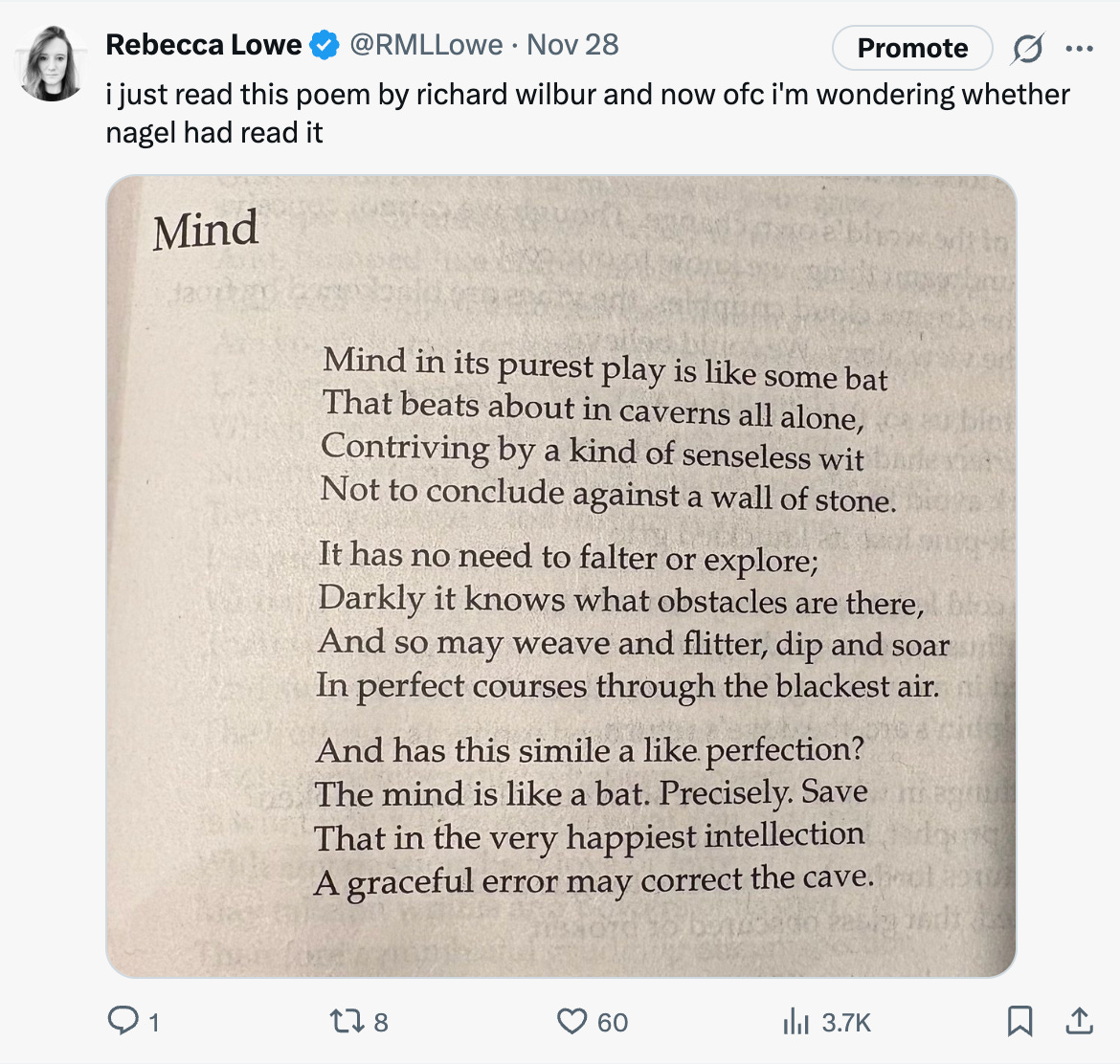
1) A couple of days ago I read a Richard Wilbur poem called Mind, which features a central bat analogy. This analogy made me wonder whether Thomas Nagel might’ve read the poem before he wrote What Is It Like to Be a Bat? (1974). It also made me think it was time I reread the Nagel paper, which is a strong contender for the best-known philosophy article of the last (almost) fifty years.
One of the few jokes I know goes like this: Q) How many freemasons does it take to change a lightbulb? A) Nobody knows! When you tell this joke, you should use an eerily quiet voice to reveal the answer. But the reason I bring it up now is that Nagel’s paper says something pretty similar.
Nagel tells us that because we have “no reason to suppose” that perceiving the world via bat sonar “is subjectively like anything we can experience or imagine”, and because we haven’t yet (!) worked out a way to access experience except through these methods of experiencing or imagining, therefore it’s not possible for us to understand what it’s “like for” the bat to be a bat.
I’d forgotten quite how many big arguments Nagel makes in this paper, however. Of course, it’s the paper from which many people take their definition of what it is to be conscious: “fundamentally an organism has conscious mental states if and only if there is something that it is like to be that organism”, Nagel tell us.
At heart, however, it’s a paper about the relation between the mental and the physical, and the limits of physicalism in parsing this relation. We can’t even say that physicalism is false, Nagel concludes, because we don’t yet (!) “have any conception of how it might be true”.
You might have realised by now that one thing I enjoy about this paper is its openness about the future. Of course, Nagel’s instances of ‘yet’ could be taken as passive aggressive. But by the end of the paper, he seems genuinely hopeful that we could, one day, design and use some as-yet-undreamt-of type of theoretical framework, through which the “subjective character of experience” could be described — in part at least — without accessing the point of view of the experiencer.
I’m pretty skeptical about this, but the section of the paper that tested my skepticism the most is the following:
“One might try, for example, to develop concepts that could be used to explain to a person blind from birth what it was like to see. One would reach a blank wall eventually, but it should be possible to devise a method of expressing in objective terms much more than we can at present, and with much greater precision. The loose intermodal analogies—for example, “Red is like the sound of a trumpet”—which crop up in discussions of this subject are of little use. That should be clear to anyone who has both heard a trumpet and seen red. But structural features of perception might be more accessible to objective description, even though something would be left out. And concepts alternative to those we learn in the first person may enable us to arrive at a kind of understanding even of our own experience which is denied us by the very ease of description and lack of distance that subjective concepts afford.
It’s been fifty-one years. Are we any closer?
2) At the weekend, I wrote a long-read about the significance of rights to liberalism, for The Pursuit of Liberalism (the new Substack run by Henry Oliver and me). I mentioned John Locke quite a few times in that piece, and I often mention him here.
I don’t have a favourite philosopher, partly because I find that kind of thing cultish, but mostly because I’m much more interested in thinking about the strength of particular philosophical arguments than who it was who advanced them.
That said, many of my views — particularly within political philosophy but also in other philosophical domains — have been influenced by Locke. So because Locke’s writing hasn’t yet featured in any of these Top Things pieces, I thought I’d expand here on a Lockean topic I discussed in my long-read rights piece.
In that piece I argued that, at least on a Lockean account, “natural rights are moral rights that are held by people in the pre-political ‘state of nature’, as well as in all other places and times”. I went on to discuss natural rights further. But if you’re interested in Locke’s particular account of rights, then it’s also worth considering what I like to refer to as ‘state of nature rights’.
State of nature rights are rights that are held by individuals in the state of nature, as described by Locke in the Second Treatise. Now, I don’t mean by this that everyone in the Lockean state of nature holds all of these rights, or that all of these rights must be held by someone in the Lockean state of nature at all times. Rather, I simply mean that Locke tells us that these rights obtain in the state of nature.
One reason I think it’s useful to have this further category of rights is that, on Locke’s account, some of these rights do not obtain in political society. This means, therefore, that not all state of nature rights are natural rights!
Or at least, this is the case if you accept my definition above, because on my definition above, natural rights are moral rights that are held in all places and times. You can think of natural rights of the kind I’m describing, therefore, along the same lines as human rights, on the orthodox contemporary understanding of the term.
Anyway, because I’m aware I didn’t discuss many rights in particular in my long-read rights piece — instead I focused on what rights are and why liberals should take them seriously — I thought I’d include here a little list of Lockean state of nature rights. This list comes from an encyclopedia entry I wrote, a few years back, on the topic of Locke on Justice.
Therefore, alongside a “common right” to the Earth and its resources, Locke minimally contends that individuals in the state of nature hold the following general moral rights: to self-preservation, to preserve humankind, to subsistence, to punish, to seek reparations, to self-ownership, to labor-ownership, to self-determination, to inheritance, and to basic freedom and equality. It seems clear that there are other Lockean state-of-nature rights, too, deriving from some of the general rights listed above – such as the “power to kill” in certain circumstances. Moreover, individuals in the state of nature can also acquire particular rights to particular property, and presumably there are other “particular” rights that can be generated, too.
This isn’t an exhaustive list, but I think it’s useful.
3) A few days ago, I read a Guardian article by Gwyn Topham about UK train services. If you’re like me, then nothing you read within or about this article could live up your experience of reading its title. So here’s the title: Soon-to-be-axed 7am Manchester-London train will still run – but without passengers. And here’s a link to the article, and to a follow-up article. I’ll leave it to you to decide whether you want to learn more. Ah England.

4) I enjoyed reading the transcript of this new Philosophy Bites episode on the topic of grief, featuring Dave Edmonds interviewing Samuel Scheffler. Scheffler focuses particularly on the anxiety that grievers sometimes feel when, after an initial intense period of grieving, they realise that increasingly “they’re able to get on with their lives”.
Scheffler notes that the loss suffered by the griever doesn’t decrease over time. So, he asks, how can it both be “appropriate to stop experiencing grief after a certain amount of time” and also be “inappropriate or at any rate that one should be experiencing something in response to the loss despite the passage of time”? It’s a good question.
But, in concluding that none of the standard answers to this question are “fully satisfactory”, I think that Scheffler (or the set of standard answers!) is discounting the way in which the seriousness with which you attend to a matter isn’t always best evaluated in terms of the amount of time you spend on it, or the extent to which it exhausts your attention.
5) At the weekend, I went to see the new film Hamnet. I haven’t read the novel it’s based on, which friends tell me is excellent. Perhaps I would’ve liked the film more if I had. That said, it was persistently brilliant, visually. And various scenes in the final section were worth waiting for. And as a film that’s implicitly about the wonders of modern medicine, it’s very powerful.
But one problem I had throughout was that I just couldn’t buy the idea that Shakespeare was Shakespeare. When, near the start of the film, Shakespeare’s future wife is falling in love with him in part thanks to his use of language — at a key moment, for instance, he tells her a story — the language he was using made this seem really implausible. Such boring cliched unevenly-anachronistic phrases!
Of course, on reflection, it’s silly to assume that Shakespeare spoke similarly to how Shakespeare wrote. Or that if he did, representing that kind of relation couldn’t be done in other ways, in a film. Or that his future wife was a particularly discerning literary critic, or that she cared about language as opposed to simply plot within story-telling. And so on. But these kinds of reflection distract you from what you’re watching!
I find this concept quite interesting: "the seriousness with which you attend to a matter isn’t always best evaluated in terms of the amount of time you spend on it, or the extent to which it exhausts your attention."
I’d never heard that lightbulb joke! So good.