


This is the content of a talk I gave yesterday, which I recorded on my phone and then used AI to transcribe. I’ve given it a quick look over and tidied up some bits, but errors of transcription may remain!
The big question
I’m going to make two caveats to begin with. The first is that I’m very much a philosopher and not a lawyer, though I am interested in questions about the law. I’m also, as you may tell from my accent, not American. So, my passing awareness of the positive law of any particular places in the world is very much limited to law in England and Wales.1
Now, the big question I’m interested in addressing here is something like: how can wrongdoing be addressed in cases in which the wrongdoer isn’t willing to address it themself, if the option of punishment is taken off the table? The reason I’m interested in this question is because I’m strongly opposed to physically and psychologically harmful forms of punishment, on rights-based grounds. I recently wrote something about this. And then this got me to thinking that I’m increasingly skeptical about the permissibility of punishment, generally.
I have problems with all the big justifications for punishment. I don’t buy retribution: on my kind of moral way of thinking, I don’t think doing wrong can be justified in the name of doing good. I’m also very opposed to consequentialist reasoning, so I don’t buy deterrent justifications. And I don’t think so-called incapacitation justifications are actually justifications for punishment. So, I’m really left in a bit of a hard place, if I want punishment to be used in the addressing of wrongdoing.
However, I also really, really care about people who’ve been wronged! I think we’ve got obligations to these people, as our fellow human beings, and as our fellow societal members. I think this is something law should be in the business of. So I might be in a bit of a difficult situation here. And, in the back of my mind, when I was thinking about these things, it came to me that compensation perhaps could be some nice answer for me, here. Or, at least, maybe it can play some big role.
Compensation is appealing because out of the various kinds of options for addressing wrongdoing, it seems like one of the least likely to count as physically and psychologically harmful, which is something that I have against many types of punishment. But compensation also seems quite hard to characterize as punishment, itself. So, it’d be really good if it could do quite a lot of the job — ideally, all of the job — in addressing wrongdoing.
Two dominant models: model 1
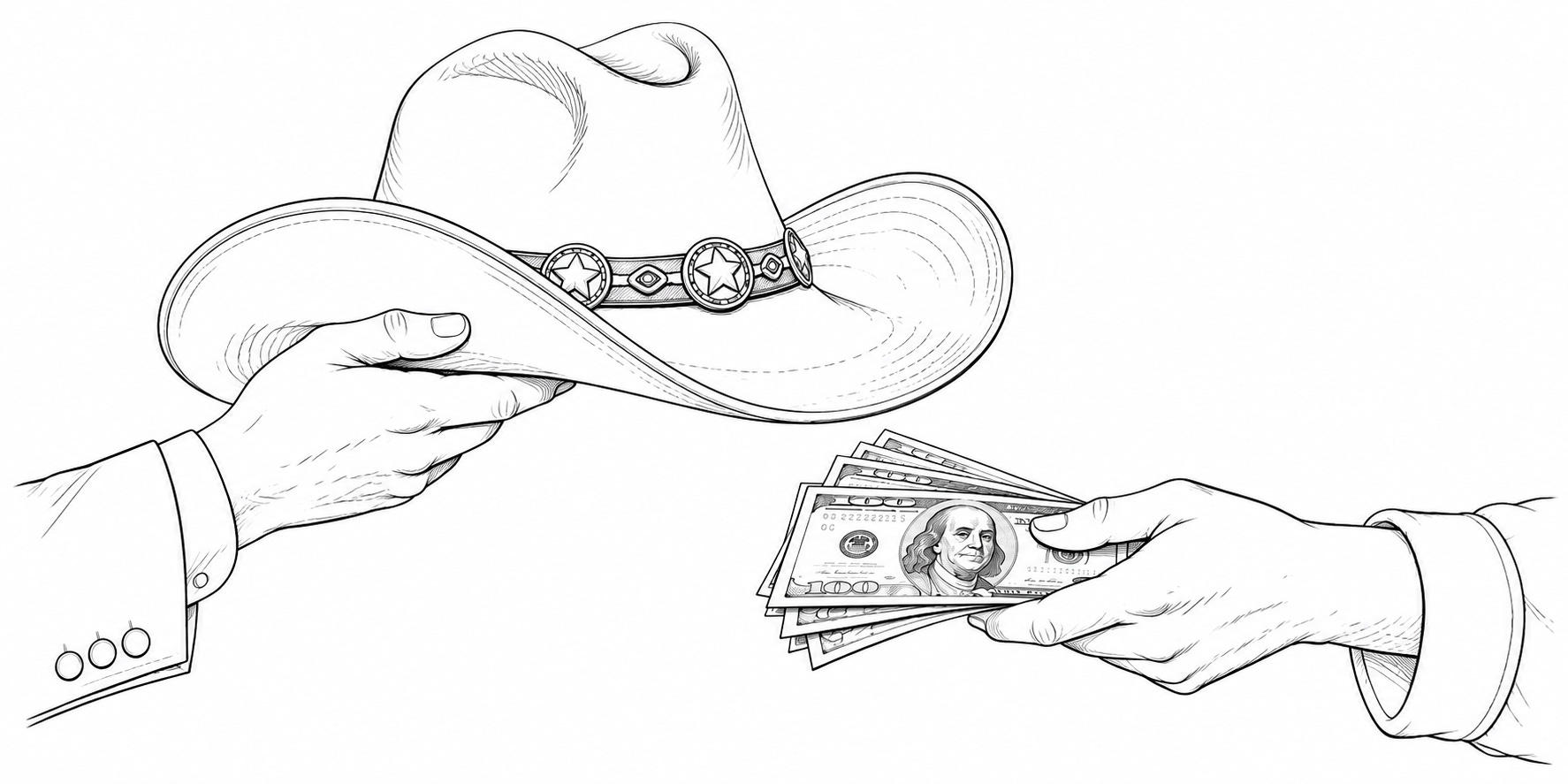
Compensation also seems central to two dominant models of addressing wrongdoing. So, let’s imagine a case in which I steal your cowboy hat. In this paper, I use the cowboy hat quite a lot, partly because I’m coming to learn stuff about America. But partly because the paper is called ‘Compensation and Wrongdoing’, which I was saving on my laptop as ‘C&W’, and which I understand is Country and Western. So, cowboy hats came to be relevant! So, let’s imagine, right, that I wrong you by stealing your cowboy hat. It seems pretty standard to think that I can ‘make this up’ to you by giving you back the same cowboy hat and apologizing.
Now, there are going to be some questions around, like, is my apology adequate? Did I mess up the cowboy hat? But, broadly, I think the standard model, which seems pretty simple, is going to be something like ‘voluntary return of goods plus apology’. It seems that in many cases we’re going to count this as the wrong having been addressed. And, what’s more, if you refuse my apology, and I keep on apologizing and apologizing, we might think it’s unfair to expect anything more from me.
Okay, there might be some cases in which, you know, I destroyed the cowboy hat, or I punched you in the nose, and then it’s not about returning your nose, and I can’t return the cowboy hat. So, instead, let’s make it ‘voluntary rectification or compensation plus apology’. This seems broadly to be the ideal kind of standard for addressing wrongdoing. Okay, maybe some wrongs are just too serious to address. But it seems to me that if we treat all wrongs like that, including me stealing your cowboy hat — no matter how great your cowboy hat is — then because we all do wrongs, we’re just going to continually all live in bad standing. And then bad standing might come to not mean very much. And this seems quite bad.
So, I’m happy to accept that this model, which I am calling ‘voluntary rectification or compensation plus apology’, is a very standard and pretty reasonable model for addressing wrongdoing.
Two dominant models: model 2
Now I want to turn to a second model. So, Robert Nozick talks in Anarchy, State, and Utopia, at one point, about “compensation plus penalty". Now, really what he’s interested in there is whether compensation can serve to permit us to do otherwise forbidden actions. But let’s just put that to one side, as interesting as it is, because I think that ‘compensation plus penalty’ is another standard model for addressing wrongdoing.
In particular, it permits us to address wrongdoing, or we might think it does, in those cases where I’m refusing to give you back the hat, and I’m refusing to apologize. In those cases, what happens is something like the law orders me to return your hat, and it visits some hard treatment on me. So, if we want to focus on the difference between these two models, I think we want to put the word ‘imposed’ in there. So, on the first model, we have ‘voluntary rectification or compensation plus apology’, which is the kind of ideal case. And then, in those instances where I’m just being a bit of a dick — and I’m not going to give it back, and I’m not going to apologize — in those cases, it’s ‘imposed rectification or compensation plus penalty’. Okay, good times!
Now, useful to me is that compensation appears on both of these models. But the obvious question arising for me, with my sudden-found anxiety about punishment, is: what could replace penalty on model two? I mean, all right, I’m refusing to apologize, I’m refusing to give the hat back, and let’s imagine that it’s okay for the state to, like, demand I give the hat back, or impose some payment on me, but I’m not very happy about punishment. So, I either need to stretch out compensation to fill the whole equation, or I need to find something else. There are some prior questions here, therefore. Questions like: do options like compensation always require a supplement? To address this, I want to turn to the role that compensation is playing, here.
A simple taxonomy
John Gardner — a very good, sadly no longer with us, legal philosopher — offers a simple taxonomy of three related concepts: restitution (actually, restitution in specie), account of profits, and compensation. Now, the context of this is his book, Torts and Other Wrongs. I really enjoyed reading this. But I should note that here he’s using this Canadian case, with this judge McLachlin, regarding equitable wrongs. So if these seem a little bit weird definitions, just note that they’re from this particular case. He’s using this taxonomy because it’s within the context of arguing that equitable wrongs are sometimes overlooked in discussion of civil wrongs. Very interesting — quite relevant to today. But let’s put that to one side, because I don’t need it. I chose this taxonomy because it’s super simple.
So, on this taxonomy, first we get restitution, which is this idea of “reuniting one party with the very thing she lost to the other party”. So, this is like me returning the cowboy hat — excellent. Then, account of profits. It’s less relevant for now, but this basically involves, on his discussion at least of the McLachlin taxonomy, the removal of a gain and not necessarily the extinguishing of a loss. This is because you can have these cases where you technically didn’t cause them to lose anything, but you gained. It’s complicated, but I’m happy just to accept that I don’t need it today. And then, compensation, Gardner says, aims to “eliminate losses inflicted by a wrongdoer even when she’s made no gains”. And, distinguishing it from restitution in specie, also it’s a monetary remedy.
Eliminating the costly effects
Okay, so there are some interesting differences between these three things. In my paper, I go into some of these. I find it fun comparing them. Things like: compensation, unlike account of profits, can take place without the removal of a gain. But it’s pretty easy to conclude that all three are presented as being aimed at eliminating losses and/or gains. I then use this to come to a conclusion that compensation, in particular, is aimed at eliminating the costly effects of wrongdoing on wrongees.
Of course, there are many further conceptions of compensation beyond the one I looked at. So, for instance, one of my American lawyer friends told me about the way in which American criminal law focuses on covering out-of-pocket economic losses. So, rather than just covering the loss of the item, it might also cover, at the extreme, something like the cost of the consequent therapy sessions that the wrongee attended. There are some further costs addressed on other conceptions, like the cost of the anxiety itself, and the cost of the future anxiety.
And then there are these further kind of side issues that also might be included when calculating costs — things like changes in market value. Robert Nozick has this great one, in that same chapter, about what if the costs are reduced by the wrongee by having prepared well for facing loss, or by doing well at reducing the loss just after it’s happened! But the argument I make in my paper is that, even on the broadest conception, compensation is aimed at eliminating the wrongee’s loss. Though I think it’s better described as eliminating the costly effects of wrongful actions on the wrongee.
Now, I have a couple of arguments to back up this conclusion. One of them is something like, it seems as if the question you want to ask when assessing these differences is: is this relevant to calculating the costly effects? Rather than: is this something above and beyond that that we should add into our calculations? We could also compare this particular aim — the tight focus on eliminating the costly effects — with options aimed at addressing other elements of wrongdoing, or things related. So, for instance: a) eliminating wrongdoer’s gains, or b) deterring future wrongdoing, and then, the most important one, c) addressing the wrongfulness of wrongdoing per se. The first two, a) and b), seem pretty easy to rule out.
The wrongfulness of wrongdoing per se
But this third one is a little more complicated, and it’s very important to my initial question. What more is needed to address the wrongfulness of wrongdoing, when the costly effects have been covered? So, if it is the case that compensation just covers all of the stuff, including the wrongfulness and not just the costly effects, then good times! Compensation can be the thing that I’m looking for.
However, you just need to come up with a couple of simple examples, like: a) I give you the hat back and I apologize; b) I give you the hat back and I don’t apologize; c) I leave your stolen hat on the train and someone else sends it back to you; and d) your neighbor sees your hat blowing off in the wind and runs after it and gives it back to you. You just have to consider these examples to see that the reasons you lost the hat and the reasons you got it back really matter! So, for instance, maybe you’re going to feel grateful to the person who posted it back to you. And in the case of me being the one who stole it but not apologizing, you might still feel pretty aggrieved.
In fact, let’s think of an example like: I attack you on the street and break your arm, purposefully, and am responsible for it. There are lots of wrongs going on here. It’s harmful physically and psychologically. I’ve invaded your privacy. It seems like there’s some kind of equal status wrong, as well. But even if we just focus on causing the pain, it seems like just because the pain has gone away — like, suddenly you get an anesthetic at the hospital — are we now going to say it’s all good? It seems like there’s something else left over. And, what’s more, we’re not really taking the wronger or the wrongee seriously unless we address that, because doing wrong is bad for the wronger as well as the wrongee.
Making up or protecting wrongees
This leads me to conclude that, on the first model, compensation is playing an important part in ‘making up’ for the wrongdoing qua wrongdoer. So when I choose to give you the hat back, or choose to pay you the money for it, I’m ‘making it up’. I’m choosing to make it up. I’m making it up as the wrongdoer. Whereas, on the second model — the model on which we have the ‘imposed rectification or compensation plus penalty’ — the thing that the compensation is doing here is defending the interests and the rights of the wrongee. So, together as society, this is some kind of societal recourse for those cases where addressing the wrongdoing is not voluntary.
It seems like we should note this distinction as a really important distinction before we can get anywhere near punishment, because it seems like this imposition thing might risk undermining the significance of the relation between the wronger and the wrongee. Somebody earlier today said something similar to this. This leads me to think all kinds of things about the role of compensation here when it’s imposed. It seems like an entirely different argument is required to justify intervention on behalf of wrongees.
Beyond that, my final conclusion is that interventions that are aimed at addressing the costly effects of wrongdoing shouldn’t be confused with interventions aimed at addressing the wrongdoing per se. The latter interventions have got to involve something aside from compensation, because it can only do the first of those things. This unfortunately leaves me having to reconsider the permissibility of punishment, or looking for some alternative options. So sadly, writing this paper didn’t really help me much on that! But I came to some conclusions about compensation, and also that maybe I just am wrong about punishment, if I really do care about the wronged people.
I just read this wholly in the context of Manchester City’s tribulations with respect to the English Premier League (EPL).